 Μake us preferred on Google
 The Greek government is preparing sweeping reforms to address the country’s escalating water crisis, as prolonged drought and rising temperatures push reserves to critical levels. A national strategy focused on water management will be presented today at the Prime Minister’s headquarters in Athens.
According to details cited by Bloomberg, the plan includes consolidating over 700 small, mostly municipal water utilities into just three main entities, aiming to streamline operations and improve the distribution and conservation of water resources.
Merging Utilities and Expanding Coverage
Currently, two state-owned companies — EYDAP (Athens) and EYATH (Thessaloniki) — manage water services in Greece’s largest cities. Under the new plan, these two will expand their operational reach, while a third public company will be created to serve the rest of the country. All three entities will remain under state control.

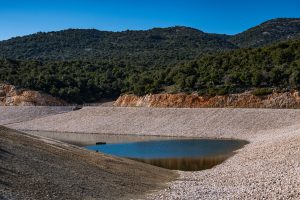
A drone view shows a part of the Eggares irrigation dam, on the island of Naxos, Greece, June 20, 2024. REUTERS/Stelios Misinas
To improve efficiency, the government also plans to reform hiring practices and attract private-sector management professionals, according to a source familiar with the plan. While the strategy is still under review and subject to change, it marks the most ambitious overhaul of Greece’s water infrastructure in decades.
New Fund for Dams, Desalination, and Climate Resilience
In parallel, the government will launch a dedicated fund to finance critical infrastructure projects, including dams and desalination plants. The goal is to bolster water security in regions most affected by drought — including Attica (the greater Athens area) and Crete — both of which will be officially classified as water-stressed zones to accelerate implementation.
This initiative comes as Greece experiences another intense heatwave, with mainland temperatures expected to reach 43°C this week. Water levels across the Attica region, home to 4.4 million people, have declined steadily for the past three years due to extreme heat and reduced rainfall.
Europe’s Fastest-Warming Region
The broader Mediterranean region, including Greece, is among the most vulnerable in Europe to climate-driven drought, which poses increasing risks to agriculture and tourism — two key pillars of the Greek economy. In addition to water scarcity, the country faces infrastructure challenges from extreme weather events, including destructive floods caused by powerful storms.
Greece currently has 1,327 water-related projects underway or in planning, requiring more than €5 billion in total investment. Since 2019, 278 water management projects have already been completed, costing €356.4 million.