Despite plentiful rainfall over the ongoing winter season snowfall coverage remains at paltry levels, a worrying situation intertwined with the specter of water shortages that affect certain regions in Greece over the hot summer months.
According to data from the National Observatory of Athens’ meteorological service – meteo.gr – the 2025-26 season so far confirms that snow cover remains at low levels, a trend over recent years that many researchers attribute to climate change.
According to meteo, on Feb. 23, 2026, snow cover in the country accounted for just 2% of the country’s total area. This percentage is significantly lower than the seasonal average, considering the mean daily snow cover for the period 2004–2026 stood at 14%.
In the meteo map below, snow cover is shown in red and cloud cover in white, as recorded on Feb. 23, 2026. The data emanates from the Terra satellite, via the MODIS instrument.
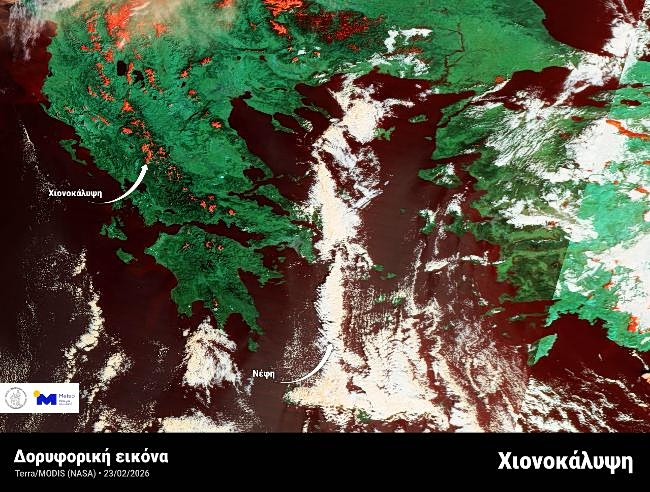
Limited snowfall
Since September 2025 that until the end of December, snow in the country was particularly limited — something that has occurred frequently over the past decade. From late December 2025, a gradual increase was observed. After Jan. 10, 2026, a sharp rise in snow cover was recorded. This was the result of a cold front accompanied by widespread snowfall across much of the country.
On Jan. 12, 2026, snow cover reached up to 18%. This was due to extensive precipitation mainly in the mountainous and semi-mountainous areas of mainland Greece, as well as in lower-altitude regions of the Macedonia province and on the islands of the northern and central Aegean.
As scientists at meteo.gr point out, a comparison with climate data shows that the winter of 2025–2026 has so far been characterized by limited snow cover, which is mainly found at very high altitudes.