 Μake us preferred on Google
 Every summer, Greece’s islands and coastlines fill with residents and visitors seeking the “Greek summer”: long days by the sea, busy beaches, and a tourism-driven rhythm that defines much of the country’s economy. Yet this seasonal influx also places significant pressure on coastal and marine environments.
Marine habitats in particular are under strain. Undersea meadows such as Posidonia oceanica and other seagrass, along with coral and reef systems, are declining due to pollution, anchoring, coastal development, and rising sea temperatures. These changes affect a wide range of marine species, including sea turtles, which rely on healthy coastal and marine ecosystems to survive.
Sea turtles navigate the Mediterranean basin throughout their lives, returning to coastal areas to reproduce. Today, climate change, coastal erosion, and increasing human activity have made this process more precarious. Nests can be washed away by storms or lost to beach alteration, while artificial lighting, boat traffic, and unmanaged tourism further reduce survival rates.
A well-known example of this tension can be seen in areas where sea turtle tourism has grown rapidly. While regulations exist to limit disturbance—such as rules governing boat distance and behavior—enforcement is often inconsistent, particularly during peak tourist season. Local communities may be increasingly aware of conservation needs, but visitors are not always familiar with the rules or their impact.
Over the years, conservation organizations have worked to study populations, safeguard nesting areas, and raise awareness about the challenges turtles face.
To better understand the struggles sea turtles face in the Mediterranean TO BHMA International Edition spoke with Eva Maria Alexandra Panagioutou, Project Manager at the Mediterranean Association to Save the Sea Turtles (MEDASSET), one of Greece’s longest-standing environmental organizations.
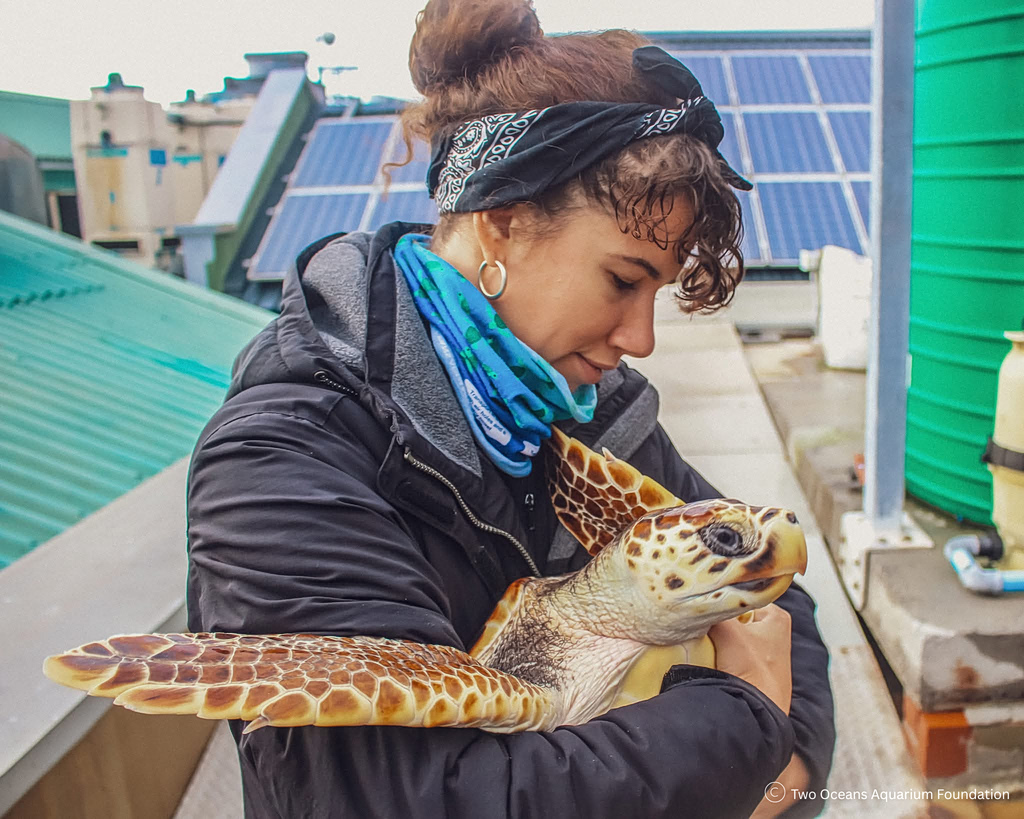
Alexandra Panagiotou holding Arnie the three flippered Green Sea Turtle to gather morphometrics at the Two Oceans Aquarium Turtle Conservation Centre. Linda Ness Photography
What inspired you to get involved in sea turtle conservation?
I actually started studying veterinary medicine, in my first year of university, because I thought that was the only way to get involved with wildlife. After a year in university, I decided it wasn’t exactly what I wanted, and I did an internship in South Africa in wildlife conservation. And I fell in love completely. I came back to university, switched majors, and then whenever I wasn’t at university, I’d be volunteering for different organizations. Initially, I was more terrestrial- based, until my masters in the UK, where I studied conservation science and policy. I began work on my dissertation there, which was about reducing the demand for sea-turtle products, and researched the illegal wildlife trade. Then, when I came back to Greece to finish it, I decided to volunteer at ARCHELON, a rescue center here in Greece, and fell in love with turtles. And the rest is history.
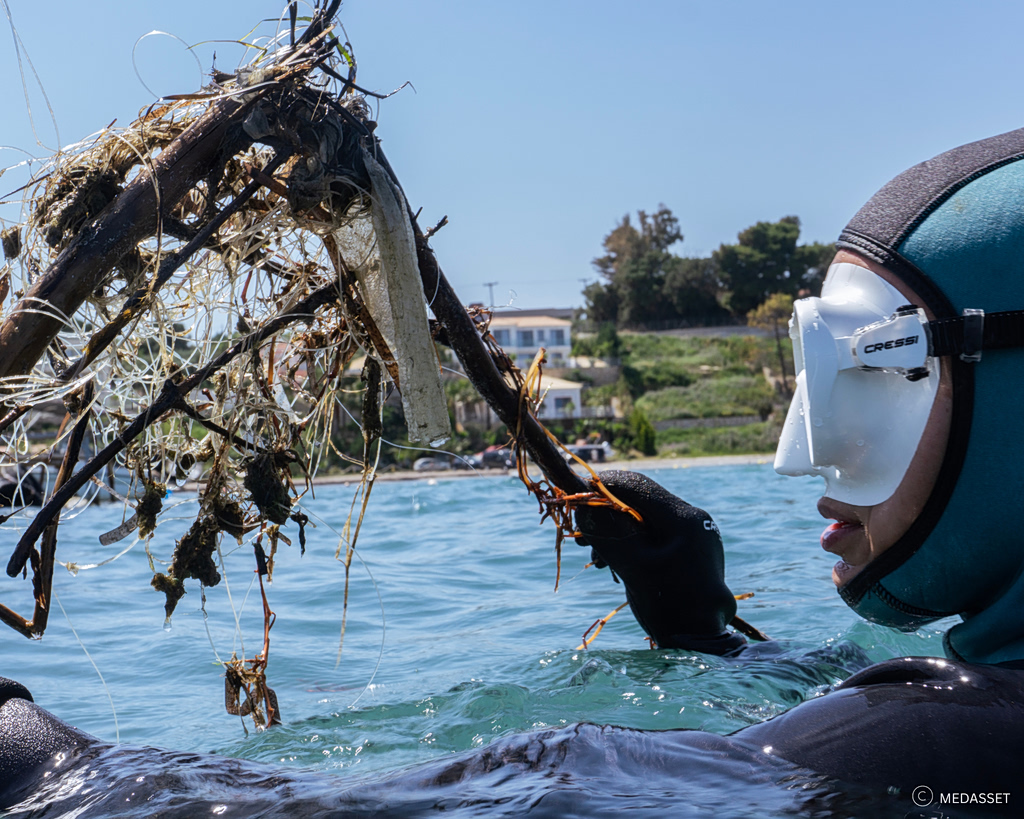
Marine conservation in action during seabed clean-ups in Zakynthos Island, Caretta² Zakynthos project, MEDASSET.
Do different species of sea turtles have different needs?
Yes, especially when it comes to their care in rehabilitation. But in the wild, too, their migration routes, and diet often vary greatly.
In the Mediterranean, the most populous species of sea turtle is the loggerhead (Carreta Carreta). We also have the green sea turtle, which is nesting more and more in Greece. We used to see it more in Turkey and Cyprus, but a few nests where recorded in Greece this year, as well. We also get the leatherbacks sea turtles, which do not nest in the Mediterranean.
Their diets are significantly different: the Carreta Carreta is basically omnivorous, while the green sea turtles become herbivorous when they are older. Leatherbacks, despite being the biggest sea turtle and reaching up to 2 and a half meters, are exclusively medusivore, which is to say they feed on jelly fish alone.
Their migratory pathways and nesting patterns also differ: Loggerhead turtles are the most common in the Mediterranean, living, feeding, and nesting throughout the region, particularly in Greece, Turkey, and Cyprus. Green turtles have a much more limited range, nesting only in the eastern Mediterranean and migrating to nearby coastal areas rich in seagrass. Leatherback turtles, do not nest in the Mediterranean and are only occasional visitors, entering from the Atlantic to feed before returning to open ocean waters.
How is climate change affecting sea turtle populations along Greek coasts?
Climate change is already having a measurable impact on sea turtles nesting on Greek coasts. Rising temperatures affect egg incubation, often reducing hatching success. And since turtle sex is temperature-dependent, with warmer nests producing more females and colder temperatures more males, they also skew the population and could eventually destabilize it.
We are also seeing increased nest inundation and erosion due to stronger storms and rising sea levels, especially on low-lying nesting beaches. Animals are quite adaptable to climate change—after all, it’s a cycle that has been ongoing since the beginning of time, and sea turtles were here before the dinosaurs— but the anthropogenic threats we pose make it all the harder for them to adapt and survive.
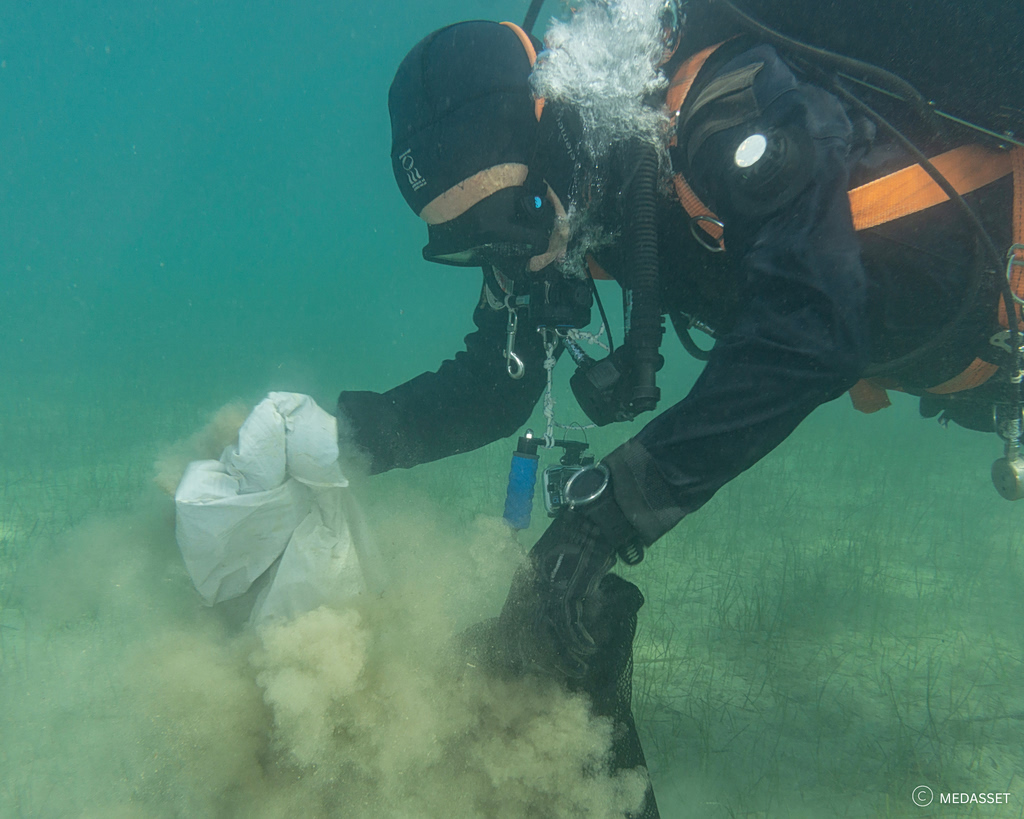
Seabed clean-ups in Zakynthos Island, Caretta² Zakynthos project, MEDASSET.
Recent studies suggest climate change might alter turtle migration routes. Could this lead to new or unexpected nesting beaches appearing in Greece or nearby regions?
Yes, this is a very real possibility. As sea temperatures rise, and temperatures and weather patterns change, turtles may adjust their migration routes and nesting choices. We are already seeing sporadic nesting events outside traditional beaches. This presents both an opportunity and a challenge. On one hand, it shows turtles’ adaptability. On the other, many of these beaches are unprotected, heavily developed, or poorly regulated.
How does seasonal human activity affect sea turtle conservation?
Seasonal human activity has a major impact. Tourism peaks exactly during the turtle nesting (late May to mid-August) and hatching season (mid-July through October).
Beach furniture, vehicles, artificial lighting, noise, and nighttime beach use can all disrupt nesting females and disorient hatchlings. It’s already hard to be a turtle, with only one or two out of everyt thousands hatchlings reaching adulthood, so the numbers are very low … But the anthropogenic threats are definitely making it even harder!
While Greece does have regulations – especially within the Natura 2000 sites and Marine Protected Areas – enforcement remains inconsistent, and local implementation varies widely. MEDASSET has repeatedly highlighted gaps between legislation and reality on the ground.
How effective has national and international legislation been in protecting sea turtles?
International legislation has been essential but insufficient on its own. Instruments like the Convention on International Trade in Endangered Species of Wild Fauna and Flora. (CITES), the Convention on the Conservation of Migratory Species of Wild Animals (CMS), and the EU Habitats Directive provide a strong legal framework and have helped reduce direct exploitation and improve habitat protection. And many COP decisions recognize climate change, bycatch, and habitat loss as threats. But the translation of these commitments into effective national action remains a slow process.
Greece, too, has some very good policies and legislations— but they are not sufficient on their own. Implementation, compliance, and political will all play a huge role, but the lack of enforcement is actually a major problems. That said, regional cooperation under CMS, the Bern Convention, and the Barcelona Convention has improved regulations, data sharing, and awareness, which is a positive step forward. They put more pressure on local and national authorities.
Having experience of both South Africa and Greece, how do they compare in terms of conservation efforts?
My experience in South Africa was very positive overall. Along the South African coast, there were three main sea turtle rehabilitation organizations, and while one could say we were operating in similar spaces and sometimes competing for the same limited resources, we never viewed it that way. Instead, we saw ourselves as a family—united by a single goal: doing what was best for our “kids,” the turtles.
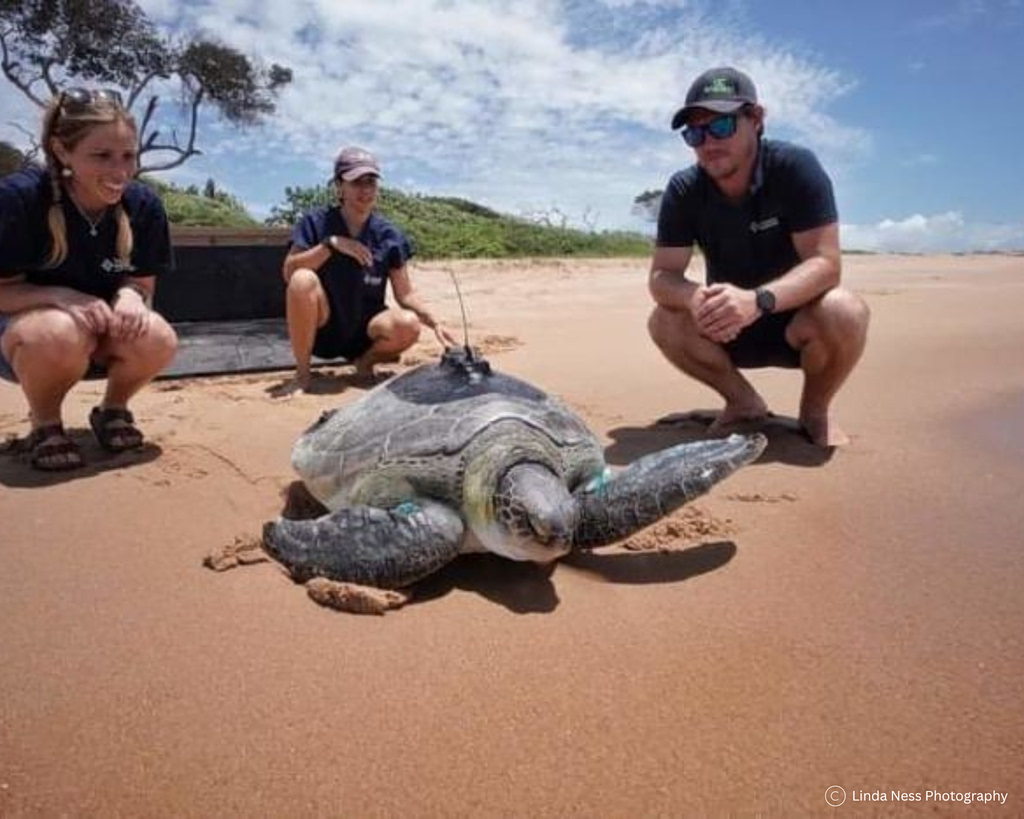
Talitha Noble, Alexandra Panagiotou and Kevin Spiby of Two Oceans Aquarium watch on as Bob starts his journey to freedom after eight long years.
We shared knowledge, expertise, and resources openly, and there were even occasions when turtles were transferred between facilities/organizations to ensure they received the best possible care.
In Greece, the landscape is more complex. There are many organizations doing important and often long-standing work, sometimes with different mandates, approaches, and pressures. With a focus on both wildlife but also on environmental conservation more generally. This can understandably lead to tension at times. Still, there is growing recognition that collaboration is not only beneficial but essential for our shared goal—especially in the face of shared challenges like climate change, tourism anthropogenic pressures, and limited funding.
How much do you think the Greek population knows about sea turtle conservation and the threats they face?
I think public awareness has improved a lot in Greece, in the last few years, especially with the younger generation and coastal communities. Our love for sea turtles, and nature in general has definitely grown.
And that is due in part to the work of many environmental NGOS. At MEDASSET we do a lot of education outreach and capacity- building. We work with fishing communities, visit schools, and we try not to work only with fellow scientists and conservationist, but with the communities as well.
However—and I’m speaking for myself here—, I haven’t seen the same level of behavioral change in Greece that is necessary, and which I’ve seen in other countries. Many people are still unaware of how everyday actions directly affect turtles.
It’s important to remember that people are not inherently bad, and that negative behaviors are often a result of a lack of knowledge and understanding. No one knows everything, we often have our areas of expertise, and unless someone brings other aspects and perspectives to our attention, we won’t find out about them for ourselves. So it’s very cool to see how most people are very open and receptive to making changes.
A lot of the fishers we have worked with have become very proactive after being informed about sea turtles and the threats they face. If they catch turtles accidently as bycatch, they learn how to release them properly and how to share important data with us. They’re often open to using safer fishing equipment, too, to reduce bycatch. Similarly in the schools we visit, children are asking what they can do for turtles – to make a difference.
Greece is such a big tourist destination, right? We see issues with ethical wildlife engagement in areas such as Zakynthos. People want to lie on a beach, go on a boat ride, and don’t spare a thought for the turtles for whom it’s time to nest, or the hatchlings who have to make it into the water. And Greeks and tourists alike are responsible—which is why it’s important to work both nationally and internationally.
How can people get more involved in sea turtle conservation efforts?
There are many ways people can help: supporting conservation organizations like MEDASSET, volunteering responsibly, respecting nesting beaches, reducing plastic use, and advocating for better coastal management.
Equally important is holding decision-makers accountable—demanding for sustainable tourism practices and the proper enforcement of environmental laws.
Conservation is not just for scientists; it’s a shared responsibility.
If you could snap your fingers, what would you change from the current situation in Greece?
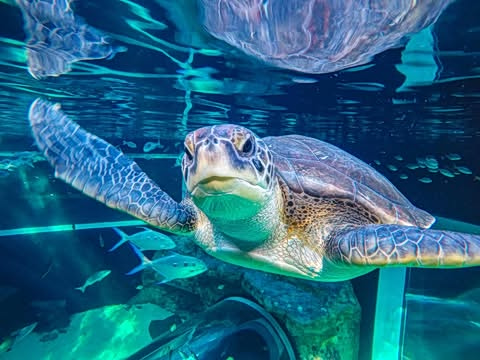
Bob the green turtle, during one of freediving enrichment sessions. Photo by: Alexandra Eva Maria Panagiotiou
If I could change one thing, it would be the mindset that nature is an obstacle to development rather than its foundation. Greece’s natural heritage is its greatest asset. We are one of the most biodiverse, if not the most biodiverse, country in Europe, and we need to protect that.
We need stronger enforcement, long-term planning beyond election cycles, and the genuine integration of environmental protection into economic decisions, those need to become one—we can’t keep on considering them as separate things.
Have things changed in sea turtle conservation since you started? What gives you hope?
Yes, things have changed. There is more scientific knowledge, stronger international cooperation, and greater public awareness than ever before. Also a big win in the conservation community was that as of October 2025, the green sea turtle (Chelonia mydas) has been re-classified from Endangered to Least Concern on the IUCN Red List of Threatened Species. There are few species at least in my lifetime, that have been reclassified positively, so that’s incredible news and gives us a lot of hope that what we are doing is working.
Still, they remain conservation dependent, meaning that they will continue to rely on targeted conservation efforts —such as habitat protection, nesting projects, or management programs—to prevent them from becoming endangered or vulnerable again.
What gives me hope is the dedication of local communities, young scientists, volunteers, and organizations who continue to fight for these species despite growing pressures. Sea turtles have survived for millions of years—if we give them space and protection, they can continue to do so!