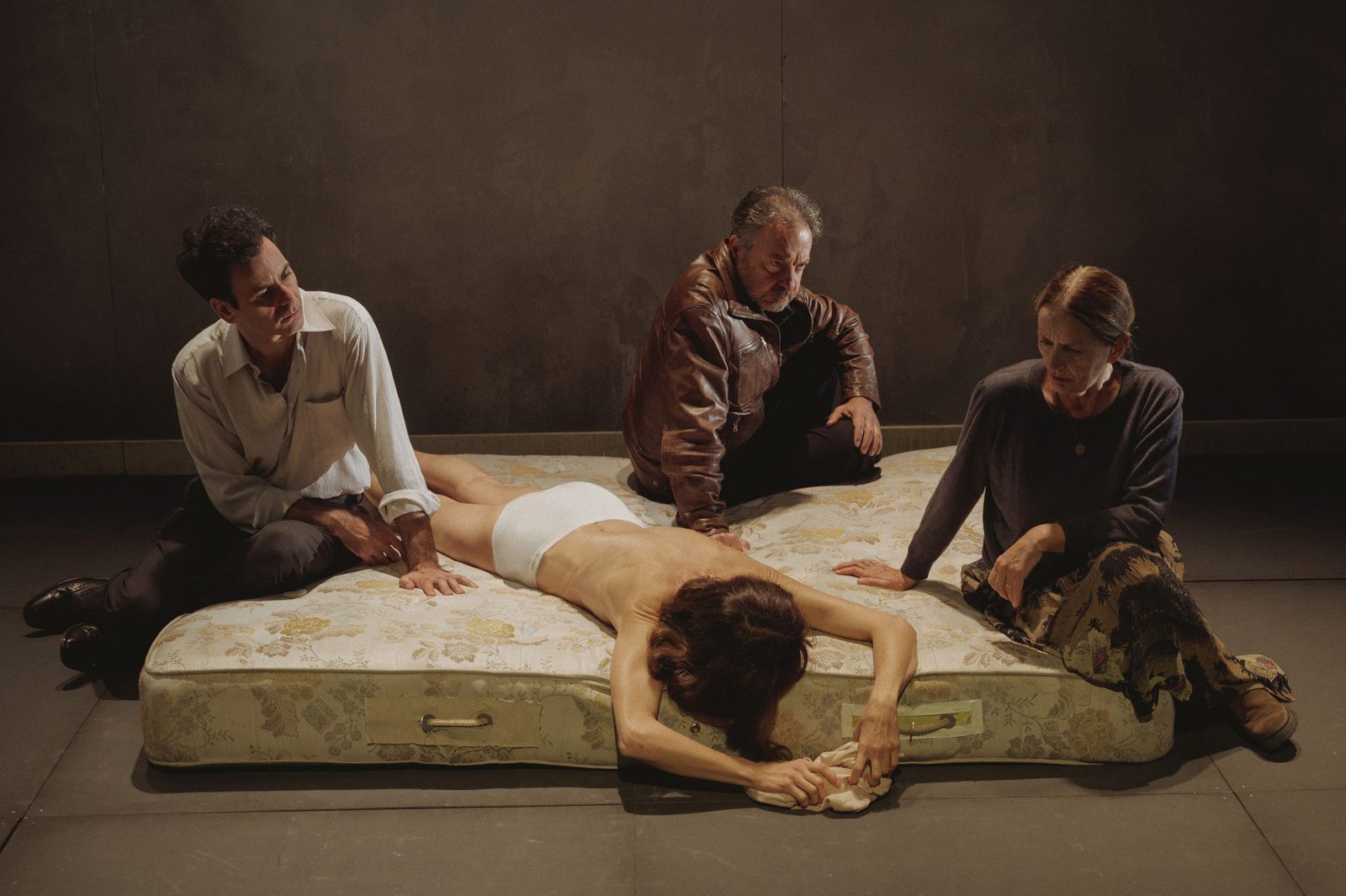
When watching theater, which can be best described as “fleeting magic”, our memory retains little; images, sensations, and words. There’s a subjective justice to this distillation.
In early July, Brazilian artist Carolina Bianchi presented The Bride and “Goodnight, Cinderella”, arguably the most significant international production at Peiraios 260 this year. Bianchi created a demanding, multilayered, reflective, and explosive experience. At one point, she fell asleep on stage, her body in a state of voluntary, controlled sedation—yet her pulsating consciousness continued to shape the hallucinatory atmosphere. Bianchi, a writer, director, and performer, delivered a serious, subversively honest exploration of gender-based violence across centuries—from the Middle Ages to today.
Rather than draw on her own traumatic experience of rape from over a decade ago, she avoided the route of direct autobiography. Instead, she dispersed the personal into the broader female experience. Her references ranged from the murdered Turkish performer Pippa Bacca to the anonymous victims of femicide at the U.S.–Mexico border, in dialogue with Roberto Bolaño’s 2666, particularly the harrowing “Crimes” section. The performance ended with haunting imagery: skeletal female remains aligned across the stage, converging on her sleeping figure—a visual that unsettled both emotionally and intellectually.
Part of the “Books on Stage” series, which adapts literature for the theatre, Louizou tackled Simon Stephens’ Blindness, inspired by José Saramago’s dystopian novel. While the unique style of the Nobel-winning author is inimitable, the adaptation preserved the plot’s existential and political weight. Louizou emphasized the breakdown of human dignity amid authoritarian quarantine, using effective staging and a strong ensemble—despite some shortcomings in performance direction.
Norwegian director Eline Arbo adapted Annie Ernaux’s The Years—a hybrid literary achievement by the French Nobel laureate—into a vibrant theatrical piece. Through a diverse all-female cast representing different ages and backgrounds, Arbo created a collective, rhythmic, and emotionally resonant portrayal of womanhood and memory. The final scene, with swirling memories and vanishing images, faithfully captured Ernaux’s spirit without overemphasizing the book’s ideological leanings.
Italian director Daria Deflorian adapted The Vegetarian, the acclaimed novel by South Korean writer Han Kang, who received the 2024 Nobel Prize in Literature. The performance explored the main character’s passive resistance to human violence by choosing to become a plant-like being. Deflorian staged the story with poetic restraint and visual elegance, though the narrative at times felt overly detailed. Still, the haunting image of the protagonist’s body painted with flowers remained unforgettable.
Emerging director Sophia Antoniou tackled Didier Eribon’s essay The Life, Old Age and Death of a Woman of the People, a fusion of philosophy, sociology, and political critique focused on the marginalized elderly. The performance began awkwardly, mimicking a TV interview with the author, but found its footing in a moving ensemble portrayal by retired actors. Using minimal yet evocative props—like chairs mimicking walkers—Antoniou brought Eribon’s critique of society’s treatment of the elderly to life, ultimately preserving the emotional depth of the text.