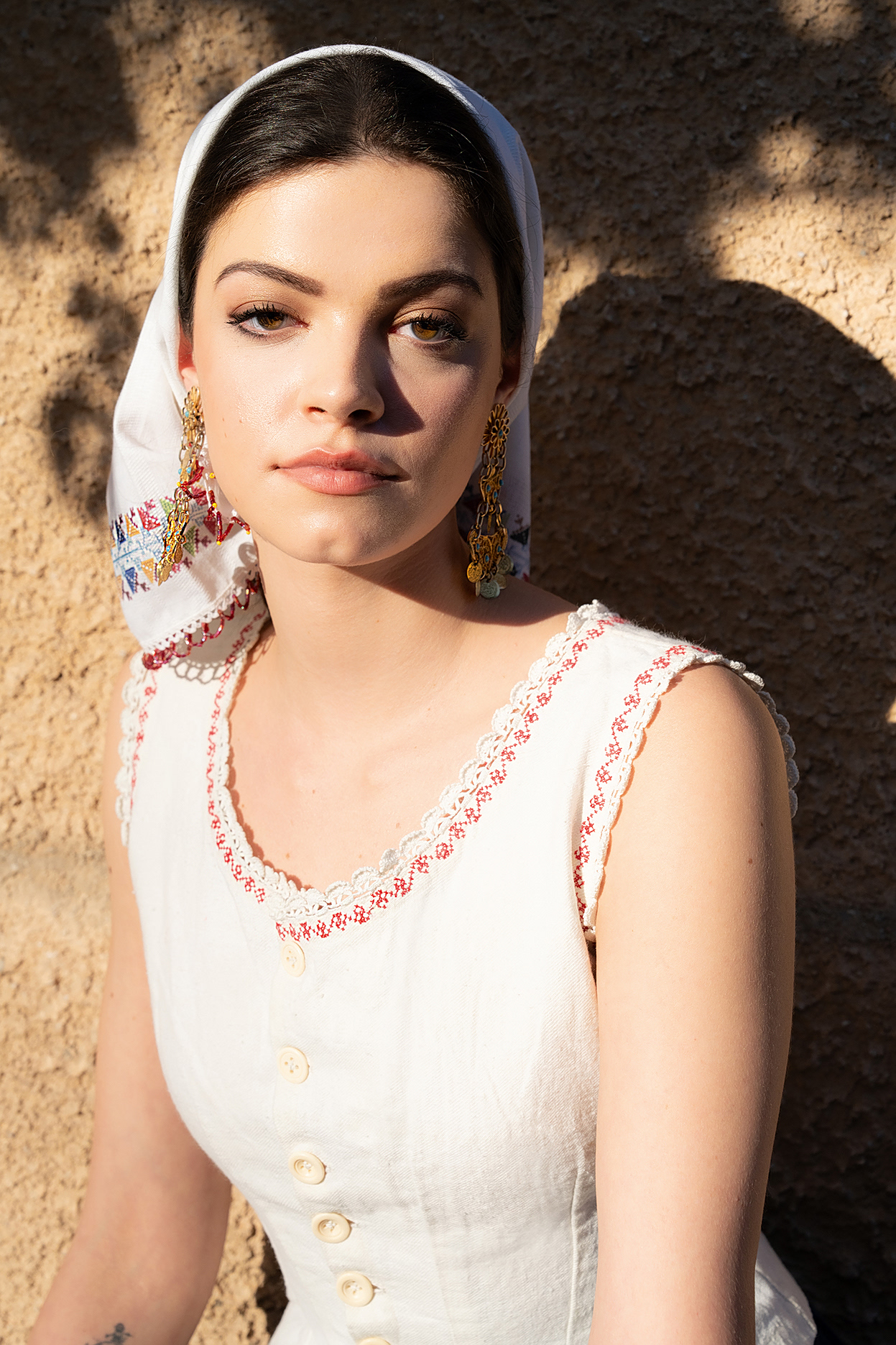
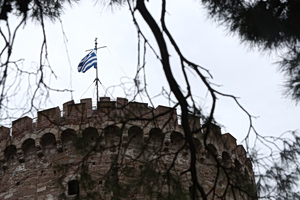
Internationally acclaimed Greek photographer Calliope boldly brings tradition into the present through her lens, while 25 personalities who embody contemporary Greek beauty give it unique expression
Creative Director: Elena Makri Liberis | Contributing Editor/Photographer: Calliope
Styling: Katerina Andrikopoulou, Despoina Koliou
Makeup/Hair/Grooming: Marianna Genti, Kerasia Koui, Morfi Menemenoglou, Konstantina Michopanou
Dimitris Gkotsopoulos
ACTOR
For me, Greece is a place that constantly reminds you who you are. Not only through its light, but through an awareness of decay. This is where the idea was born that human beings are transient, that existence has depth, but also limits. That brings you closer to your truth because you cannot hide behind illusions of permanence.
That truth is also carried within Greek aesthetics. If I had to describe it in three words, I would say: light, moderation, root. In Greece, light is not innocent, nor decorative. It is a light that reveals, that does not let you hide, and beside it there is always a shadow. Moderation, to me, is the balance between those two — between light and darkness, beauty and danger, the fleeting and the eternal. The root is the deep memory you carry without realizing it, even when you move far away from it.
What I carry from Greece is the feeling that I am part of a world greater than myself. That inside me there is something I cannot fully explain, but I know it shines. Something that does not belong only to me, but passes through me. And perhaps that is the most authentic Greek experience. Not to understand everything, but to stand respectfully before what cannot be understood and yet still moves you.
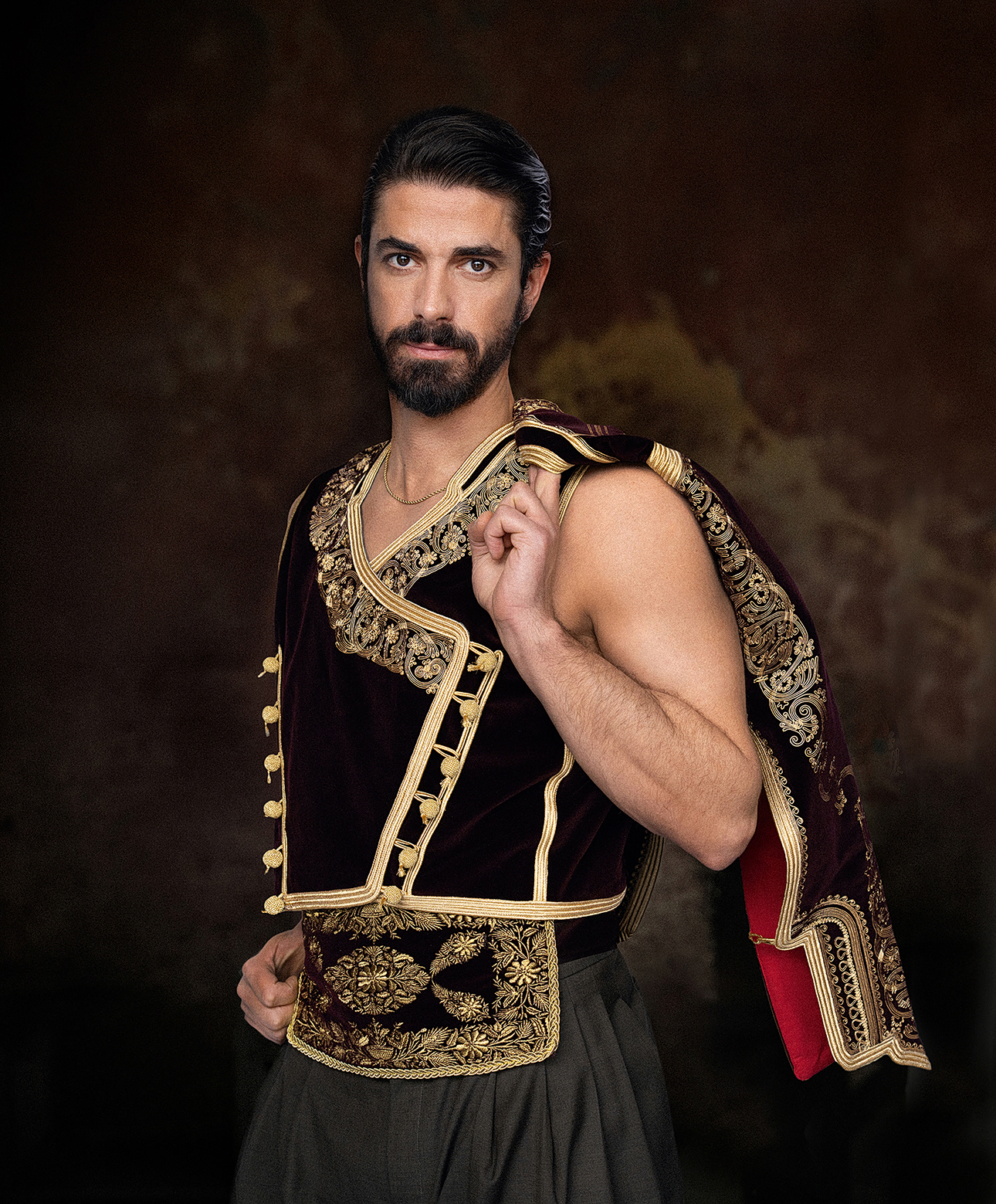
Vest and ceremonial jacket from the uniform of King Otto’s warrant officer, courtesy of the Lyceum Club of Greek Women. Trousers by Sotiris Georgiou.
Irene Tassou
ACTRESS
I feel most authentic in moments when the noise around me stops and I am simply left alone with my truth. Greece plays a very deep, almost subterranean role in that feeling. It is the smells, the light, the language, the memories. All the things I carry within me without even realizing it, because they are part of my identity.
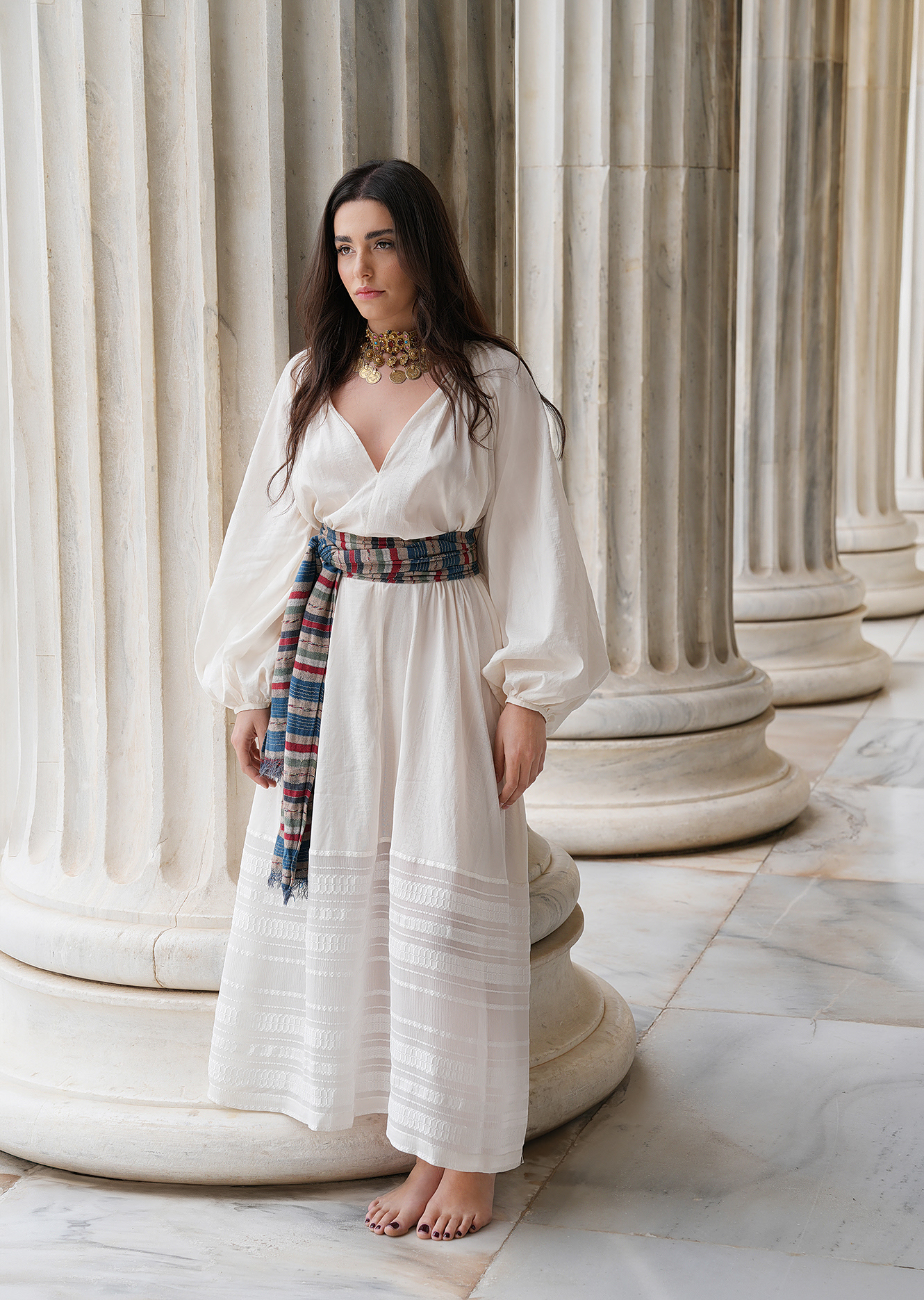
Dress by Zeus+Dione, aesthet.
Neckpiece from Roumlouki, Imathia, courtesy of the Lyceum Club of Greek Women.
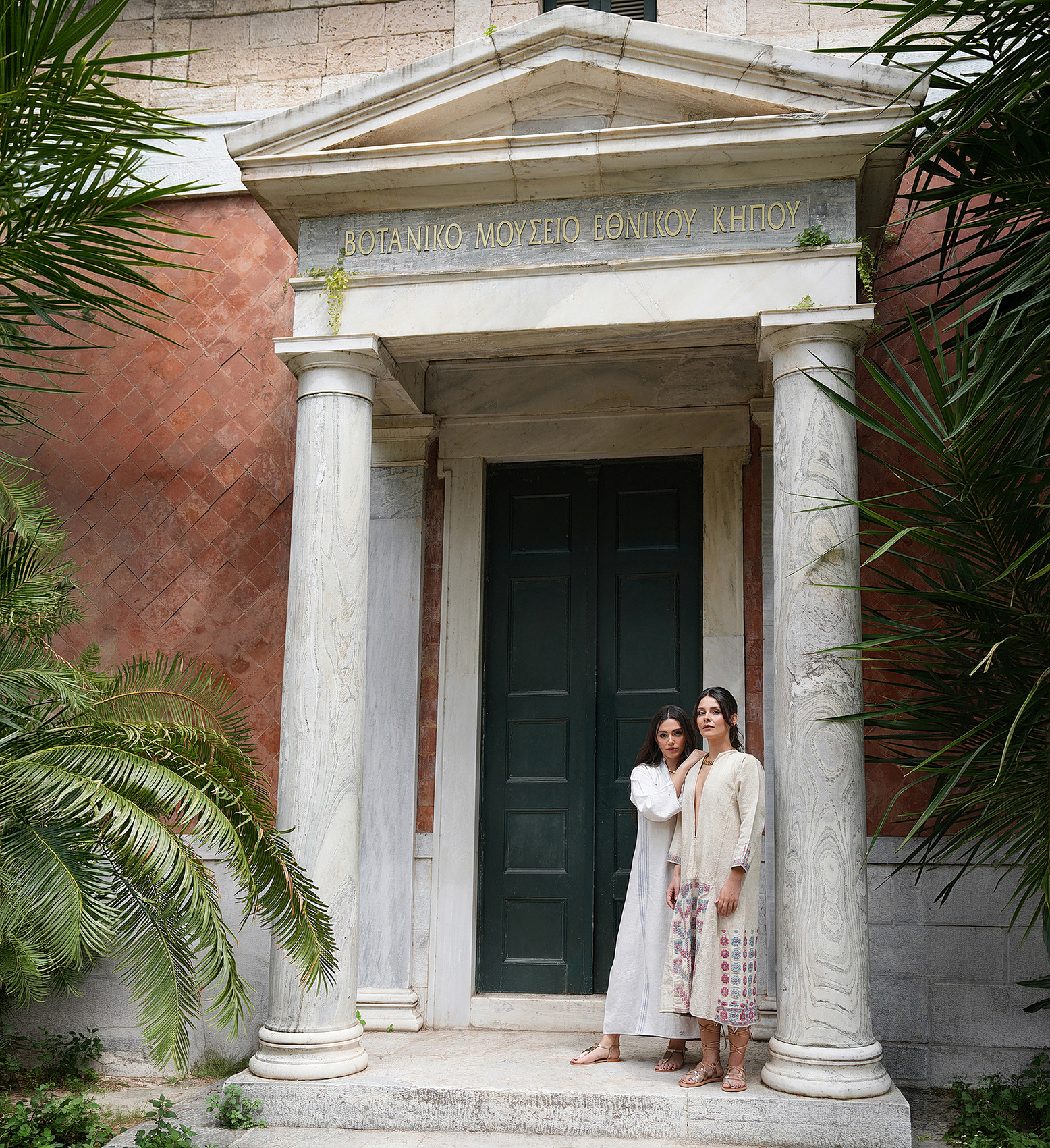
Irini Tassou wears a Thracian caftan by Queen Calliope. Sandals by SPYRIDAKIS LEATHER. Jewelry by Zolotas.
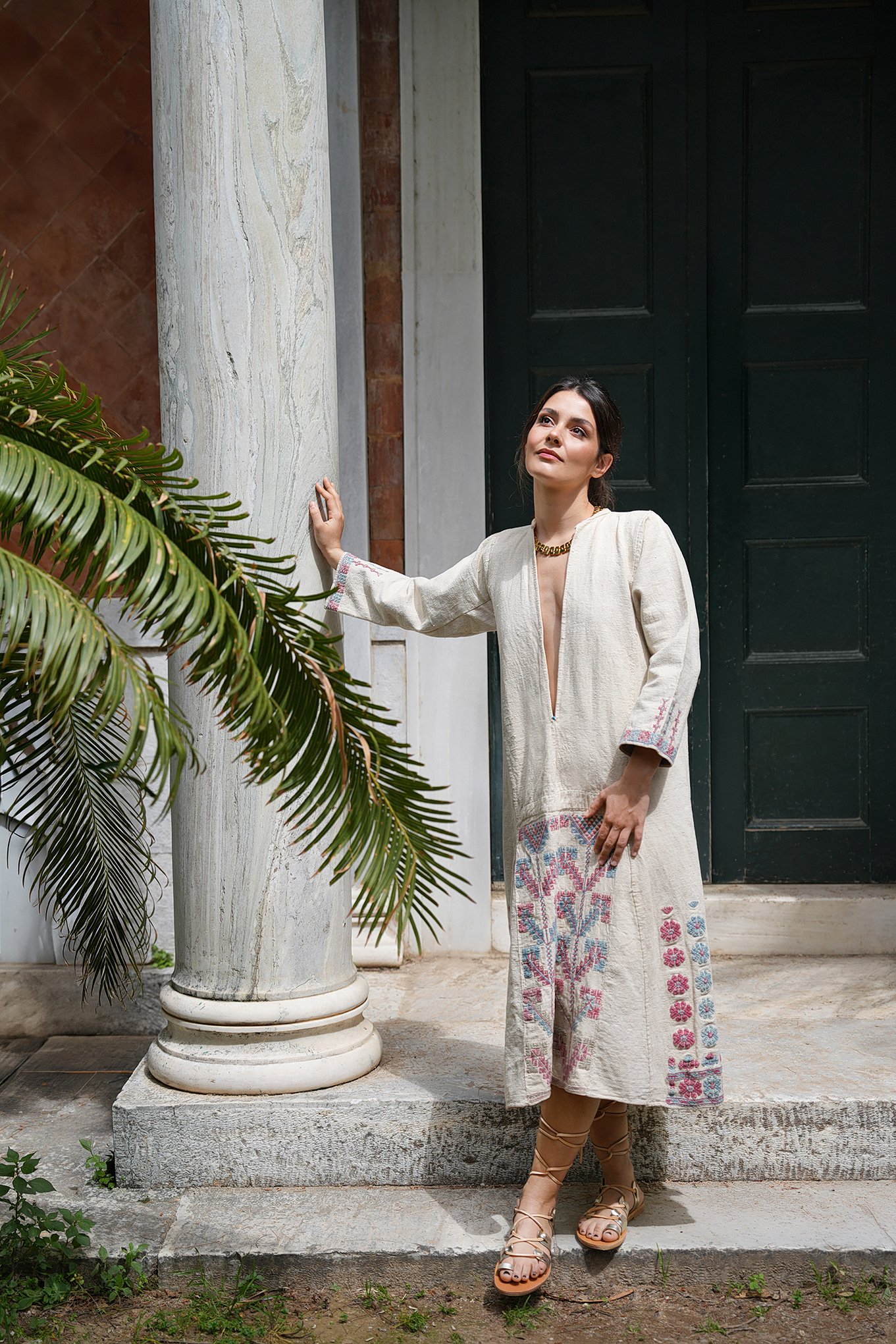
Asimenia Voulioti
ACTRESS
I remember my grandmother early in the morning in the courtyard of her house in Trikala, rolling out pastry dough on the table to make wild greens pie. I was around seven years old, sitting beside her and watching her. She wore a headscarf with the purity women of her generation carried, and with her hands and rolling pin she stretched the dough with almost ritual concentration.
The filling was made from greens she had picked herself from the land, and the olive oil was her own fresh green oil from her olive trees. I recall that moment with deep tenderness, full of scents and the kind of love that can be expressed through food and offering.
Dora Anagnostopoulou
JOURNALIST
You carry cultural memory within you even if you do not consciously remember it. It exists. There is therefore also a distinctly Greek way of telling stories, drawn from our shared mythology and history, but also from a living oral tradition that each of us absorbs through family narratives.
My father, an exceptional storyteller and the child of refugees from Asia Minor, was born and raised in Athens’ Ambelokipi district. His personal journey is the story of a generation — and therefore national history. The people in his life — his mother, his father, Mrs. Eleni from Constantinople, his friends, the girl he fell in love with who became my mother, the strict headmaster at school, the troubled colonel during his military service, and many others — create the mural of an entire era.
Perhaps that is why I search for people’s stories. Because together they form our great Greek narrative.
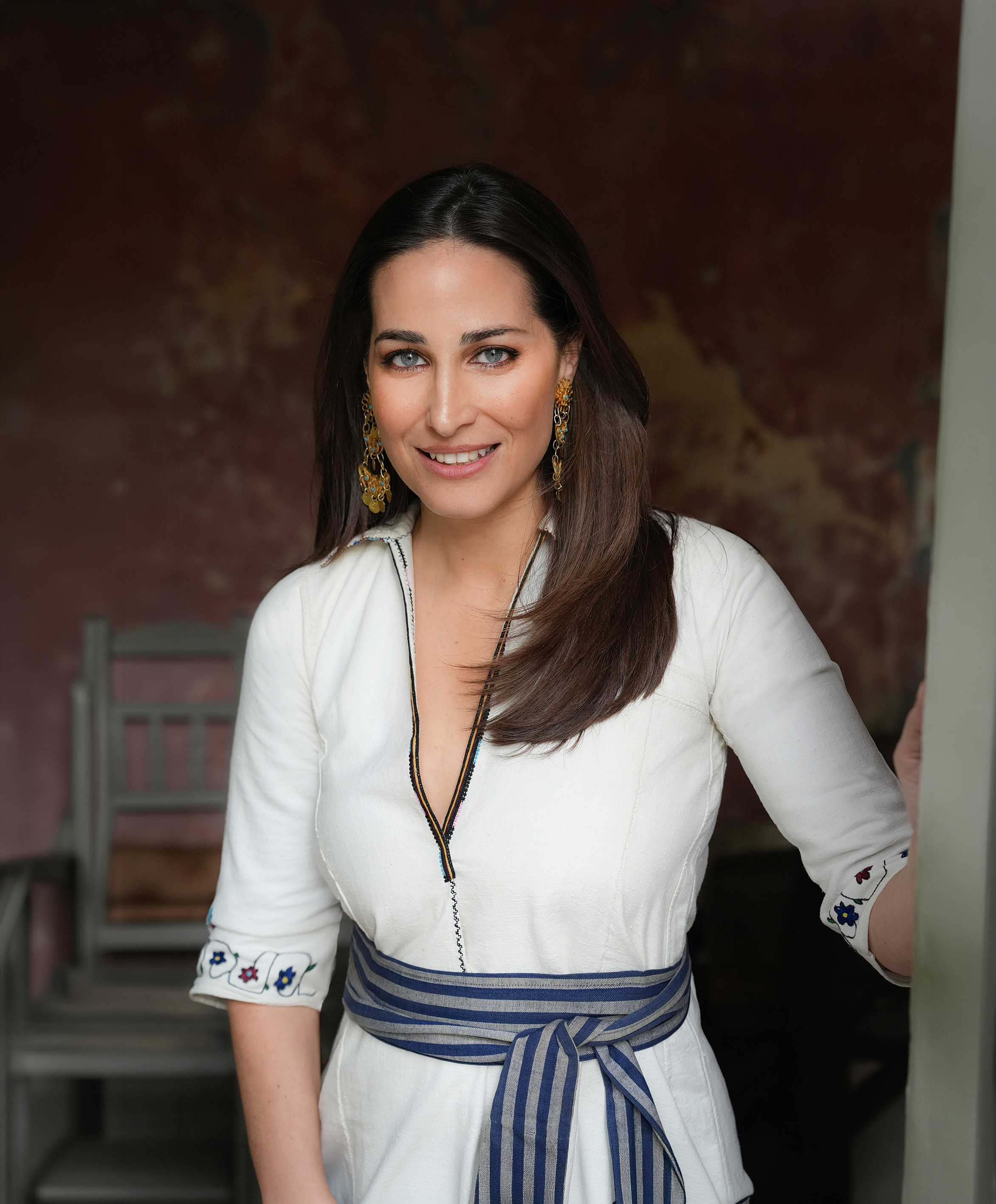
Flórina shirt and earrings courtesy of the Lyceum Club of Greek Women.
Dora Anagnostopoulou presents the midday news broadcast and the show “MEGA Stories” on MEGA TV.
Vasilis Michas
ACTOR
My relationship with Greece is alive and experiential. I grew up here, I speak the language, and the culture has shaped me in ways I do not fully understand. I cannot define Greekness because it changes over time.
If I had to describe Greek aesthetics in three words, they would be: duality, simplicity, moderation. Greece combines extremes: something barren and wild that is simultaneously beautiful. That contradiction deeply interests me on a personal level too — the idea that you can be strong and vulnerable at the same time. It is something I pursue and connect with.
As an actor, I search for a universal language beyond national identities.
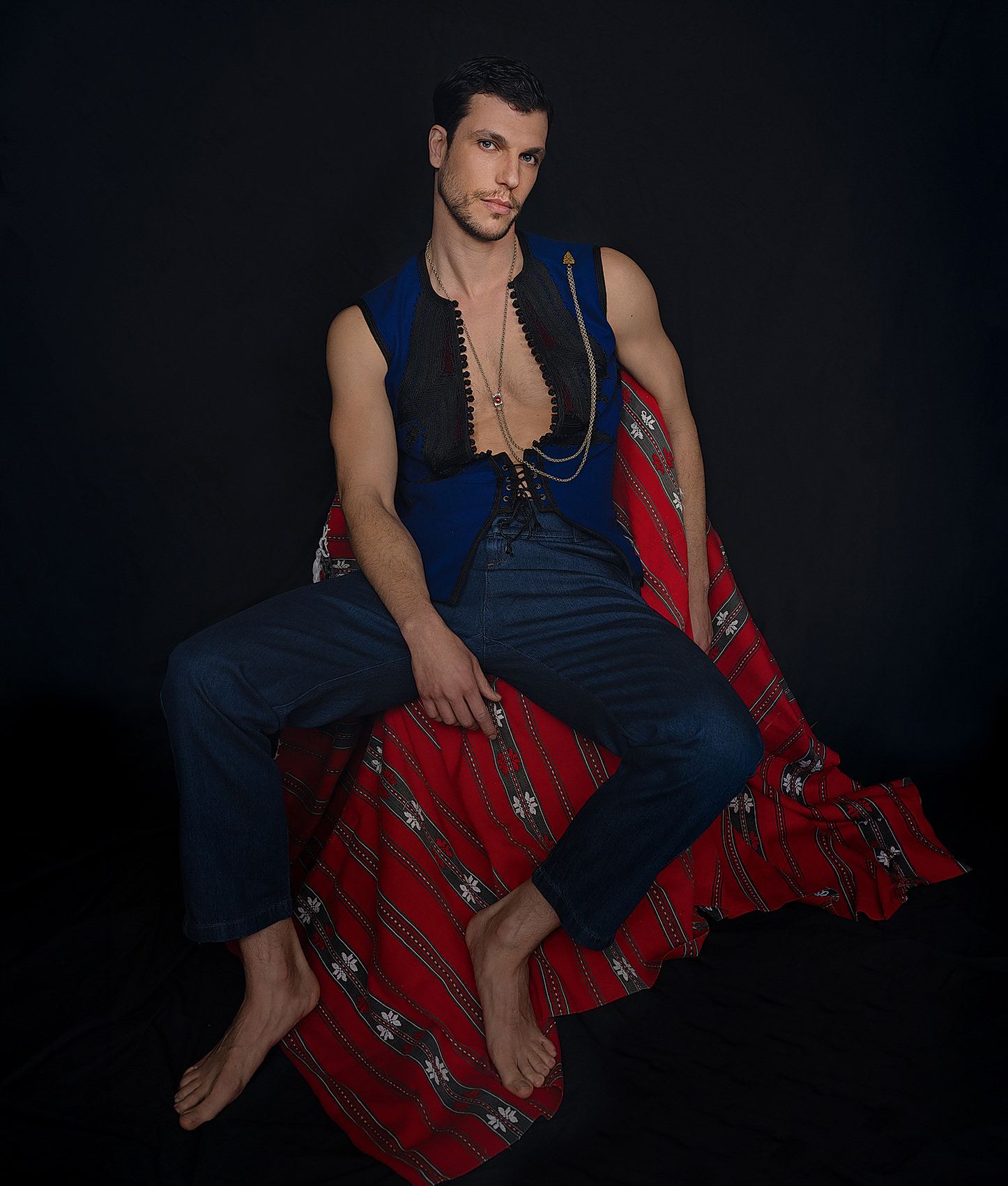
Cretan vest and watch chain courtesy of the Lyceum Club of Greek Women. Jeans by Parthenis.
Danai Loukaki
ACTRESS
I come from Crete and grew up there; you can see it in both my appearance and my character. You cannot easily mistake me for anything else. I carry my origins both outwardly and internally.
When I lived abroad, in London and Manchester, I realized how much cultural memory filters my perception. I could not easily decode what I was seeing because I did not share the same references. That is why I returned to Greece during the financial crisis — because I did not recognize the environment out there and I needed the Greek light, the Parthenon, the imagery that felt familiar to me.
Even if things here were difficult, it was more important for me to be in a place I recognized.
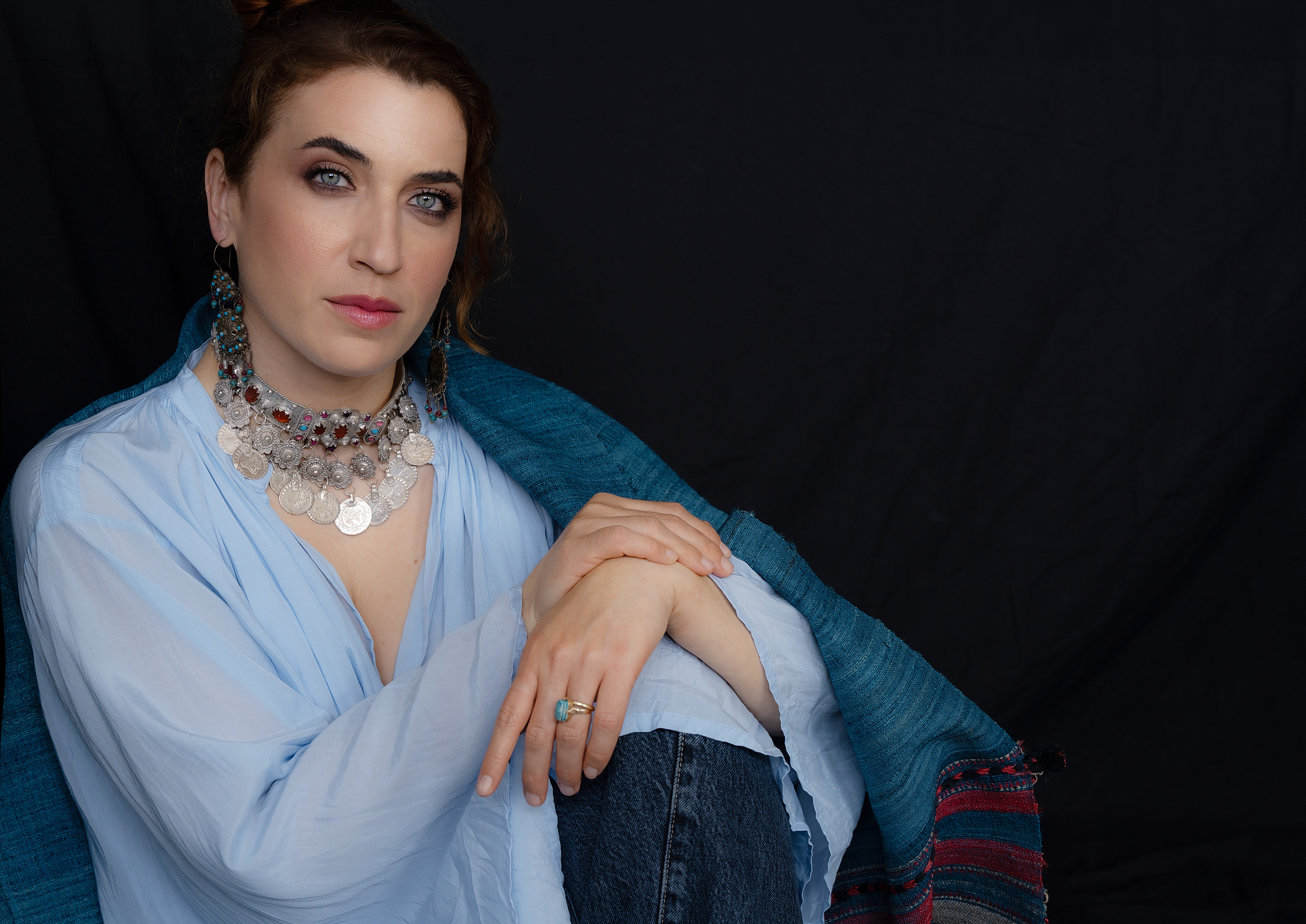
Woven scarf by QUEEN CALLIOPE. Shirt by Fey Athens. Neckpiece from Roumlouki, Imathia, courtesy of the Lyceum Club of Greek Women.
Danai Loukaki stars in the ERT1 drama series “Electra” and translated Simon Stephens’ play “Vanya,” staged this year at the Karolos Koun Art Theatre and published by Kapa Publishing.
Mairi Mina
ACTRESS
I feel most authentic when the “performance” stops — not only on stage, but in everyday life too. During a difficult rehearsal, in an honest conversation without pretension, in moments when I do not need to prove anything.
That is where Greece functions not as an idea, but as a framework: the language with its particular economy, the light that does not flatter, the sociability that constantly brings you into contact with others. It is an environment that grounds you — sometimes abruptly, but usefully.
What I would like to change is the convenient mythology we create about ourselves. We are not lacking stories; we are lacking responsibility toward them. We should tell them not only beautifully, but fairly. We should allow the light to reveal the shadows we ourselves create.
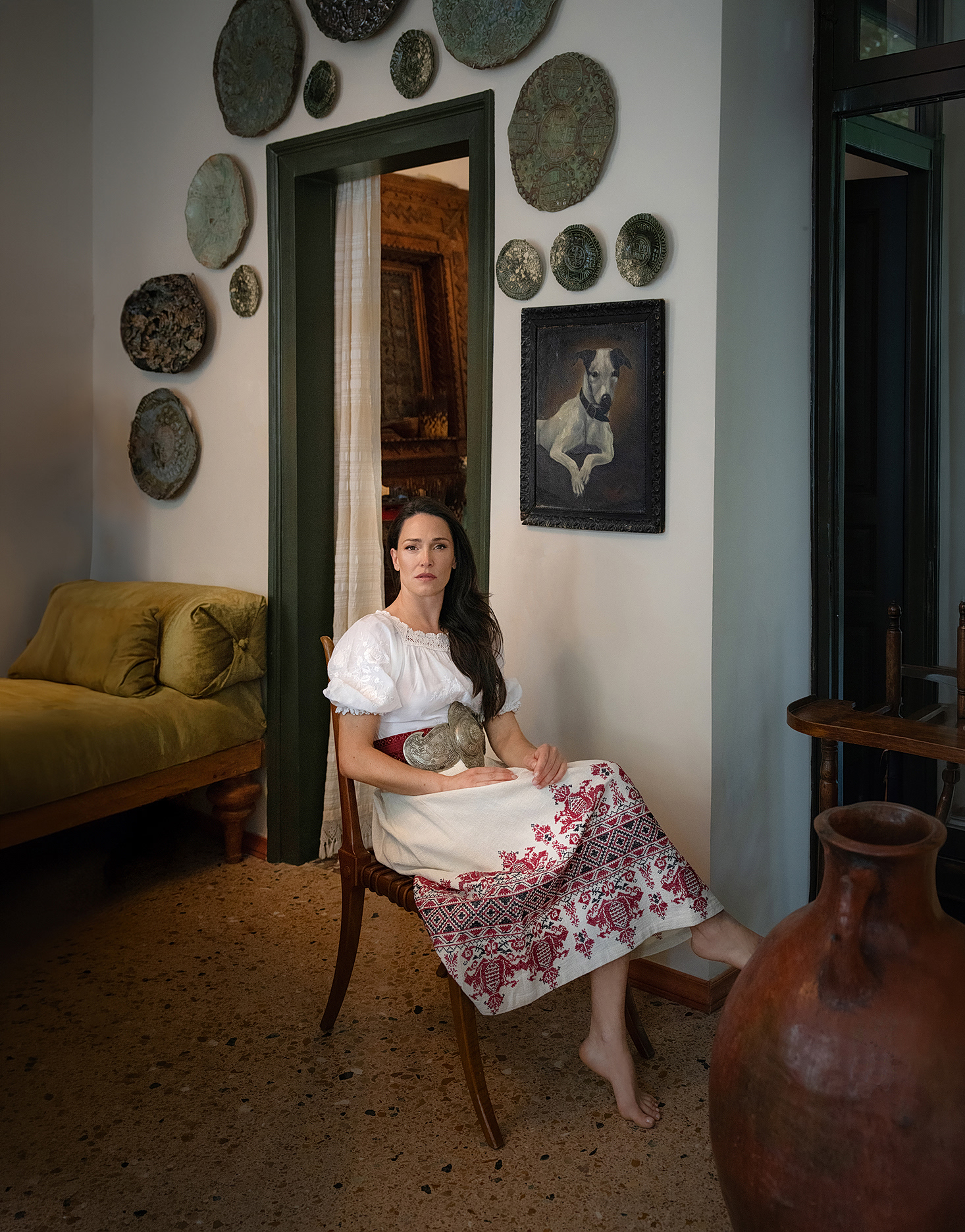
Corfu shirt and buckle courtesy of the Lyceum Club of Greek Women. Skirt by QUEEN CALLIOPE.
Marina Kalogirou
ACTRESS
When I stand beneath the Parthenon and look at it, I feel wise for a moment. A wise person is not someone who knows many things, as we mistakenly believe, but someone who remains constantly aware that they are only a grain within infinity.
It reminds me that we are here to share awareness of this eternal light.
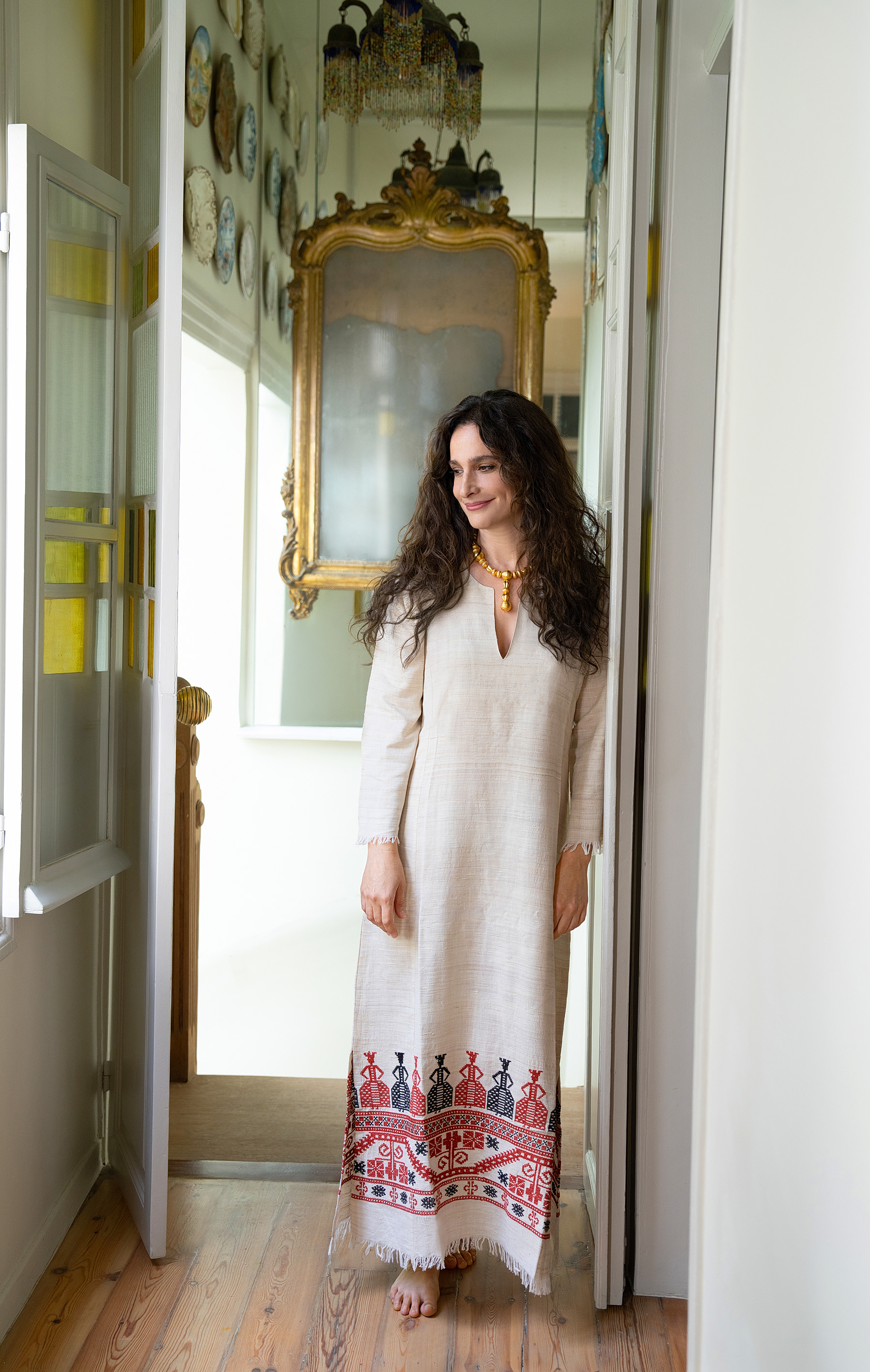
Caftan by Queen Calliope. Neckpiece by Lalaounis.
On July 1 and 2, Marina Kalogirou will appear in the site-specific performance “Delos” at the archaeological site of Delos as part of the “All of Greece, One Culture” 2026 program.
Elli Tringou
ACTRESS
What does Greek beauty mean today? Beauty, to me, is universal. It has no nationality. Kindness is beauty. Solidarity, empathy. Nature is beauty.
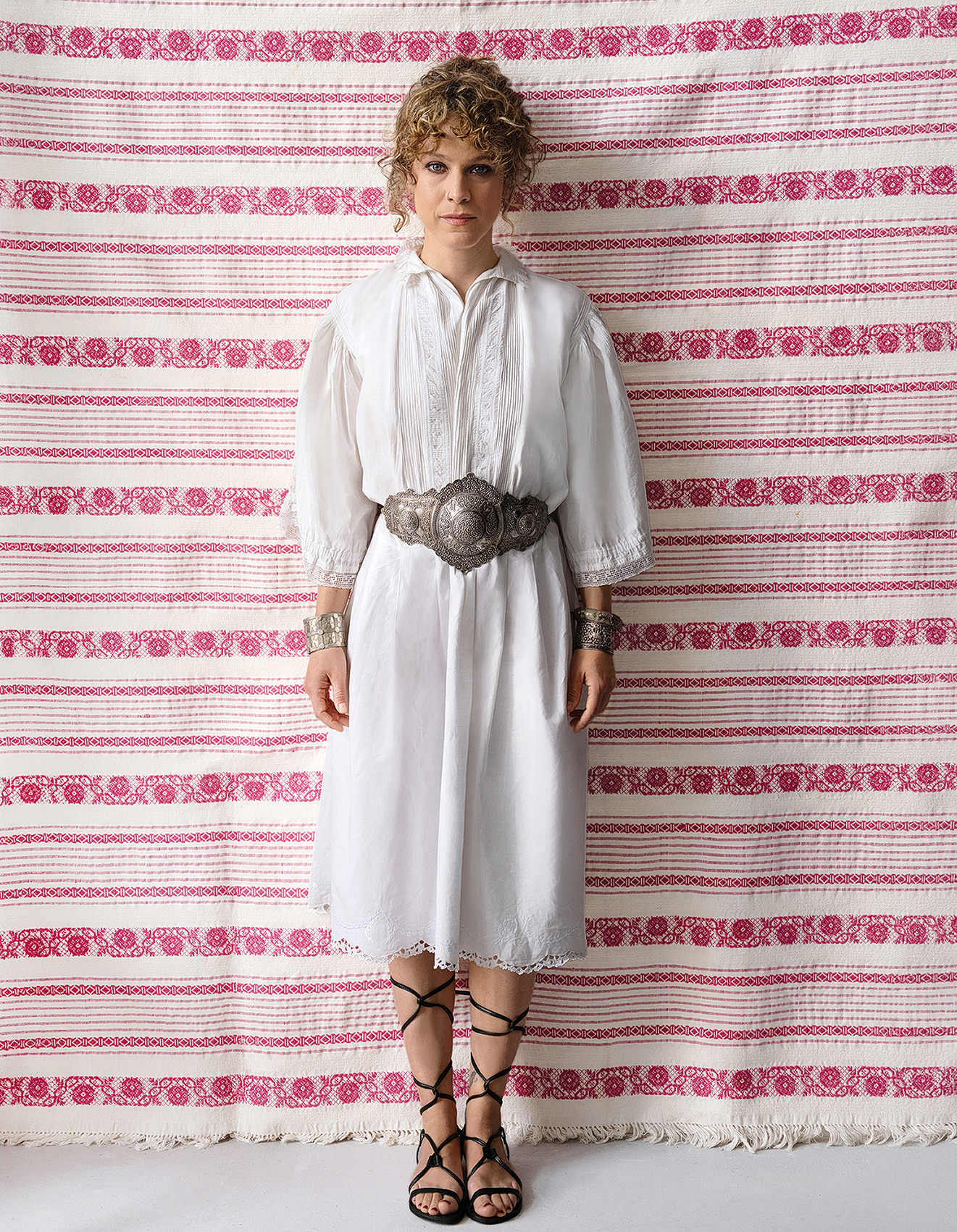
Dress and bracelets by QUEEN CALLIOPE. Brooch from Martinos Antique Shop.
Ifigenia Tzola
ACTRESS
An authentically Greek moment permanently engraved in my memory — one I always carry with me — is Sunday family lunches at my grandparents’ home, full of warmth, meaningful communication and genuine comfort.
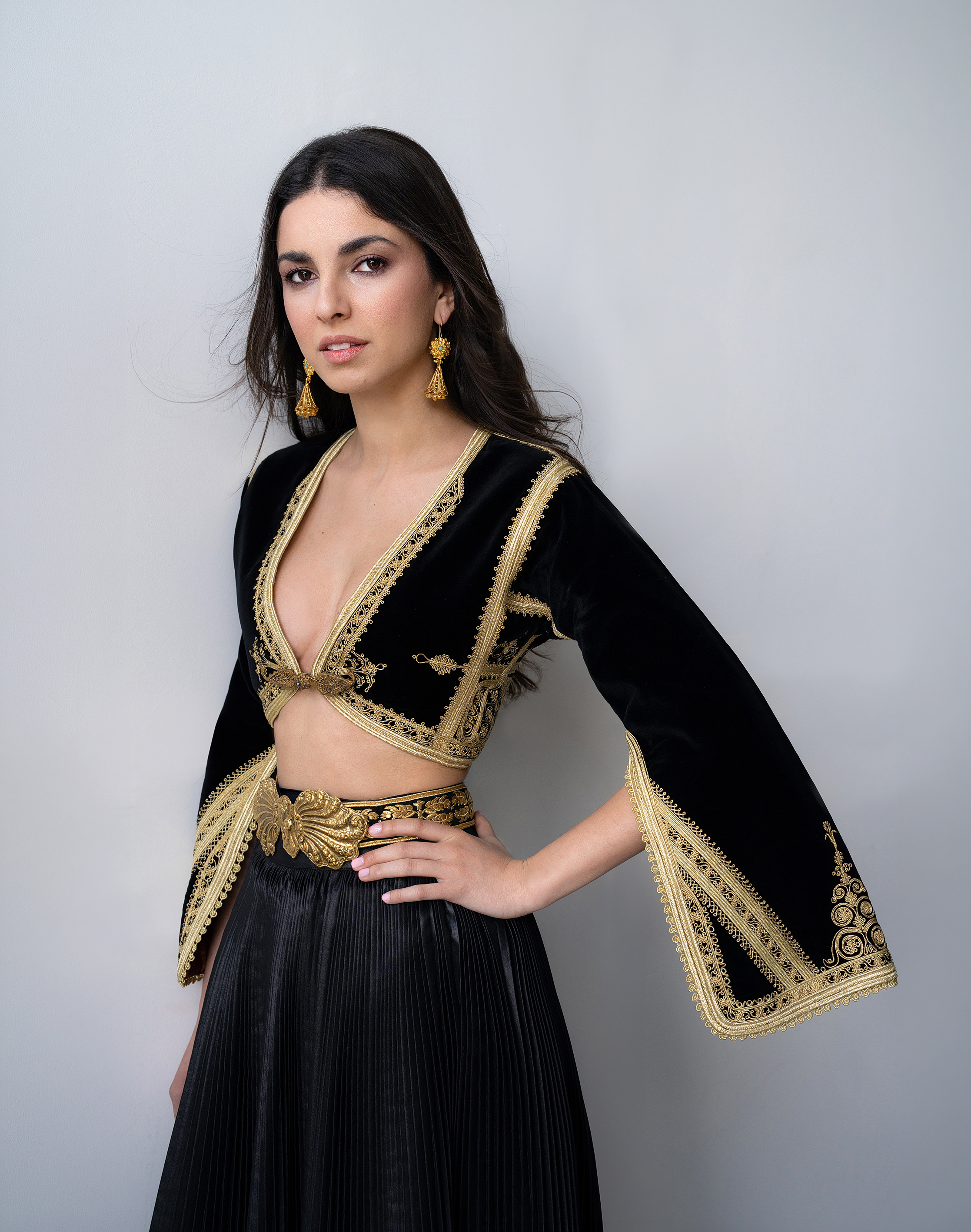
Vest, skirt and belt from a traditional Symi costume by ARISTOTECHNIMA – Aristidis Tzonevrakis. Earrings and brooch by QUEEN CALLIOPE.
Antigone Kouloukakos
ACTRESS
Greek cultural memory is ultimately a point of stability you can always return to — consciously or unconsciously, depending on what serves you at that moment.
I firmly believe the Greek actor possesses an extraordinary inheritance of artistic tools; they simply need to keep exercising them and never grow complacent.
I choose light and connect it with the sky, the sea, the sun, the earth, the scents of jasmine, prickly pears, olive trees, orange blossoms and almond trees. I draw strength and hope when I close my eyes and picture these things.
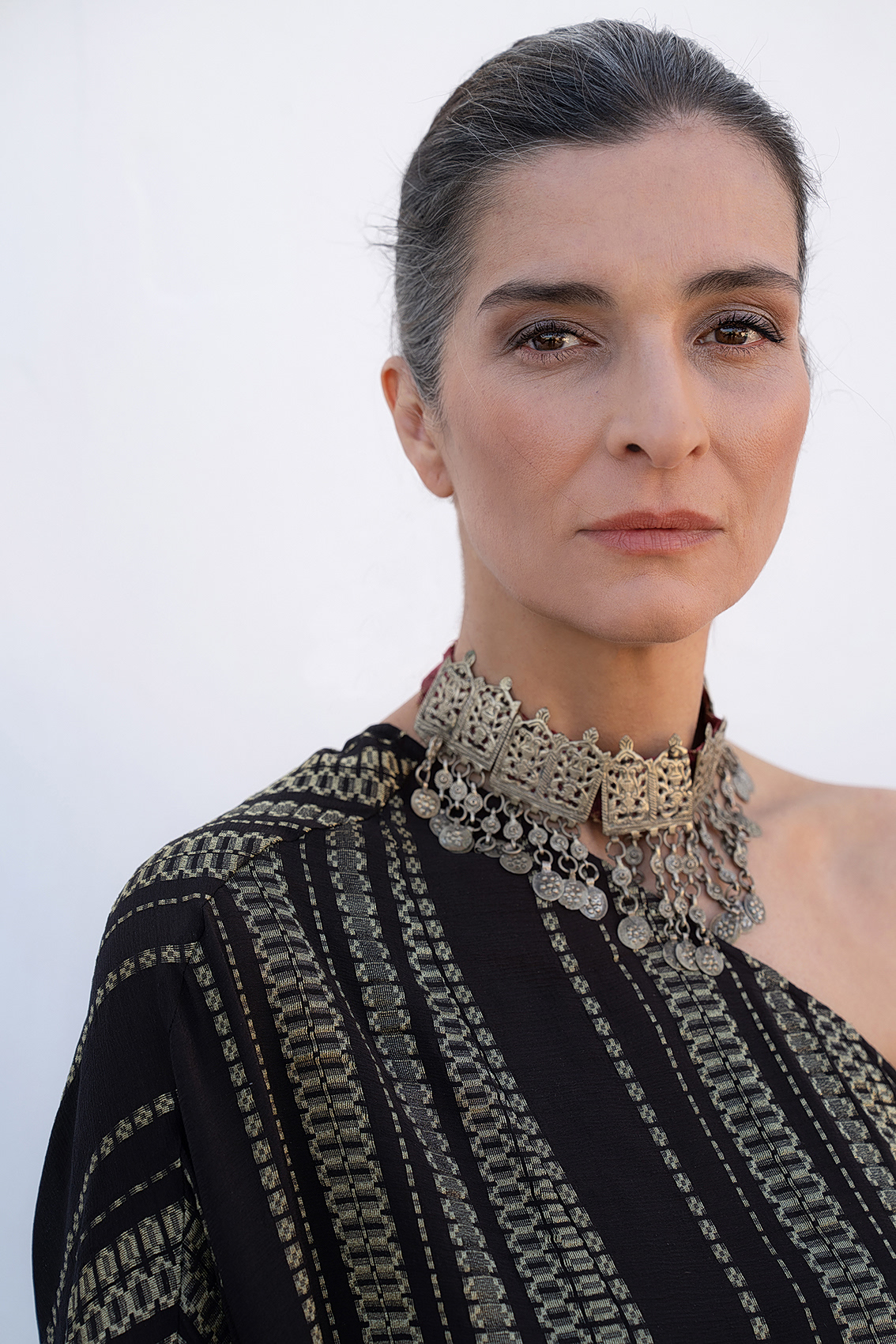
Dress and sandals by Zeus+Dione, aesthet. Neckpiece from Martinos Antique Shop.
Nikos Kosonas
ACTOR
I feel most authentic when I return to simplicity: close to nature, away from screens, surrounded by people I love. Around a table beside the sea, with a Greek salad and that familiar feeling that time stretches wide enough to hold everything — conversations, silence, laughter.
I am grateful we can still experience that. It may be the Greek quality I love most, though I do not know how to name it. Maybe it does not need a name. Maybe it is enough that we feel it. That is authenticity — a return to what truly matters.
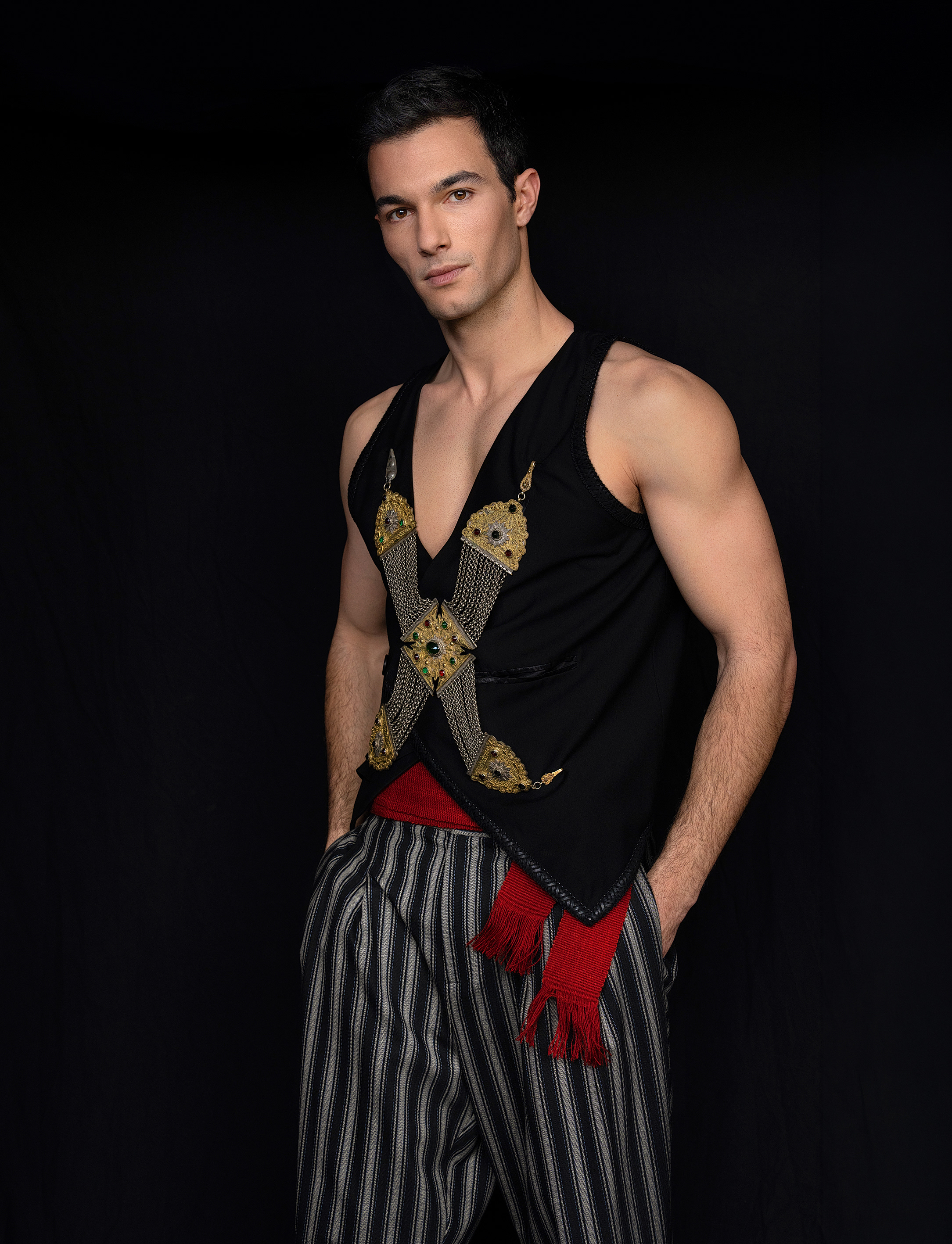
Nikos Kosonas wears a vest by ARISTOTECHNIMA – Aristidis Tzonevrakis, shirt by Zeus+Dione and trousers by YIORGOS ELEFTHERIADES.
Kimona Venieri Vassilaki
VISUAL ARTIST
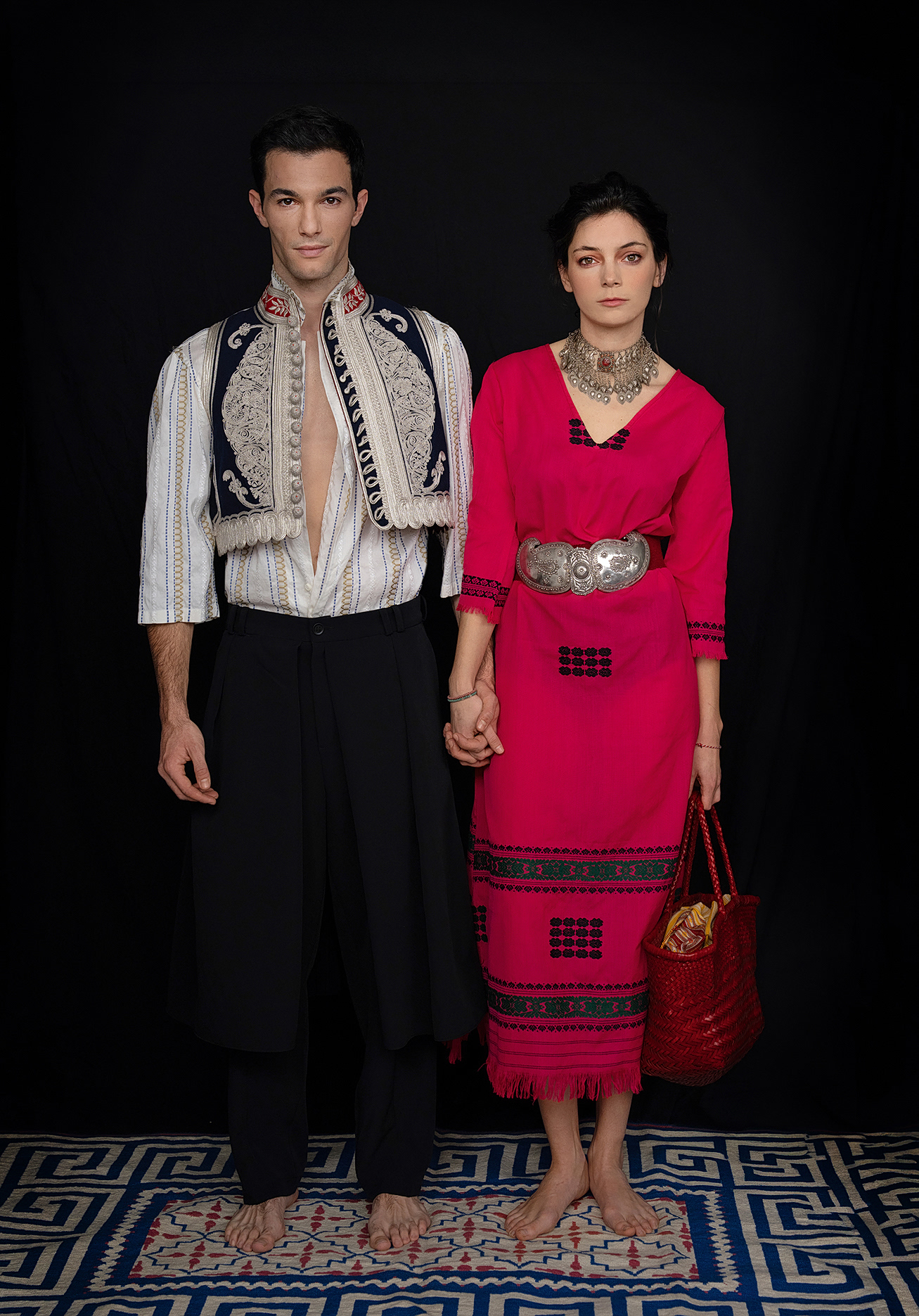
I perceive Greek culture as a familiar shadow hanging clothes in the sun, slicing a pear or a fig, or like a flag fluttering in the wind.
And every time I truly love something — a song, a house, a garden, a neighborhood — it is because it carries within it something tender and familiar, something old.
Leon of Athens
SINGER & SONGWRITER
I feel great peace and calm close to Greek nature. I am deeply connected to Greece as a place, and especially to the sunlight. When you live abroad for years, especially in northern countries, you realize it is not something to take for granted. You miss it beyond words.
These days I was in Corfu filming my new song. The villages, the music, the food, the landscape… I remember walking with my father in Hydra by the sea and talking. He is no longer alive, and those memories now hold even greater power for me.
I also feel lucky to have grown up here for another reason. I will never forget the image of elderly women on Lesbos caring for refugee babies during the migration crisis. To me, that is a luminous image of Greece. Humanity, hospitality, openness and love.
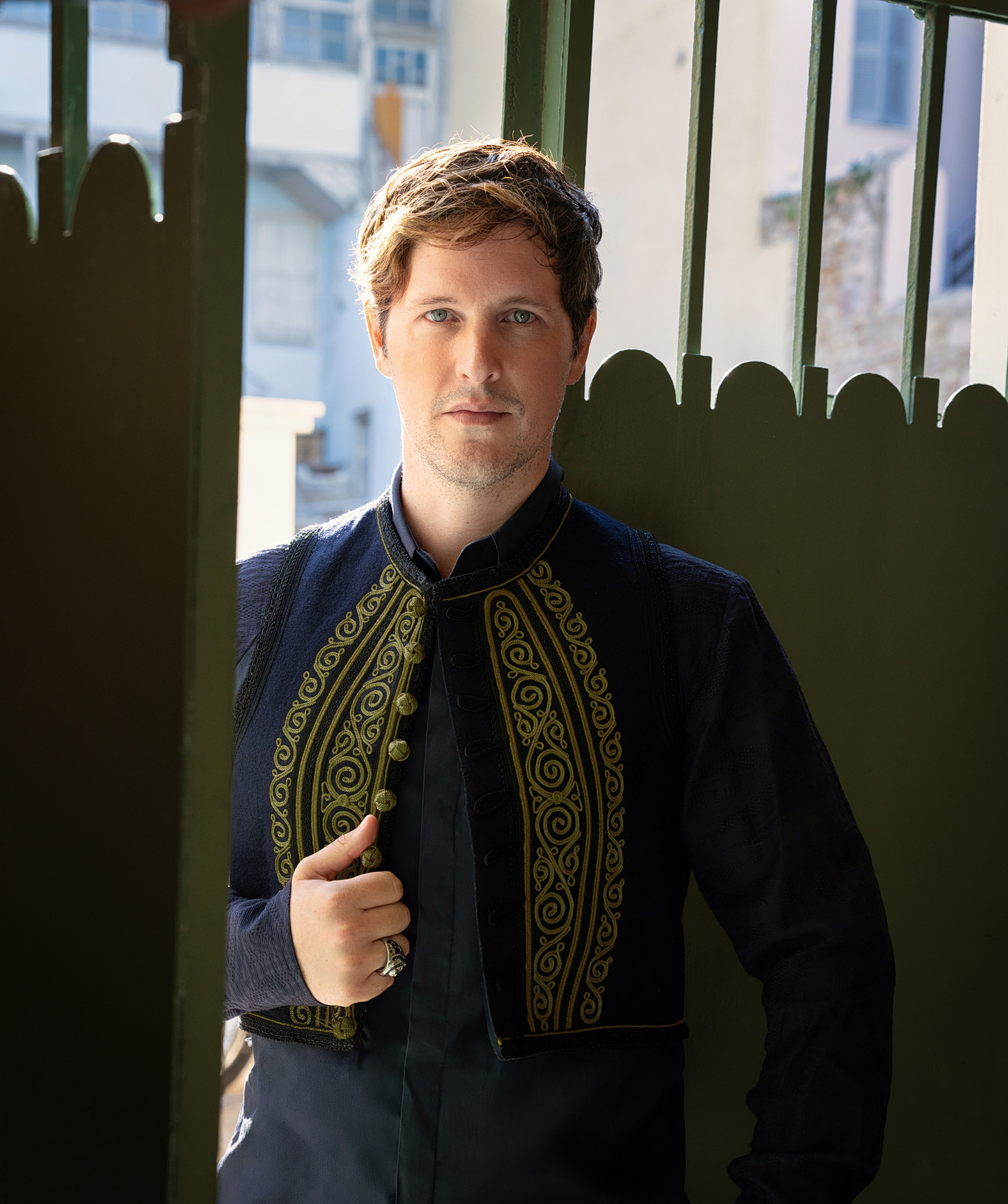
Vest courtesy of the Lyceum Club of Greek Women. Shirt by Yiorgos Eleftheriades.
Leon of Athens began his US tour with Marina Satti on May 17 and releases his new song “Selini (Myrto)” on May 29.
Katerine Duska
SINGER & SONGWRITER
I feel most authentic when I create by writing and performing songs. I seek the freedom to be different without belonging to a fixed framework.
Greece challenges me and strengthens me through a mixture of familiarity and distance that has deeply shaped me. My strongest memory is arriving from Montreal for the first time at age seven and discovering what felt like a magical and thrilling world.
Greece in three words is contradiction, reinvention and multiculturalism: the coexistence of old and new, the constant transformation of the familiar and the endless exchange of influences. That is how I see music too — without borders.
I would like Greeks to preserve our warmth and spontaneity, but also evolve with greater meritocracy and acceptance of difference.
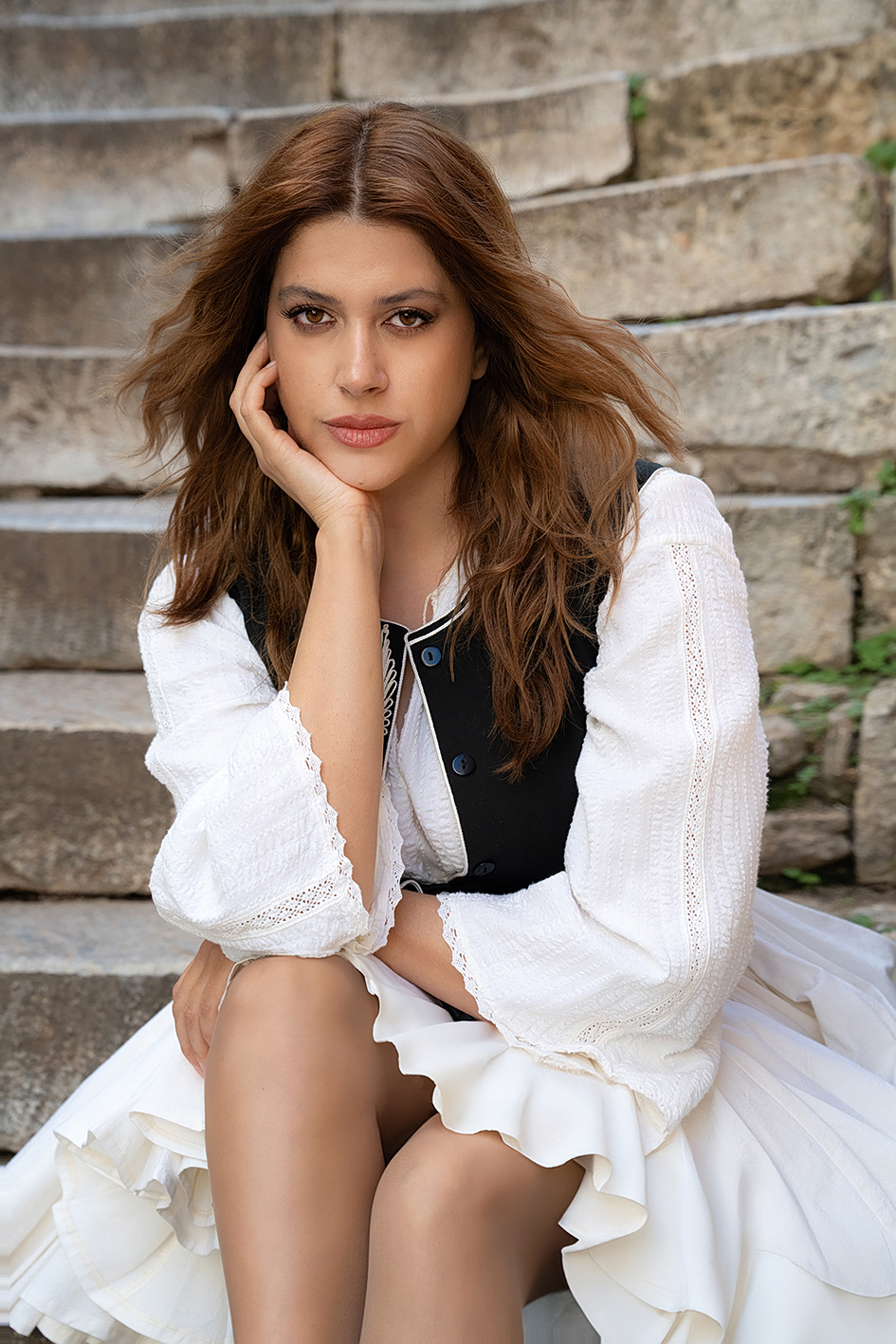
Vest and skirt by Zeus+Dione. Shirt courtesy of the Lyceum Club of Greek Women.
Katerine Duska is currently finishing her new album, “Bring Your Trauma,” which will be released after the summer.
Maria Korinthiou
ACTRESS
Authenticity is defined by the identity that shapes us. It is something I myself have never compromised. To carry my truth, my identity, my light. It exists in my soul, my body, the rhythm of my speech, the way I stand and represent a country with a great history: Greece.
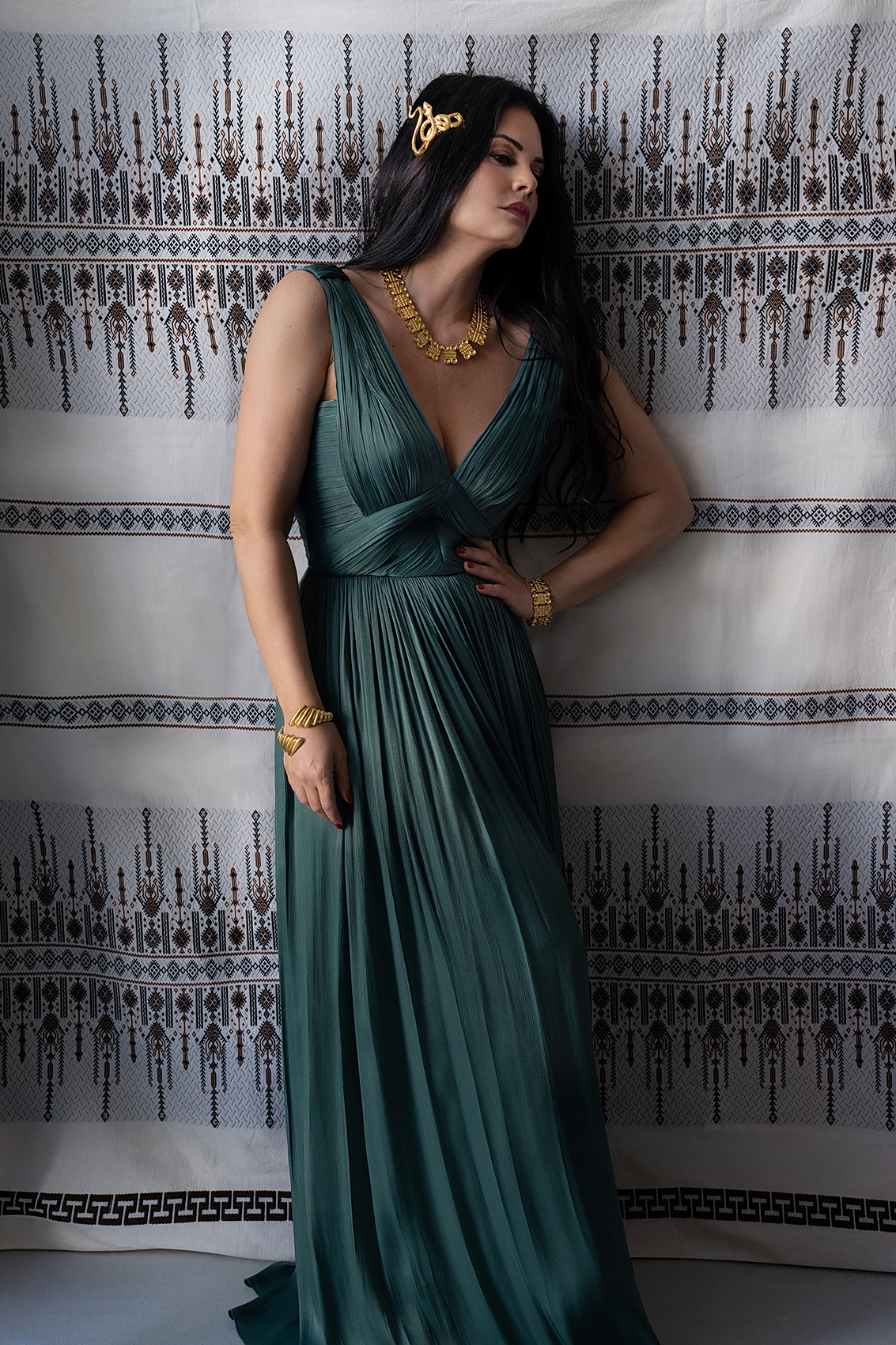
Dress by Costarellos, aesthet. Comb by QUEEN CALLIOPE. Jewelry by Zolotas.
Alkistis Poulopoulou
ACTRESS
There is something in the unpretentious simplicity of Greece that strips me of every “role” and returns me to something deeply true and essential. That is where I feel my defenses melt away and I become one with the landscape, the light, the air and the sea.
The people, the language, even a simple summer evening remind me who I am beyond appearances or ambition. They ground me while also inspiring me to dream.
If I could change something, it would be our occasional inability to believe in our own potential and support creativity, culture and people trying to create something beautiful. Greece has immense talent and imagination. I wish there were more space, trust and support for that.
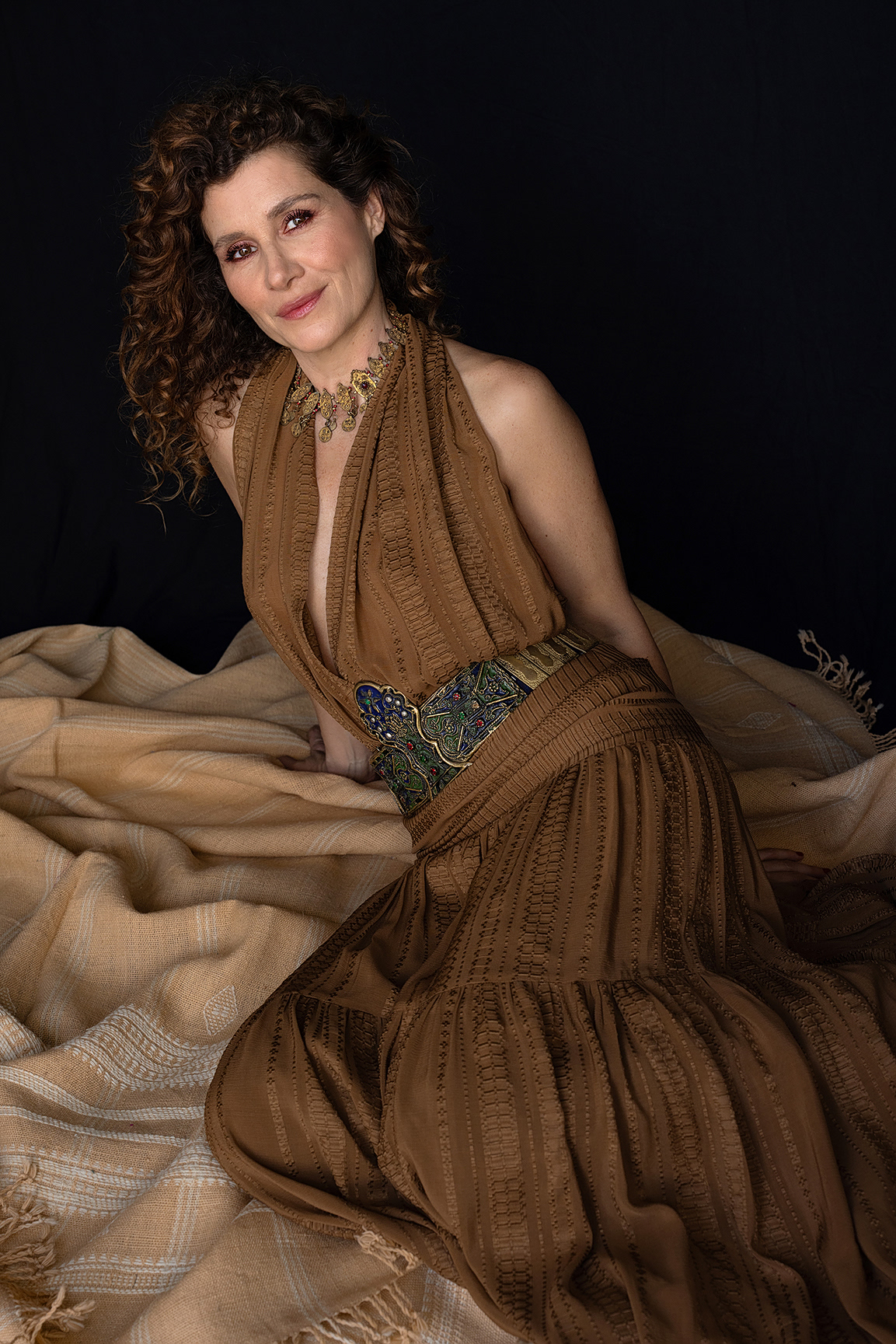
Dress by Zeus+Dione, aesthet. Neckpiece from Martinos Antique Shop. Thracian crown courtesy of the Lyceum Club of Greek Women.
Kalliopi Chaska
ACTRESS
Last year ended with the realization that constant social media consumption had deeply affected the way I perceived the world. So this year I made a conscious decision: to constantly check with myself whether my actions reflect my truth.
No matter how complicated and noisy life becomes, simplicity is always a powerful guide when we return to our core and our roots.
I come from a small mountain village with only 30 permanent residents — Nikia on the volcanic island of Nisyros. It is not touristy, never pretentious. The people are kind-hearted and genuinely care for one another, and beauty is not defined there by narrow standards but by volcanic landscapes, pink skies, stone houses and Dionysian dances.
Often, the most important things are much simpler and closer than we think.
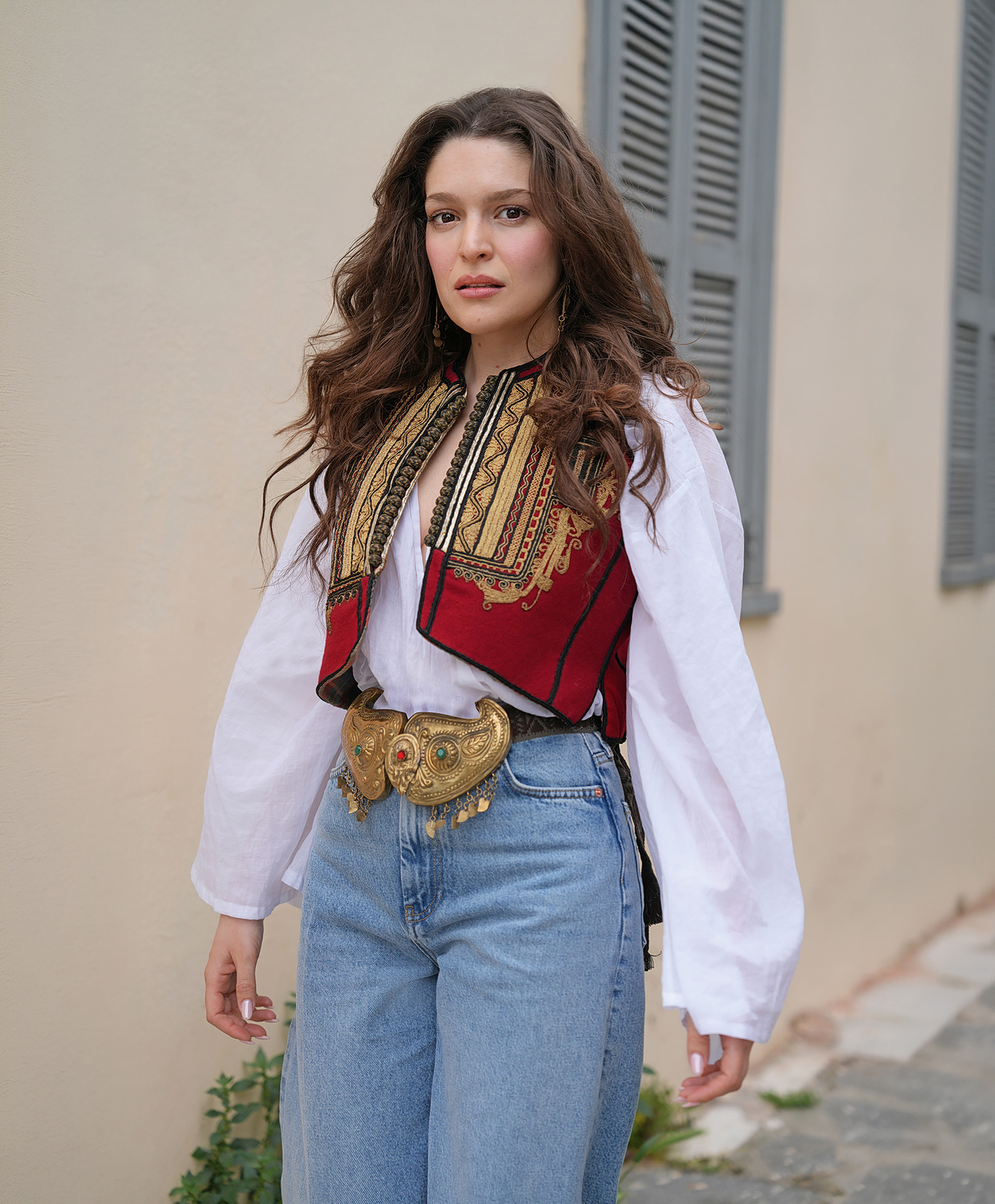
Amalia Kavali
ACTRESS
This is the land where words with immense meaning were born: “democracy,” “virtue,” “philotimo” — the uniquely Greek sense of honor and moral duty. How do we carry those words today? How were they passed down to us?
I see the struggle of certain artists trying to keep those words alive in both their lives and in our country, often while fighting against a hostile Greece. Composer Manos Hadjidakis against sensationalist populism, Melina Mercouri against the military dictatorship, Maria Plyta and Thalia Flora-Karavia against patriarchy.
Others preserved “philotimo” during difficult times: actor Thanasis Veggos trying to save filmmaker Nikos Koundouros during exile, Chairopoulos helping Attik during the Nazi Occupation, painter Panayiotis Tetsis making a bouquet every morning for the immigrant florist in his neighborhood at a time when immigrants were unwelcome.
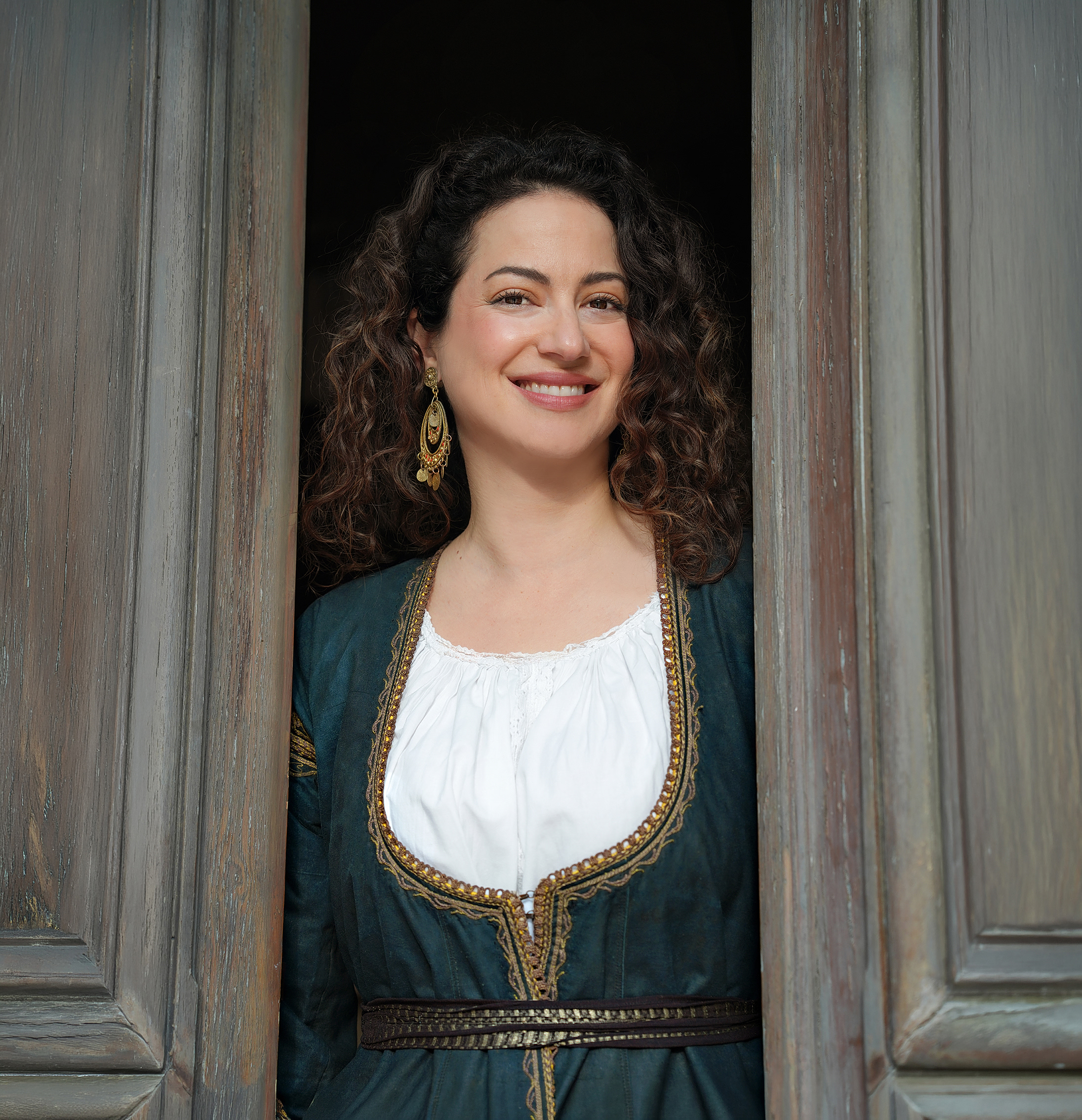
From them I draw strength and inspiration. I wonder who today is trying to pass these words on to the next generation.
P.S. Alongside my acting work, I document artists’ homes and tell stories from their lives. That is where I build my own cultural memory. (x.art.es)
Dimitris Kitsos
ACTOR
I feel most authentic when I can express myself without internal censorship, in an environment of safety — or when I have created that safety within myself.
I grew up in Ioannina, a misty place surrounded by strong natural landscapes, lakes and mountains, and that experience — together with the diversity of Greek scenery from the mainland to the islands — shaped the way I see the world.
Greece moves me emotionally, but it also troubles me socially and politically. I often feel that the need for genuine accountability and trust in institutions remains unresolved, without real change or justice in how problems are handled. At the same time, scandals exposed internationally damage the image of the country.
That condition — the anger, sadness and disappointment — affects me deeply and influences both the stories I tell on stage and my relationships.
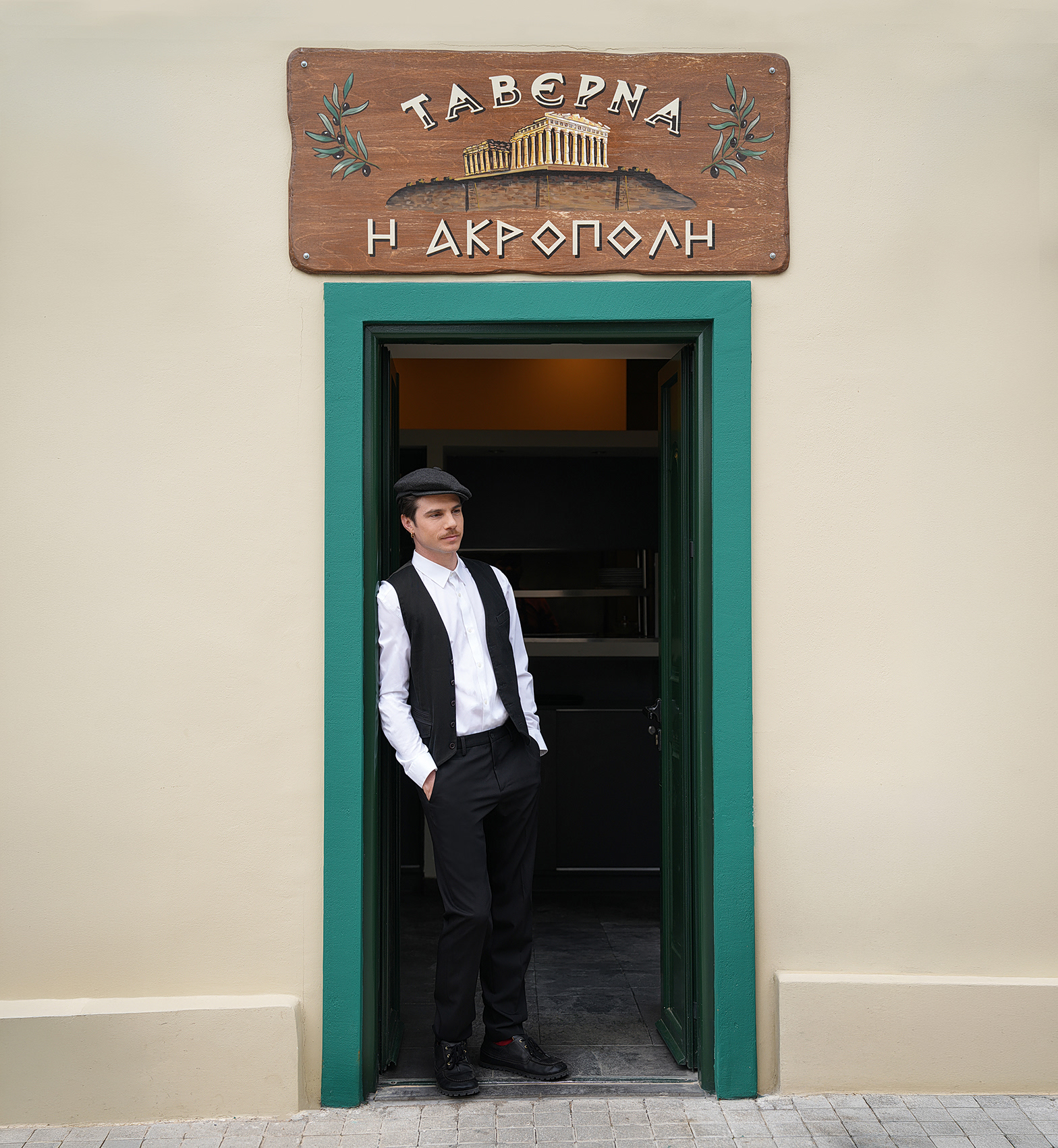
Giorgos Gerontidakis
ACTOR
Our cultural foundation runs through us: we gave birth to theater, and we carry it inside us. Our history, from the ancient world to more modern moments such as the Greco-Italian War of 1940 and the 1973 Athens Polytechnic uprising against the military junta, naturally translates into our work.
In the performing arts, we express something already existing within us. Art is universal, but each country chooses what it highlights. In Greece we constantly return to tragedy, and internationally there is also a renewed interest in it.
We live with the concept of heritage. I want us to preserve our hospitality and open-heartedness, but change the division and darkness that exist mainly at the political level.
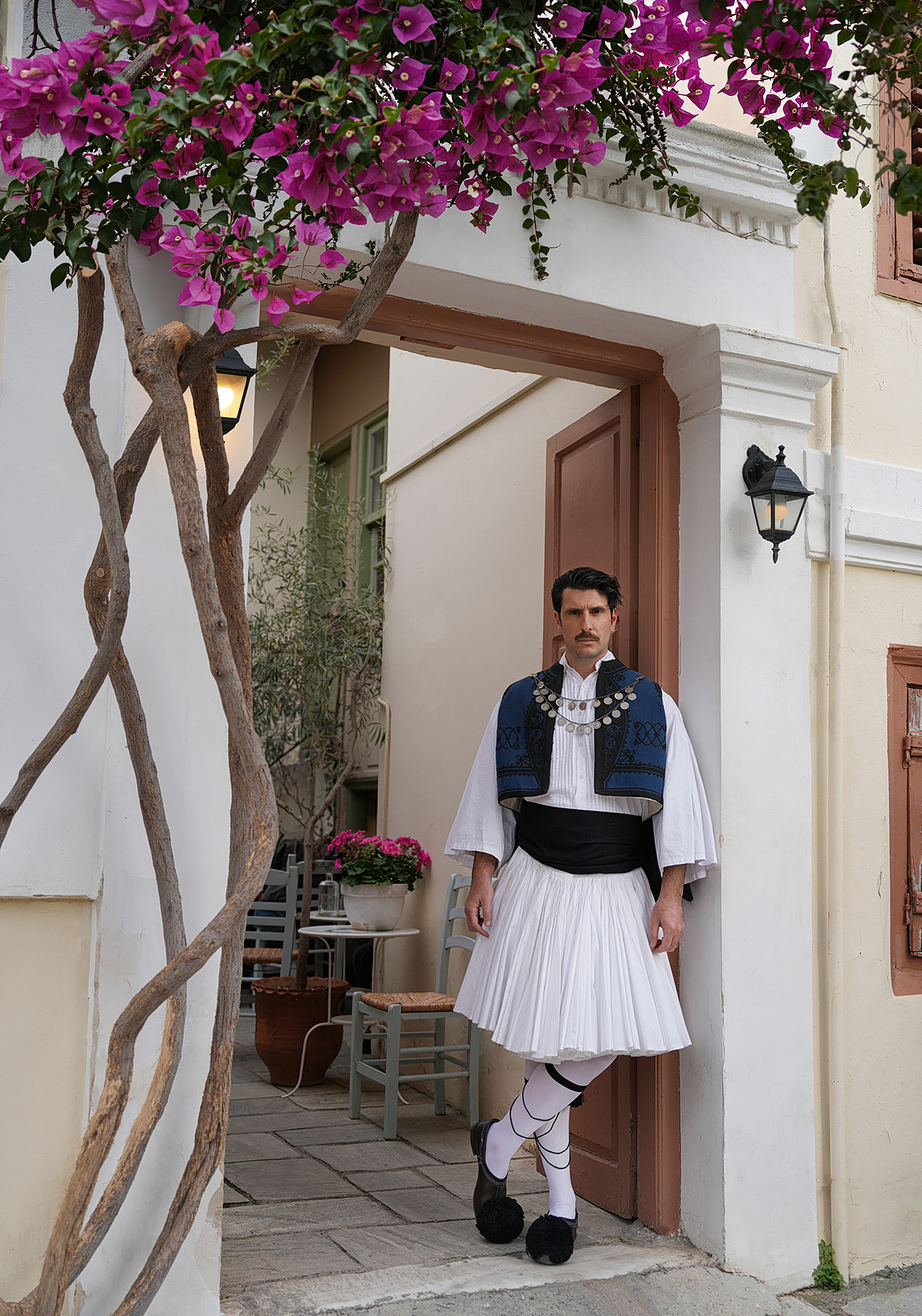
Dafni Labroyanni
ACTRESS
I was born in Greece and raised by Greek parents, relatives and neighbors in an era before not only the internet, but even supermarkets.
Obviously, I am made mostly from “Greek materials”: playing in empty lots, a sun that burns everything in summer, plains and blue mountains in the distance, loud voices, celebrations, lilacs, fights, stubbornness, solidarity, self-sacrifice, corruption, dictatorship, songs by incredible composers and poets, the sea, rocks, sand, beers, ouzo, indifference, eternal inferiority complexes, ingenuity and so many other things I do not even realize exist inside me and helped create who I am.
All of these shaped the way I speak, move and exist. And all of them baptize the stories of the people I portray as an actress.
Now that I have limitless access to information from around the world, I can add whatever I want to my ingredients. But usually, you only pass through the baptismal font once.
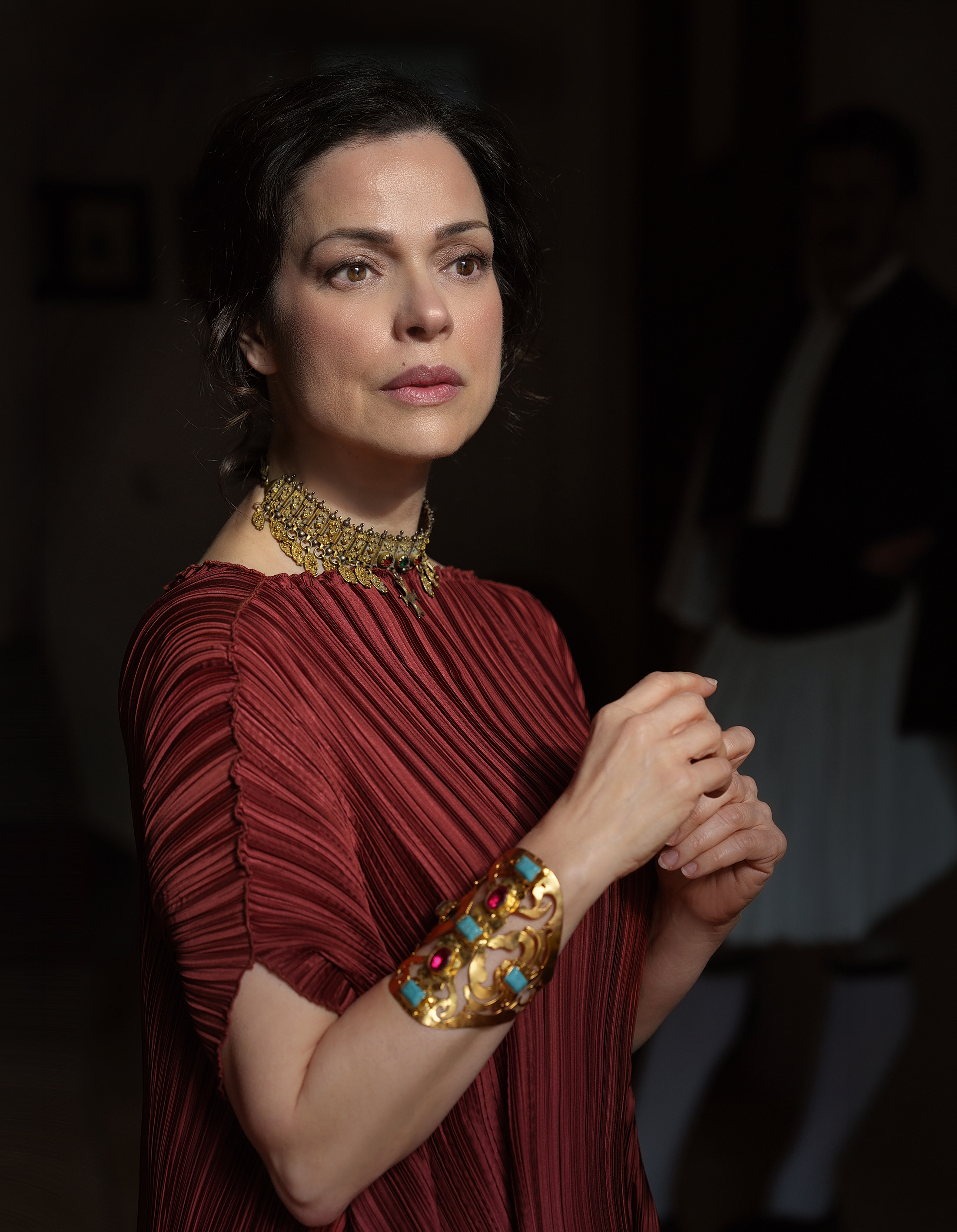
Dress by Daphne Valente, aesthet. Neckpiece from Martinos Antique Shop. Bracelet by QUEEN CALLIOPE.
Anastasis Roilos
ACTOR
Very often, whether for work or research, I return to Greek texts. Almost every summer I engage with Greek tragedy. Even when I work on other material, I return to ancient Greece and always find something new, something worth communicating.
That is what I feel we lack: we say we are Greek and possess a great heritage, yet we do not truly know it. We need to seek it out more actively and carry it meaningfully in our thinking.
Everyone talks about critical thinking, but critical thinking cannot exist without knowledge. Plato, Socrates, Aristotle, Aeschylus — you realize their heroes still speak in a language astonishingly close to our own.
What I would like us to preserve is our heritage and culture. What I would like us to change is setting clearer limits on stupidity: in behavior, littering, driving and social life. In the end, all these things share the same root — indifference toward the collective good. That is what we should confront more collectively, through education and critical thought.
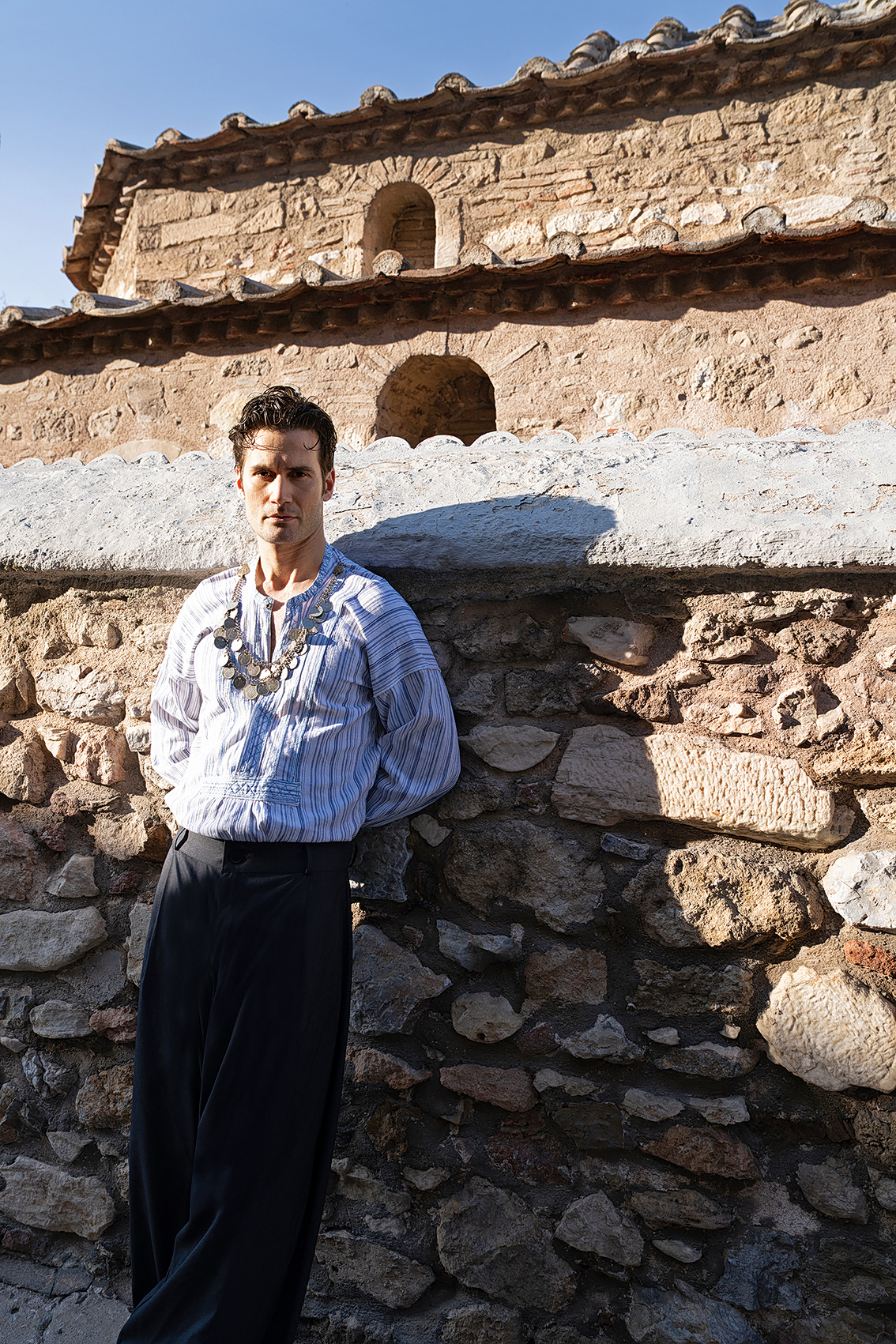
Karpathos shirt and chest ornament courtesy of the Lyceum Club of Greek Women. Trousers by Dante.
This summer, Anastasios Roilos will appear at the Ancient Theatre of Epidaurus in Aeschylus’ “The Persians,” directed by Christos Theodoridis, where he will play Xerxes.
Orestis Chalkias
ACTOR & MUSICIAN
Having actor parents, I grew up inside a cultural memory connected to theater, ancient tragedy, Epidaurus as an experience, Greek cinema and the great films that shaped us.
Over time, of course, all of this evolved and transformed. Karolos Koun’s theater profoundly shaped what we call “Greek theater.” It traveled across Europe and was embraced worldwide.
Today theater has changed. There are younger creators bringing their own perspectives while working to international standards, and I see that positively. I do not know whether it still makes sense to talk about “Greek theater” in the same way as before — it is constantly shifting.
What bothers me is that Greece often functions like a “global summer house” because of overtourism. I would like to see more meaningful management of the country’s wealth and possibilities by Greece itself, without losing what truly matters.
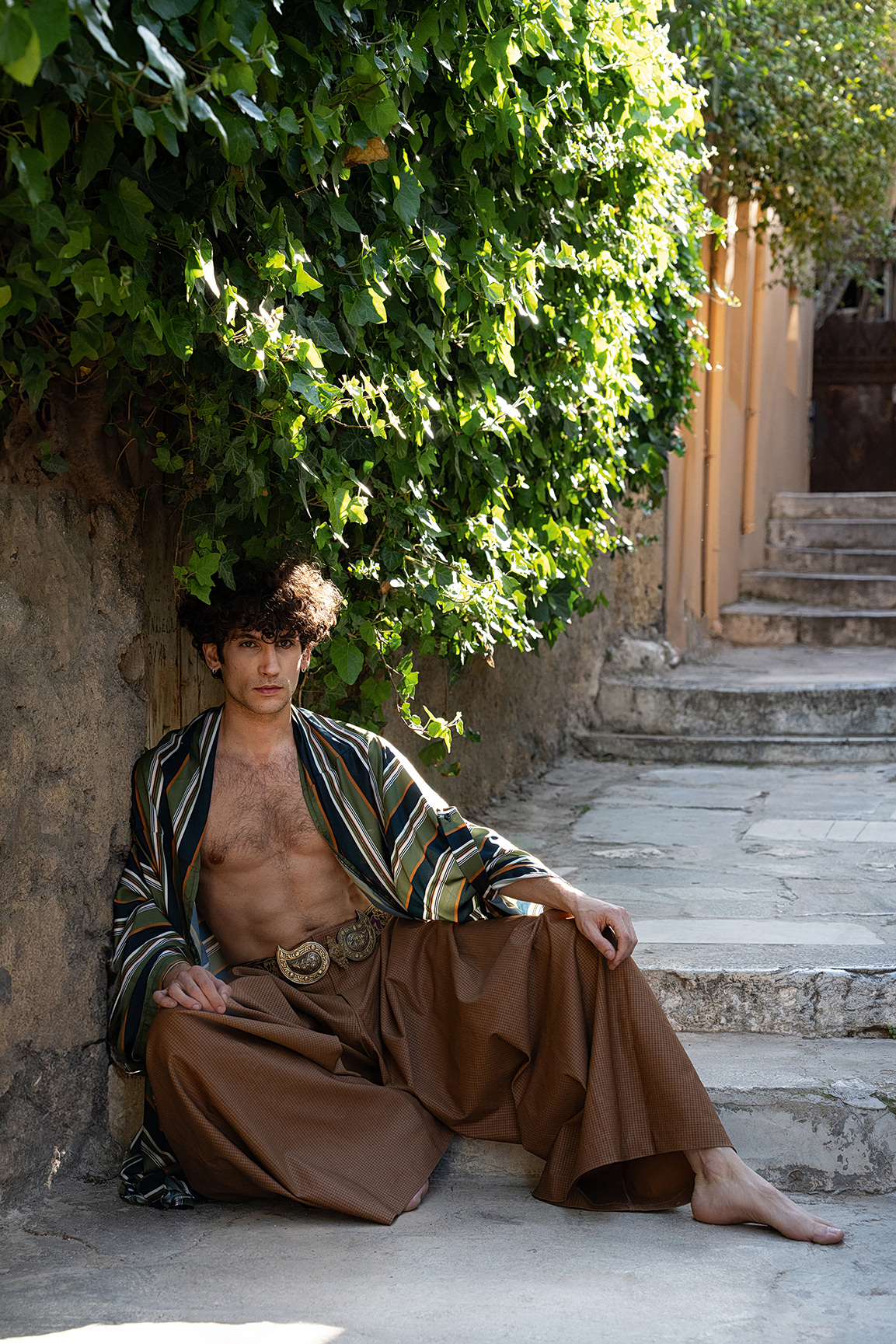
Kimono and wide-leg trousers by Dante. Buckle by QUEEN CALLIOPE.
Tzeni Kazakou
ACTRESS
When I act, I feel I never begin from zero. There is always something before me: a shadow, a narrative, a gaze that was already spoken centuries ago.
Perhaps that is why I am so interested in what lies in between. Not only what is said, but what remains behind the words. That is where all the tension exists for me. That is where I feel Greek cultural memory.