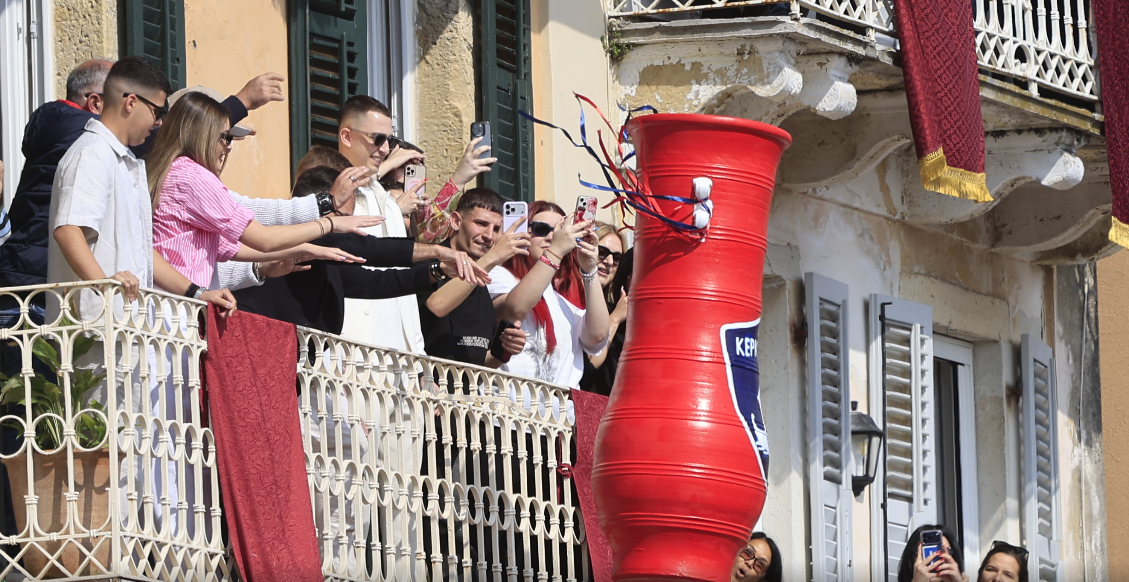
Crowds gathered across western Greece on Saturday morning to observe one of the country’s most distinctive Easter traditions, as residents hurled clay jugs from balconies and rooftops to mark the First Resurrection of the Greek Orthodox Easter.
In Corfu, large numbers of spectators packed the Liston arcade and Spianada square to watch locals drop water-filled earthenware pots from the decorated balconies of the old town, the deafening crash of clay on stone serving as a symbolic banishing of evil and a proclamation of the Resurrection.
The custom, known as the “Botides,” dates to the era of Venetian rule, though its precise origins remain disputed. One account traces it to local Catholics who threw out old household objects at the start of the new year to make way for new ones. The people of Corfu, according to tradition, adopted the practice and substituted clay jugs for the discarded items, maximizing the noise. A second theory connects it to antiquity, when Greeks marked the beginning of the agricultural season in April by smashing old vessels to be filled anew with the first harvest. Whatever its true origin, islanders today see the ritual as a symbolic awakening from winter and a celebration of renewal.
In the northwestern town of Preveza, hundreds of clay pots were simultaneously smashed across the old town’s cobblestone streets shortly after ten o’clock in the morning, as the bells of the Church of Saint Charalampos rang out. The custom in Preveza is rooted in the Ottoman period, when Christian communities would create loud noise to keep Ottoman authorities away from their neighborhoods during religious observances.
The Preveza tradition has gained national recognition in recent years and efforts are underway to have it inscribed on UNESCO’s Intangible Cultural Heritage list. The municipality distributed free clay pots to visitors and offered traditional Lenten sweets, while the Preveza Municipal Philharmonic band performed Easter hymns following the smashing. Local authorities reported high hotel occupancy rates over the Easter period, reflecting the event’s growing draw as a religious and cultural tourism destination.