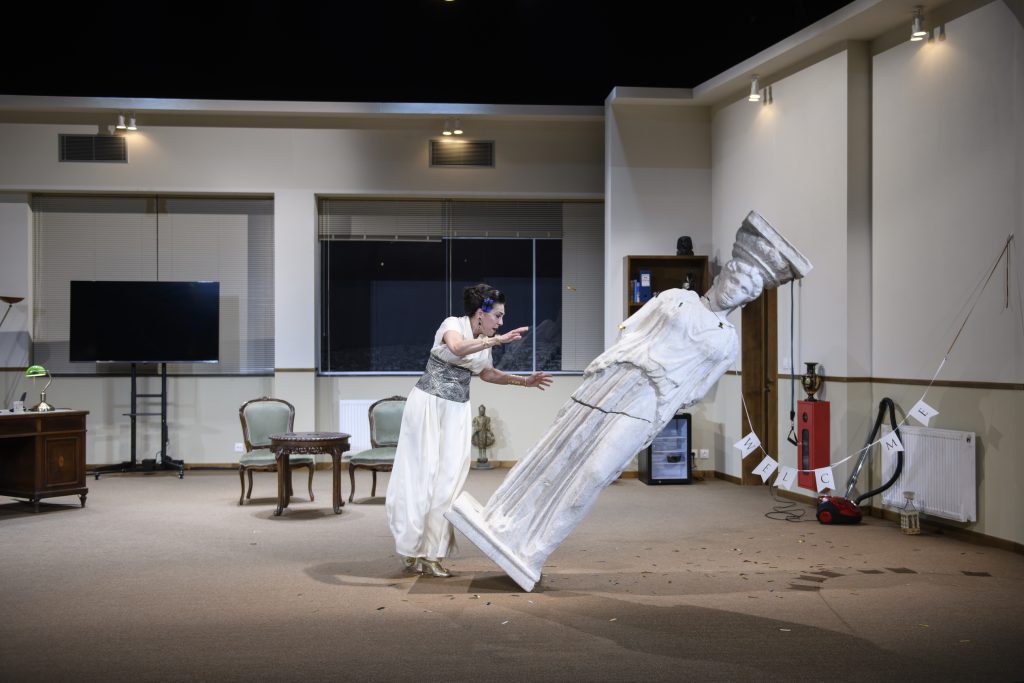
Entering the theatrical world of Mario Banushi is an experience that lingers long after the curtain falls. At just 24, the he Greek-Albanian director had already drawn international attention with Goodbye, Lindita, his second stage work, which critics hailed as a striking new voice in European theatre, with The Guardian singling him out as “an exciting new talent”.
Now, Banushi adds one of theatre’s most prestigious distinctions to his rapidly growing list of accolades: the Silver Lion of the 54th International Theatre Festival of the Biennale di Venezia, awarded in 2026.
Winner of the Golden Lion for Lifetime Achievement for Biennale Teatro 2026 is the most celebrated Italian director of theatre and opera, Emma Dante.

Twenty-eight year old theatre director Mario Banushi.
The decision was taken by the Board of Directors of La Biennale di Venezia, following a recommendation by Willem Dafoe, Director of the Theatre Department. The award ceremony will take place during the festival, running from June 7 to 21, at Ca’ Giustinian, the Biennale’s headquarters in Venice.
The Biennale’s Citation
In its official motivation, the Biennale praised Banushi’s deeply personal yet universally resonant theatrical language: “With his almost autobiographical storytelling, which ranges across the experiences of mourning, lamentation, absence and family traditions, Mario Banushi has revealed himself through his poetic, elliptical language, made of silences rather than words, yet evocative and painfully communicative.”
The citation continued: “Memory, everyday sounds, and the little things in life are the cornerstones around which intimate yet shared, universal ceremonies are celebrated. Memories, dreams, coexistence and loss unfurl in sequences of only apparently simple actions that – on the contrary – between radical realism and perspectival flights into abstract dimensions, open up to symbolic journeys into the archetypes of the human. Banushi’s theatre, so immediately intimate and deeply rooted in the Balkan culture, also knows how to be intelligently political, a sharp stab at the contradictions of our time.”

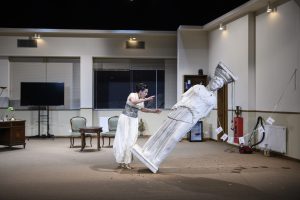
A scene during the performance “Goodbye Lindita” at the National Theatre of Greece. Credit: National Theatre of Greece.
Romance Familiare: A Trilogy of Memory and Loss
At this year’s International Theatre Festival, Banushi will present Romance Familiare for the first time as a complete trilogy, bringing together his three major works: Ragada (Greek for “stretch mark), Goodbye, Lindita and Taverna Miresia (Miresia is Albanian for kindness).
Born in Greece in 1998 and raised in Albania until the age of six, Banushi returned to Greece, where he later graduated from the Drama School of the Athens Conservatory. His debut work, Ragada, was created during the pandemic and staged inside a private apartment, outside conventional theatre spaces.
The production caught the attention of the artistic leadership of the National Theatre of Greece, leading to his invitation to create Goodbye, Lindita. Originally scheduled for a three-week run, the production went on to play for three years at the National Theatre, before touring internationally to major festivals and venues.
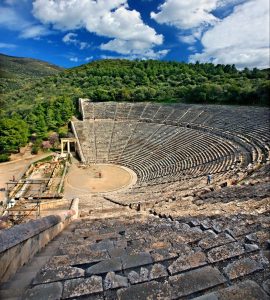
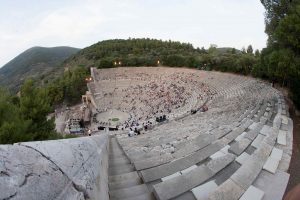
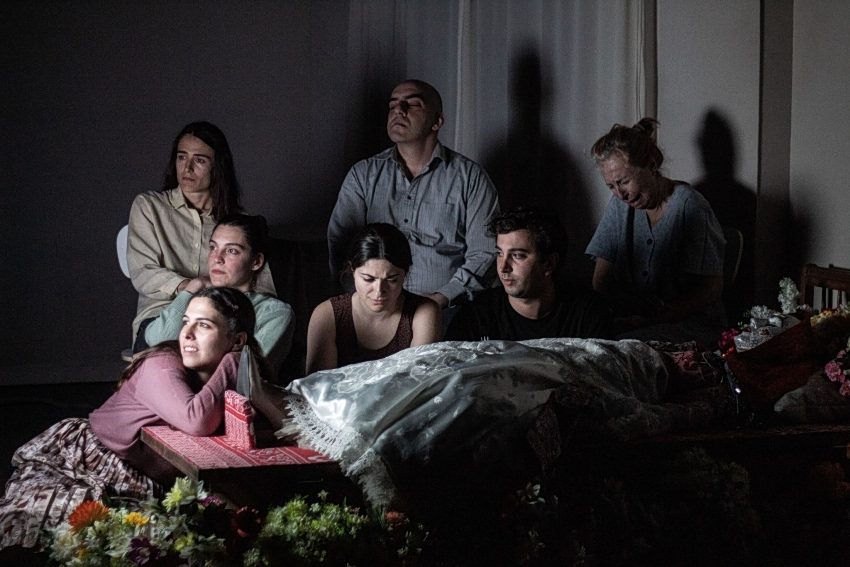
The third part of the trilogy, Taverna Miresia – Mario Bella Anastasia, premiered at the Athens Epidaurus Festival and has since travelled extensively, further solidifying Banushi’s international reputation.
As Banushi told The New York Times: “I want to create theatre that people feel, not theatre people understand. I want you to imagine your own stories, see your own life, then live with this.”
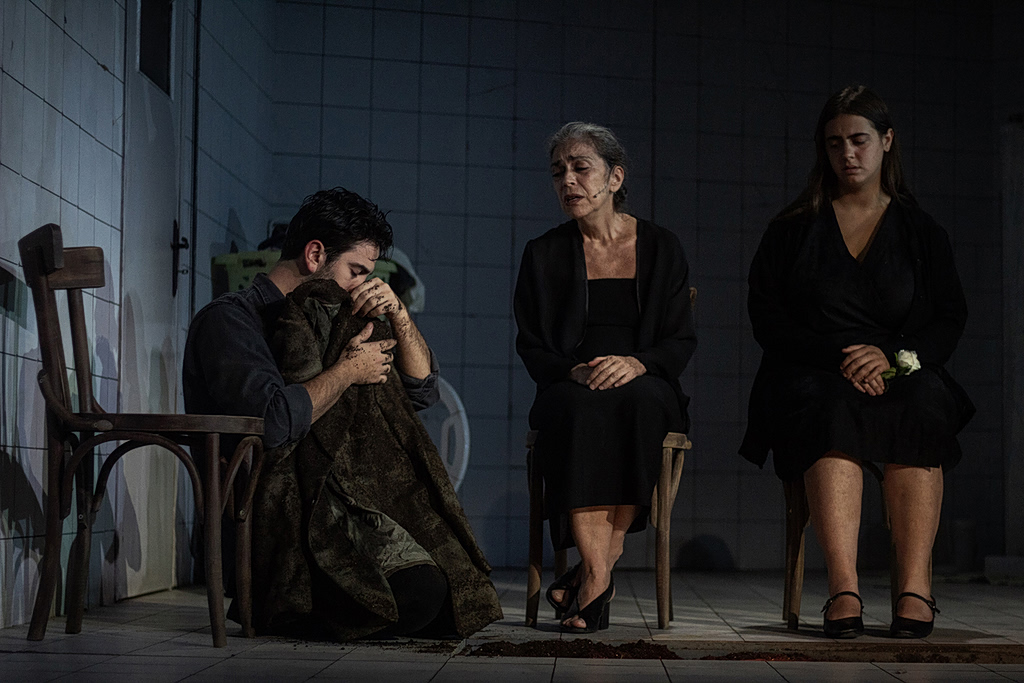
A photo from the performance “Taverna Miresia”. Photo credit: Theofilos Tsimas/Athens Epidaurus Festival
An International Voice Rooted in Family Intimacy
Banushi’s work has been presented in cities including New York, London, Berlin, Milan, Vienna, Montreal and Taipei. His theatre is defined by a rigorously visual, largely non-verbal language that draws on memory, family rituals and displacement, creating sensory experiences that transcend traditional narrative structures.
In 2023, Goodbye, Lindita earned invitations to major international festivals such as the Vienna Festival, International Theatre Amsterdam, the Adelaide Festival and BITEF in Belgrade, where Banushi received both the Jovan Ćirilov Special Award and the Politika Award for Best Director.
His work has been featured by The New York Times and the BBC, and reviewed by The Guardian, Le Monde and Libération, marking him as one of the most compelling theatrical voices of his generation.