Archaeologists have uncovered an ancient cult site on the Greek island of Ithaca dedicated to Odysseus, the legendary hero of Homer’s epic, offering fresh evidence of the deep entanglement between myth and religious practice in ancient Greece, the Culture Ministry announced.
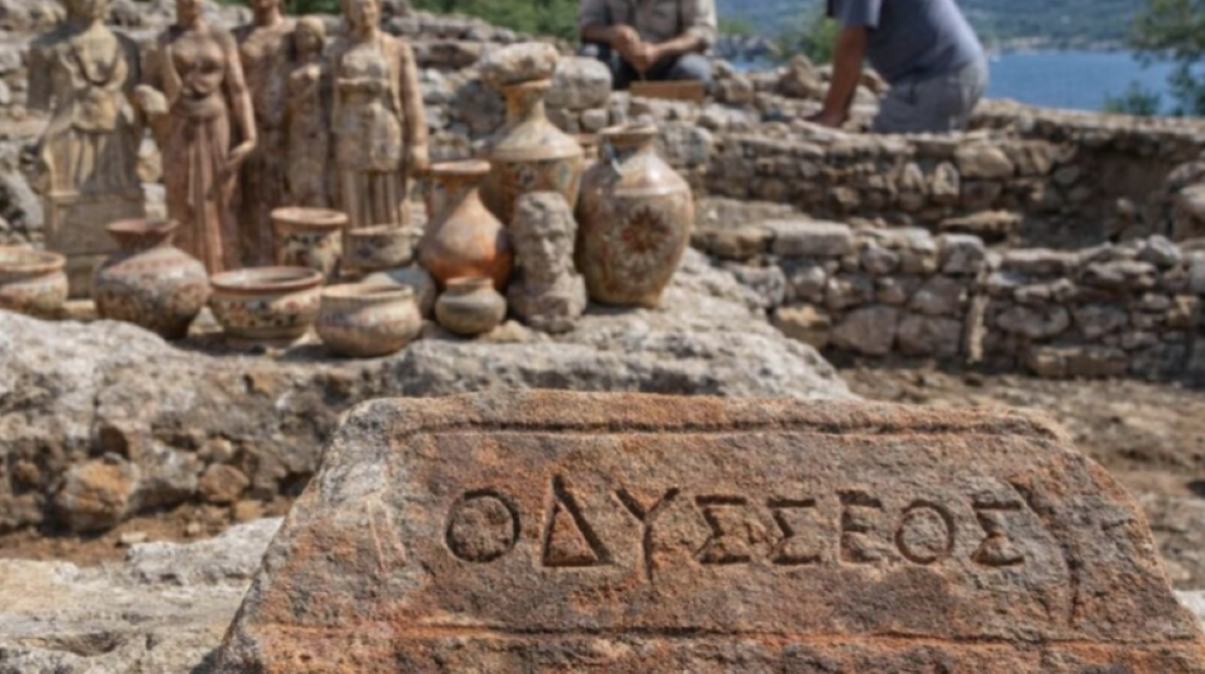
Excavations at a site known as the “School of Homer,” perched on a hillside overlooking the sea, yielded votive offerings spanning from the Mycenaean to the Hellenistic period, along with a ceramic fragment bearing a variant of the name Odysseus — what the ministry described as strong evidence of sustained, organized worship of the mythical king of Ithaca.
The site shows uninterrupted religious activity spanning more than a thousand years, with ceramic, metallic, and ritual objects recovered from successive historical periods. Offerings range from the Mycenaean era, roughly 1600 to 1100 B.C., through to the Hellenistic period ending around 31 B.C., suggesting that veneration of Odysseus outlasted sweeping political and cultural upheavals across the ancient world.
The presence of Mycenaean material is particularly significant, as it indicates that Ithaca’s association with Odysseus predates the composition of the Odyssey in the eighth century B.C., lending weight to the view that the island’s mythological identity was already well established long before Homer committed the story to verse.
The Culture Ministry stopped short of claiming the find proves the historical existence of Odysseus, but said it demonstrated that epic heroes occupied a living place in ancient Greek religious experience — venerated through offerings, rituals, and dedicated sanctuaries rather than existing purely as literary figures.
The ministry described the discovery as one of the most significant of recent years, saying it opens new perspectives on the transmission of myth, the relationship between oral tradition and religious practice, and the ways in which landscape itself was shaped by legend.