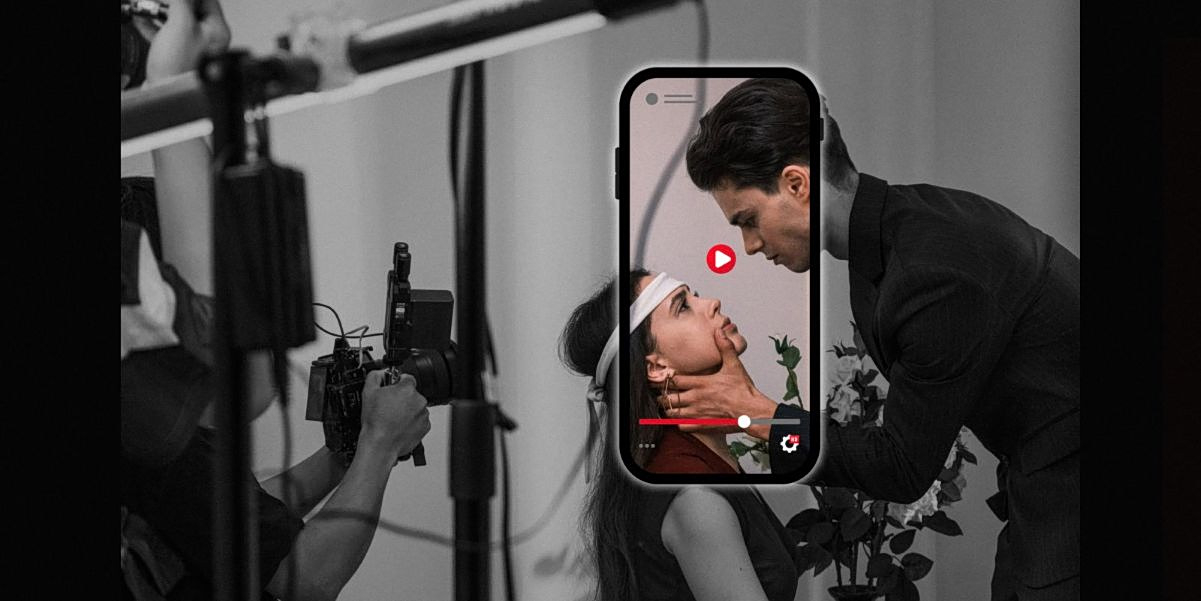
The terms micro drama or short drama may not yet be part of your everyday vocabulary, but chances are you’ve already encountered the phenomenon. While mindlessly scrolling through TikTok, Instagram, or Facebook, you’ve probably come across sponsored videos that feel like something more than a throwaway online skit. They feature polished production values—professional lighting, deliberate camerawork, and trained actors.
And yet, something about them feels off. The scripts are often blunt to the point of caricature, performances exaggerated, and emotions pushed to melodramatic extremes. Frequently hyper-sexualized, they recall the soft-core television series of the 1990s, without ever tipping into outright pornography.
They resemble romantic dramas locked in a constant state of overdrive: flawless bodies, breathless confrontations, and dialogue charged with an almost naïve bluntness. What startles at first is not so much the content as its context—the sudden intrusion of such an intense narrative into the most casual, unguarded kind of scrolling.
That, precisely, is the point. Micro dramas almost always begin in medias res, plunging viewers straight into conflict. Characters and backstories are not introduced carefully; instead, the audience is forced to piece them together on the fly. The opening moments hinge on an immediate hook—a slap, a scream, a sexual encounter, a shocking revelation. “How could you do this to me?” “It’s not what you think.” Here, the cliffhanger comes before the plot.
A familiar scenario unfolds: a neglected wife, cheated on and mistreated, remains loyal and forgiving until her husband leaves her. Then fate intervenes with operatic bluntness. She wins the lottery; he loses everything, ends up destitute. Revenge beckons—but how will it play out? Click the ad, download the app, pay a small subscription, and the answer awaits. This is the essence of the micro drama: not just a short video, but a compressed, aggressive form of storytelling engineered to seize attention and push viewers toward the next episode—and then the next.
Known variously as short dramas, vertical dramas, or micro dramas, the format originated in Asia, particularly China, where it is called duanju. These bite-sized fictional videos, shot exclusively for smartphone screens, initially appear to be another symptom of the attention-fragmented age.
Episodes last 60 to 90 seconds, filmed in a vertical 9:16 frame, designed for rapid consumption during idle moments—work breaks, commutes, fleeting boredom. Beneath this surface, however, lies a fully fledged industry, complete with multimillion-dollar investments, specialized know-how, a distinct aesthetic, and a clear ideological framework.
According to Apptopia data published exclusively by Axios, the share of U.S. users who spend time on both mainstream platforms—Netflix, TikTok, Instagram, YouTube—and leading micro-drama apps such as ReelShort and DramaBox increased throughout 2025. By December, around 11% of Netflix users were also using DramaBox or ReelShort, up from 8% in January. This is not a mass migration, but something subtler: a parallel habit quietly taking root.
Greek director Alexandros Chatzis is the first from Greece to collaborate with the Korean short-drama platform Vigloo, directing three vertical series filmed in Greece. One of them, The Heir of Mykonos, follows the son of a powerful Greek shipping magnate who conceals his identity while pursuing an American photographer vacationing on the island.
&;
As Chatzis explains, all the extras across the three productions were Greek, while the leads were a mix of American professionals and European actors—Greek and Spanish—capable of speaking fluent English with convincing American accents. When the collaboration was first proposed, he admits, he was unfamiliar with the genre and unaware of the scale of the market in Asia and, increasingly, in the West. “I came primarily from cinema,” he says. “Short dramas operate on a completely different logic, with a different ideology.”
Each series runs roughly 50 to 60 minutes in total, divided into one-minute episodes designed solely for smartphone viewing. “Everything revolves around the economy of attention,” he notes. “That’s why an episode rarely exceeds 60 seconds. Elements that might be beautiful or atmospheric in film are forbidden here. Dark shots, especially at the start, are avoided entirely. Research shows that when users see darkness on screen, they simply scroll past.”
Narrative structure is governed by an equally strict protocol. “Every episode must end with a cliffhanger,” Chatzis explains. “You leave the viewer with an unanswered question that pulls them into the next installment. It’s not a new idea—we saw it in daily TV series decades ago—but on mobile it becomes denser, more aggressive. The transition to the next episode is instantaneous.” On most platforms, the first seven episodes are free; continued viewing requires a subscription.
Chatzis describes the form as hybrid: “A Korean narrative framework inspired by K-dramas, American-style dialogue, and often American or English-speaking actors who can convincingly perform an American accent.”
In their relentless brevity and heightened emotion, micro dramas may look disposable. Yet their quiet expansion suggests something more enduring: a new grammar of storytelling, perfectly calibrated to the restless rhythms of the scroll.