One of Greece’s best-preserved ancient fortresses sustained limited damage during the recent four-day wildfire that swept across the Attica-Boeotia region, following an inspection by Culture Minister Lina Mendoni this week at the Aigosthena site.
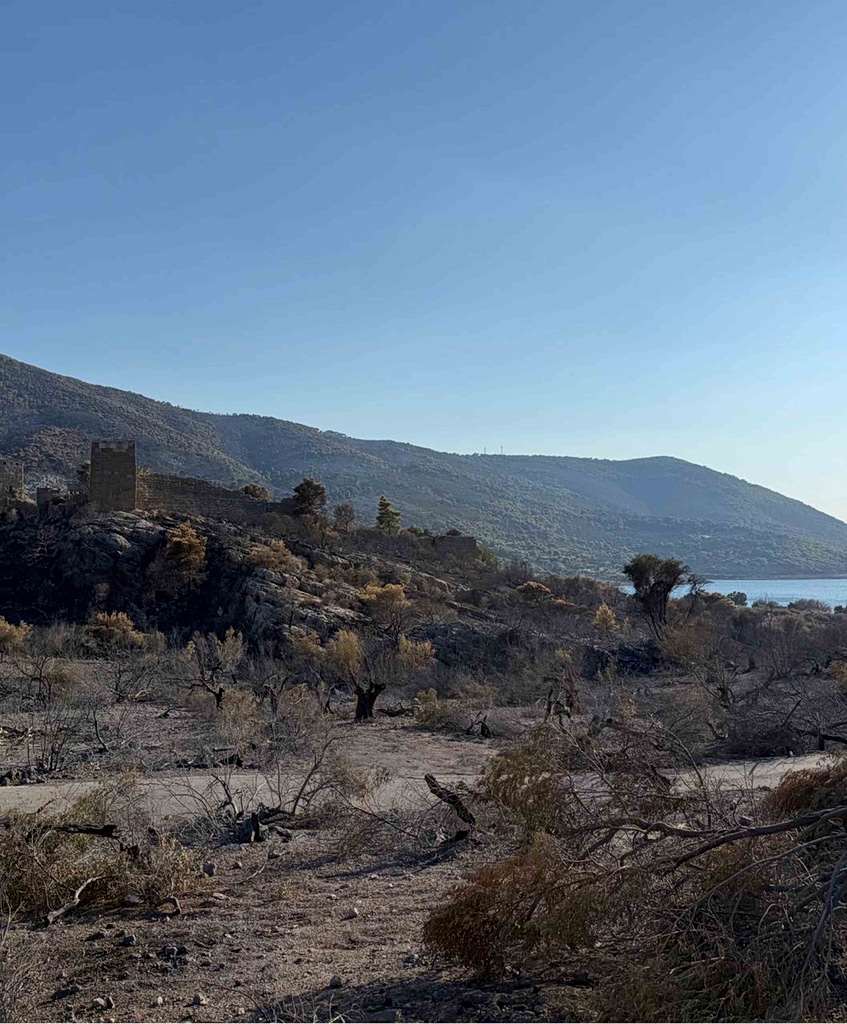
The assessment found that the blaze left scorch marks on sections of the walls and restored towers of the ancient fortress of Aigosthena, near the coastal Porto Germeno resort on the Corinthian Gulf, while chapels inside the acropolis require immediate cleaning to remove soot from their frescoes.
The fire also damaged stone blocks in the northern section of the fortress that had been prepared for ongoing restoration work.
Greater damage was recorded to the site’s modern restoration infrastructure. The collapse of wooden supports on scaffolding installed along the fortification walls triggered a chain reaction that affected the scaffold structure, an overhead crane, stored construction equipment, electricity and water supply networks, and the local archaeological service’s site offices.
Dating to the second half of the fourth century BC, the fortress of Aigosthena occupies a strategic position overlooking the southeastern Corinthian Gulf. The fortified settlement remained inhabited from the Classical period through the Byzantine and post-Byzantine eras and is considered one of the most complete surviving ancient fortifications in Greece.
The damage comes after a series of destructive wildfires across central Greece over the past week, which scorched thousands of hectares (tens of thousands of acres) in the Attica-Boeotia region and required a prolonged firefighting operation as strong winds repeatedly fueled the blaze. Authorities have warned that exceptionally dry vegetation and persistent high winds continue to create extreme wildfire conditions across much of the country.
Wildfires have threatened several major archaeological sites in Greece over the years.
In 2021, flames reached the archaeological site of Ancient Olympia in the western Peloponnese, prompting an extensive operation that prevented major damage to the UNESCO World Heritage monument despite fires burning around its perimeter. The same fire season also threatened the archaeological site of Tatoi, the former Greek royal estate north of Athens, where restoration projects and historic buildings suffered damage.
In 2023, firefighters worked to protect the archaeological site of Mycenae in the northeastern Peloponnese as a wildfire approached the Bronze Age citadel, while previous major fires have also endangered the Temple of Apollo Epicurius at Bassae and archaeological sites on the island of Rhodes.
Although emergency interventions have generally prevented catastrophic losses to the monuments themselves, repeated wildfire seasons have increasingly exposed Greece’s cultural heritage to the effects of extreme heat, prolonged drought and more frequent large-scale fires.