 Μake us preferred on Google
Just 20 meters from the Small Theater of Epidaurus, an entire ancient city is beginning to give up its secrets. This is the Epidaurus that lived in the shadow of the famed Asklepieion and the Theater of Polykleitos. The theater draws thousands of visitors every year, yet the city’s own history has remained largely unknown. In recent years, systematic archaeological research has gradually brought to light the monuments and religious life of its urban center. It has revealed a city with its own sanctuary of Asclepius, monumental fountains, stoas and places of worship, all of which round out the picture of Epidaurus as one of the most important healing centers of the ancient world. Vassilis Lambrinoudakis, professor emeritus of Classical Archaeology at the University of Athens and co-director of the excavation, presented the findings at the University of Athens during a special ceremony honoring the excavation’s donors.
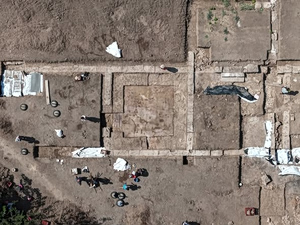
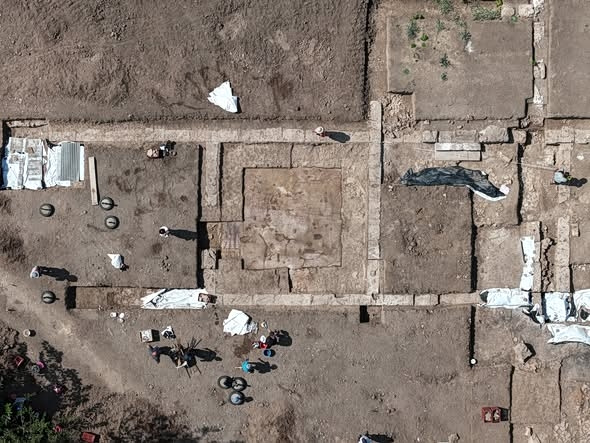
A major milestone in this effort has been the discovery of the temenos, or sacred precinct, of Asclepius described by Pausanias, whose location had long remained unknown. Near the Small Theater, at the heart of the ancient city, excavators uncovered an organized cult site with an open-air enclosure, a monumental fountain with a large cistern, a western stoa and a nymphaeum. The finds support identifying it with the precinct mentioned by the ancient traveler. Among them is a potsherd inscribed with the name of Asclepius.
Other notable finds include small clay discs decorated with female busts in relief, along with fragments of large figurines with similar imagery. Researchers link them to a female deity of motherhood and the renewal of nature. In local religious tradition, she may have been identified with Epione, the wife of Asclepius.
This reading adds an intriguing dimension to our understanding of the healing cult at Epidaurus. It suggests the cult was tied not only to the god of medicine but also to the regenerative forces of nature.
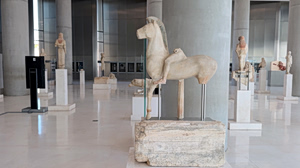
The same line of inquiry revives the question of who is depicted in a marble statue of a woman found in the ancient city in 2021. The figure is carved from Parian marble and wears a chiton and himation. She may be the statue of Epione that Pausanias describes in the precinct of the god of medicine, but that possibility has not been confirmed.
The story of the ancient city is closely bound up with the great Asklepieion outside the urban core, where research has also shed new light on the origins and development of the cult. Beneath the Tholos, excavators have uncovered an Archaic building dating to the late 7th century BC. That is roughly six decades earlier than the date previously thought to mark the beginning of the worship of Asclepius.
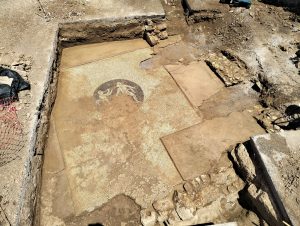
The building had a peristyle ground floor and an underground chamber cut into the natural bedrock. Its walls were covered with a thick coat of deep red plaster, and its floor still has a pebble mosaic, one of the best-preserved early examples of the form in Greece. Its layout, its westward orientation and the descent to the underground chamber all support the view that it was a cult building linked to the chthonic, or underworld, nature of Asclepius, built long before the later Tholos.
Building K
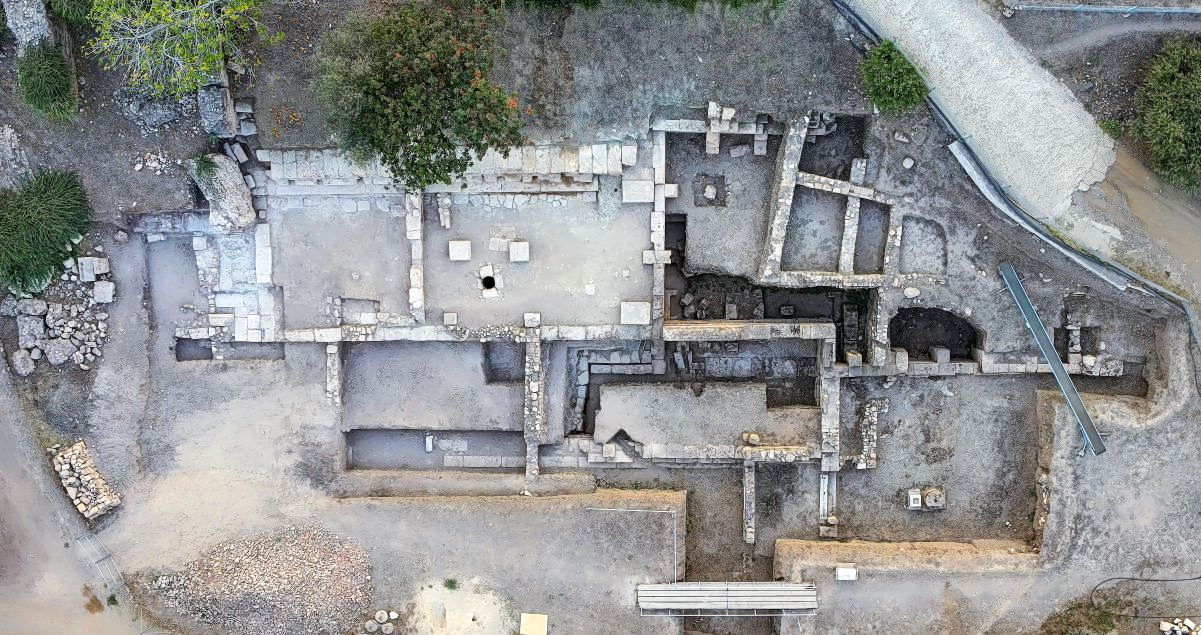
Work at the sanctuary has also produced finds at Building K, where excavators have uncovered a large complex with successive building phases running from the Hellenistic period to late Roman times.
One feature stands out: an underground chamber the excavators call “the Crypt.”
The chamber has a three-part layout, reused architectural elements and openings that let the midday sun shine inside. The lower parts of four amphorae were found set into the natural ground. Together, these features have led to the hypothesis that the space may have been used for mystery cults during the late Imperial period, though its purpose has not been firmly established.
The finds are part of a University of Athens research program that has been studying the Asklepieion systematically since 2015 and, has extended its work to the ancient city. The project is led by Vassilis Lambrinoudakis, University of Athens associate professor Stelios Katakis, and the Ephorate of Antiquities of Argolida, represented by its director, Grigoris Grigorakakis.