The Posidonia International Shipping Exhibition is not merely the largest maritime event held in Greece. It is the global meeting point for an industry that is transforming rapidly and being called upon to simultaneously respond to new and constantly shifting economic conditions, geopolitical crises, energy challenges, and technological changes. It is the space where shipping meets its future, and where Greece reaffirms, once again, its role as a leading maritime power in the world.
In a period of intense international instability, shipping becomes even more critical. Developments in the Middle East, instability in the Red Sea, attacks on crucial maritime routes, and the uncertainty surrounding the Strait of Hormuz demonstrate that the freedom of navigation is directly linked to energy security, the functioning of supply chains, the prices of energy and goods, and, ultimately, the daily lives of millions of ordinary people. It is a crisis that, above all, reminds us of the value of human life and the need to protect our seafarers, who work under exceptionally difficult and often dangerous conditions.
Currently, a massive percentage of the world’s energy supply passes through the Strait of Hormuz. The longer this uncertainty is prolonged, the greater the risks to the global economy and social stability. No one can predict when these crises will end, nor what their full impact will be on economy and societies around the world. What we do know, however, is that the international community must guarantee the protection of the freedom of navigation, the safety of crews, and the unhindered operation of international maritime routes, on the basis of the International Law of the Sea and the decisions of the International Maritime Organization.
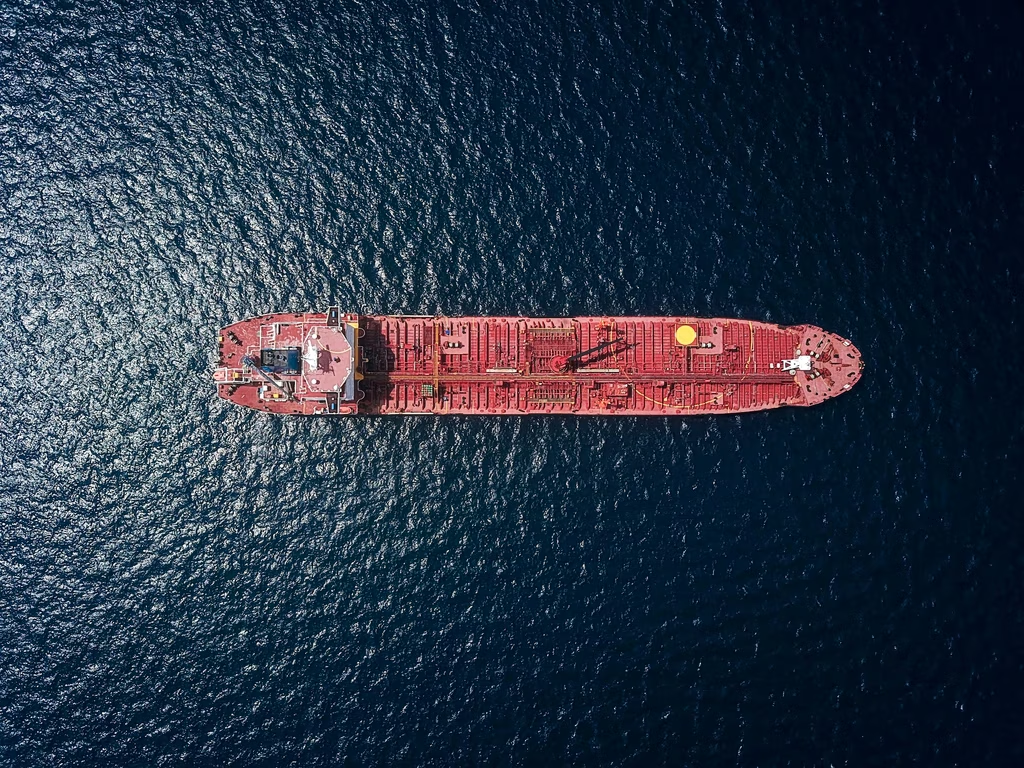
Within this complex environment, Greek shipping continues to serve as a pillar of stability and growth. Greece remains one of the most powerful maritime forces globally, with the Greek-owned fleet accounting for approximately 20% of global capacity and over 60% of the European Union’s fleet. It holds a prominent position in the transport of energy and bulk commodities, utilizing modern vessels that far exceed all and every international maritime requirement. It is a strategic national asset that supports not only the Greek economy, but also the functioning of global trade. Greek shipowners and the Greek maritime community as a whole command respect internationally, because they have consistently invested in quality, reliability, and shipping’s long-term prospects.
In this context, the green transition and the decarbonization of shipping constitute a common goal and an essential priority. No one doubts the need to take measures to ensure a cleaner planet. However, especially in the case of shipping, we cannot ignore the need to maintain the competitiveness of a sector that is of strategic importance to Europe’s economy, energy security, and overall resilience—a reality demonstrated daily by the ongoing crises in global shipping lanes.
The transition must be executed with realism, technological neutrality, and a regard for international competition. This necessity is already—and rightfully—recognized within the EU in the case of other productive sectors, including transport.
This same principle must now be applied to shipping, too. Today, available alternative fuels cover a mere 0.5% of global shipping demand, while the sector is responsible for approximately 3% of global emissions. Therefore, an abrupt and unrealistic transition, embarked on with insufficient technological maturity and infrastructure, will inevitably lead to increased transport costs, new inflationary pressures, and a further burden on the average European family–which is already under pressure from the high cost of living and the energy crisis. This is why Greece insists that the discussions underway at the International Maritime Organization must maintain a substantial balance between environmental ambition, shipping competitiveness, and the protection of social cohesion—namely, the income of the average European household.
At the same time, shipping is entering a new digital era. Artificial intelligence, automation, “smartports,” cybersecurity, and new digital applications are already bringing a new global maritime ecosystem into being. Greece cannot sit on the sidelines simply observing these developments. Our goal is to create a modern, flexible, and competitive maritime environment with less bureaucracy, stronger digital services, and better services for seafarers, businesses, and island communities.
However, the greatest strength of Greek shipping remains its people: the Greek seafarers—men and women—who keep the Greek flag flying high in every sea across the globe. This is why we are investing substantially in maritime education, increasing the budget for the next seven years by 25% with additional resources amounting to 90 million euros. Our goal is to create modern educational conditions and bring younger generations back to the maritime professions. For Greece, the sea is not just a tradition; it is a professional prospect and an opportunity to create well-paid jobs in an industry with global momentum.
Greek shipping is about more than just numbers and economic indicators. It is a fundamental element of our historical and national identity. It serves as proof that Greece can play a leading role on the international stage through knowledge, an outward-looking approach, adaptability, and the strength of its people. And in an era of profound realignments, our country has a duty not merely to observe developments, but to actively participate in shaping them, with a clear plan, self-confidence, and a strategic vision for the future of shipping and of Europe.
Mr. Vassilis Kikilias is the Minister for Maritime Affairs and Insular Policy.