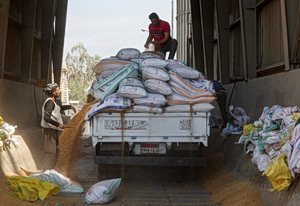
International markets are showing serious concern over escalating attacks on ships, ports, and terminals in the Black Sea, as disruptions to grain exports from Russia and Ukraine could trigger a new shock to global food prices.
The two countries rank among the world’s most important wheat suppliers, together covering roughly 30% of the global market. Russia is the world’s largest grain exporter, while Ukraine ranks fifth. Any prolonged disruption to their ports directly affects the availability and prices of key agricultural products.
Benchmark wheat futures have already moved close to three-year highs, as traders react to growing disruptions to export activity, including attacks on Ukraine’s largest port on the Danube and on Russia’s Black Sea terminals at Novorossiysk over the past two weeks.
The impact on grain
Analysts say the impact on the wheat market will be worse than the closure of the Strait of Hormuz was for crude oil. “The longer this continues, the bigger the consequences we’ll see,” sources told the Financial Times, given there are no signs of de-escalation in Russia’s war in Ukraine.
According to estimates, disruptions in the Black Sea and Sea of Azov basin could affect up to 86 million tons of exports this year, equivalent to 17% of global grain trade, according to Oxford Economics, with 52 million tons of Russian exports and 34 million tons of Ukrainian exports affected.
SovEcon, a research firm focused on Black Sea agricultural markets, said alternative export routes for Ukraine via rail and the Danube River would replace only around 17 million tons, even with additional capacity added to those routes.
Bad timing
The timing is considered especially unfavorable, since August marks peak season for moving the new harvest. The winter wheat harvest has progressed significantly, but producers and trading companies are struggling to get their goods to ports and secure ships to transport them.
Ukrainian grain exports this month have fallen roughly 75% compared to last year, according to government data. Meanwhile, Russian shipments are expected to be limited to 2.2 million tons, down from around 4.6 million tons in August 2025, with most shipments now moving through routes outside the Sea of Azov and Black Sea.
Export capacity from Russian ports in the region has been dramatically curtailed, as many key terminals have halted operations.
Pressure on grain markets
Rising wheat prices are adding pressure on agricultural products already strained by widespread drought, El Niño-related disruptions, and fertilizer shortages stemming from the war in Iran, raising fears that the latest escalation could drive a broader rise in global food prices.
Economists expect global food prices to rise 11.8% this year and 4.8% in 2027.
Grain prices soared to record highs after Russia’s 2022 invasion of Ukraine, but eased following a UN-brokered Black Sea grain initiative that allowed ships to pass freely. After that deal collapsed in July 2023, Ukraine developed new export routes along the Black Sea coast to Romania’s Constanta port and along the Danube.
This summer’s excessive heat and low rainfall, however, have lowered water levels on the Danube, reducing the number of cargo ships that can pass and driving up transport costs.
Despite the rise in wheat futures, analysts warn the market may be underestimating the risk of a prolonged crisis. Since 2022, the prevailing view has been that Black Sea disruptions are temporary and eventually resolve. But if attacks continue or expand, the resulting supply shortfall could prove far larger than what’s currently reflected in prices.