The global tourism market is expanding fast- but so are the pressures reshaping it. Climate change is driving more extreme heat, water stress and insurance risks, all of which increase operating costs for hotels and destinations. At the same time, reactions against overtourism are intensifying across popular hotspots, prompting experts to warn that better management is urgently needed.
Meanwhile, efforts to cut greenhouse gas emissions are forcing every part of the travel value chain, including hotels, to reassess how they operate. Travelers often say they want more sustainable options, yet their choices do not always match their stated preferences, leaving hotels uncertain about how to respond.
Against this backdrop, To Vima International Edition speaks with Inge Huijbrechts, Chief Sustainability & Security Officer at Radisson Hotel Group, about how the company is developing its framework for Net Zero hotels, what verified low-carbon operations look like in practice, opportunities for Greece, and how sustainability and security are becoming intertwined across Radisson’s global portfolio.
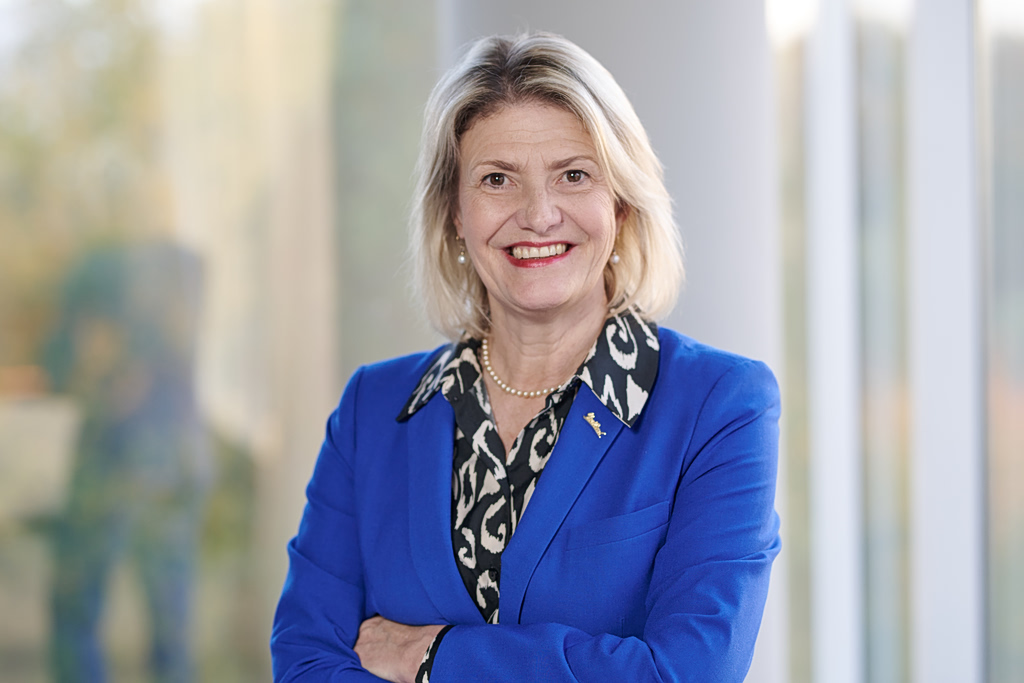
Inge Huijbrechts, Chief Sustainability & Security Officer at Radisson Hotel Group
Q: Founded in 1962 Radisson Hotel Group is one of the world’s largest hotel groups with ten distinctive hotel brands, and more than 1,580 hotels in operation and under development in 100+ countries. How has Radisson’s approach to sustainability evolved over the years, and what is your role in it?
A: Our sustainability program goes way back. We have Scandinavian origins, so there was early awareness of environmental issues. We had an environmental policy in 1989, which is quite remarkable for the hotel industry.
Since then, we’ve built a program with a classical focus on three areas: people, community and planet. Over time, the real game changer has been adopting science-based targets. These targets are part of the Science Based Targets Initiative (SBTi), which is a global standard-setter that helps companies set verified, science-based emissions-reduction targets aligned with the Paris Agreement.
Just before COVID, we had our near-term targets approved by the SBTi, and during the COVID period we had our long-term Net Zero targets (by 2050) approved. Under the SBTi model, to reach Net Zero a company has to reduce greenhouse gas emissions as much as possible across all operations and the value chain, and then neutralize the small amount (max 10%) that remains through credible carbon compensation, so that overall climate impact is effectively zero.
SBTi and Net Zero efforts really shifted the conversation inside the company and made clear the scale of transformation we need.
Sustainability is now embedded in our strategic transformation plan, which began in 2017 with a new brand architecture and even a new company name, Radisson Hotel Group. We focus on: decarbonizing our business, green buildings – certified green hotel properties, green energy and green operations.
Internally, we talk about “green energy,” meaning renewable energy, and “green operations,” which is a focus on good habits to use less resources – energy – water, and produce less waste. Through these efforts we have reduced our carbon footprint intensity (emissions per square meter of hotel space)by about 33% since 2019. That’s good progress, but we know we need to accelerate and scale up.
A core part of our strategy is to integrate sustainability into the guest value proposition. Guests need to know they’re staying in a more sustainable hotel and understand what actions the hotel is taking. That has always been our approach, and it guides our efforts to pioneer Verified Net Zero hotels.
We now have two verified Net Zero hotels. They showcase the maximum we can currently do on Scope 1 [direct], Scope 2 [indirect] and operational Scope 3 [indirect across the value chain] emissions. Everything is verified by a third party and fully transparent. We track how the market responds: Does it create a revenue uplift? Does it increase guest recognition and satisfaction? So far, it does.
In these efforts, my role is essentially about two things: getting the fundamentals right and pushing decarbonization at speed and scale, and using pioneering projects like Net Zero hotels to create market pull and revenue opportunities.
Alongside that, I also lead safety and security for the group.
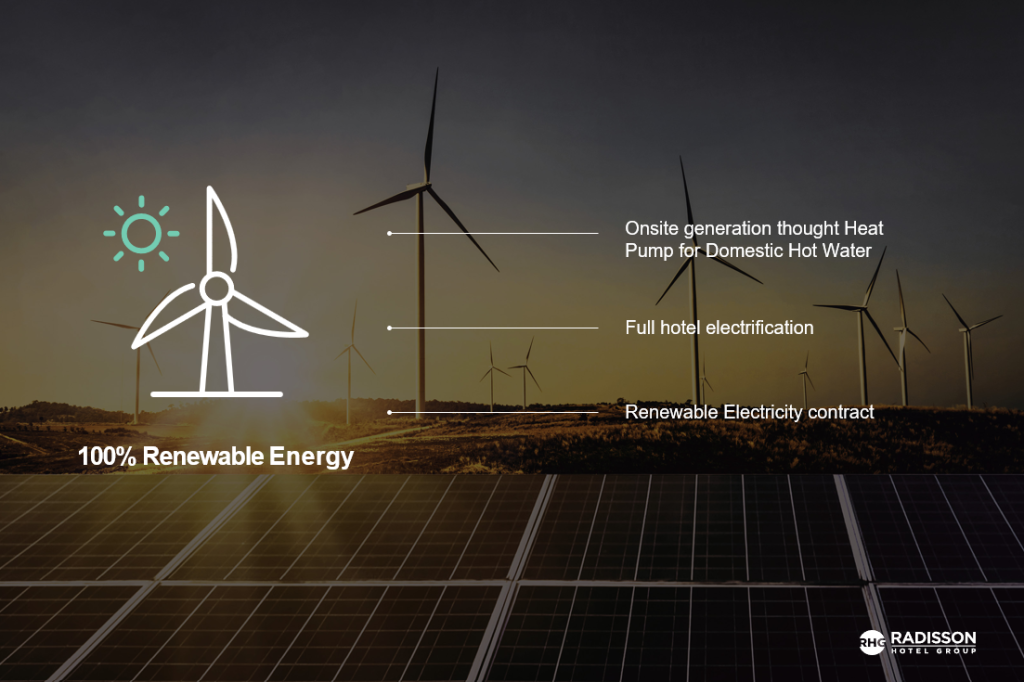
An imagine depicting Radisson’s energy mix, which reduces emissions
Q: What are the biggest obstacles you face in delivering on your SBTi targets?
A: There are a few.
The first is how our targets are composed. We are an asset-light company. A large part of our portfolio is franchised hotels, which fall under Scope 3. That’s straightforward.
But we also have many managed hotels. These are hotels where we don’t have full P&L control or investment control. Still, they are counted under Scope 1 and 2 for us. That gives us decarbonization responsibility in places where we don’t control the capex or all operational decisions. That’s a challenge, and it’s not unique to Radisson; it’s an industry-wide issue that needs ongoing discussion as standards evolve.
The second challenge is the spread and variation. Radisson Hotel Group is active in about 100 countries, with one thousand hotels in operation and almost 600 more in the pipeline over the next two to three years. Consumption, regulation and options for climate change mitigation action is highly fragmented because of different ownership structures and local markets.
If you want to move to renewable energy contracts, the volume per hotel or per owner is not always attractive for developers or utilities. Matching a fragmented portfolio with the renewables market is difficult. We spend a lot of time finding creative mechanisms.
For example, in India there is a mechanism called Group Captive for purchasing renewable energy. It was designed for industrial sites and hard-to-abate sectors. We used a new regulation to make it work for a hotel, showing what is possible. But because regulations and subsidies vary state by state, you cannot automatically replicate it everywhere. You prove the concept, but it doesn’t always open the door to fast acceleration across the whole portfolio.
What we hope will scale is our Verified Net Zero hotel model, which we want to turn into a cross-brand program. We want more new hotels to aim for Verified Net Zero status and attract asset owners and franchisees who see that it can generate additional revenue by attracting clients — especially in the B2B segment — who care about sustainable travel.

An image of a low-carbon menu, by Radisson hotels
Q: You also oversee security at Radisson. How do sustainability and security interact?
A: I came from the sustainability field and took on operational safety and security about seven years ago. It took a while to realize how closely the two are connected. There is a real resilience nexus.
Safety and security are about keeping people, assets and reputation safe- with people always coming first. We are a people business. That’s what we train for in crisis and incident management: people first.
If you are a responsible player in your local community, you earn a license to operate. The community is more likely to accept and protect you in times of protests or local turmoil. We see this in many locations.
The reverse is also true: focusing on safety and security can benefit communities. If we keep our team members and their families safe, that has a wider positive impact.
We operate around the globe. In some places our hotel may be the only international brand in that location. So it is vital that teams are always engaged on both safety and security and sustainability. The way we build awareness, engage staff and run champion programs is very similar for both fields.
So while sustainability and security may sound like separate domains, in practice they are deeply interconnected through resilience.
Q: What exactly is a Net Zero hotel, and how is it verified?
A: Our Verified Net Zero hotels are unique in three ways.
First off, the scope. We include Scope 1 and 2 emissions- the energy used by the building- which we reduce to zero, as well as operational Scope 3, which covers things like laundry, waste management, and food and beverage. Everything operational that the guest experiences is counted.
Secondly, we use the Net Zero Methodology for Hotels, an industry-defined framework based on SBTi but tailored to hospitality. It explains how hotels can achieve Net Zero in practice. We are already implementing the 2040 requirements of that methodology today.
And thirdly, verification. We have the entire approach- our targets, measurements and methodology- verified by a third party, TÜV Rheinland. That provides full transparency and independent assurance that these are genuinely Verified Net Zero hotels.
In practice, we eliminate Scope 1 and 2 emissions, significantly reduce Scope 3 emissions, and then neutralize the remainder with credible carbon removal credits.

An image of heat pumps, used by Radisson to reduce emissions.
Q: How is carbon removal different from the carbon compensation you’ve done in the past?
A: We’ve been working with carbon compensation for a long time. Since 2018, we’ve compensated all the carbon footprint of our meetings and events worldwide. Those are avoidance credits- from renewable energy projects, biogas, cookstove projects or reforestation.
For Verified Net Zero hotels, we wanted two things: to move into carbon removals, not just avoidance, and to choose projects closer to our hotels, as part of a 360-degree approach.
We partnered with Agreena, which runs large soil carbon and regenerative agriculture projects in Europe on a total surface of 4.5 million hectares of farmland (a surface bigger than the country of Denmark). They work with farms in several countries. For example, the farms linked to our projects in the U.K. are not far from Manchester, and for Oslo the farms are in Denmark.
The idea is to increase the carbon absorption capacity of soils by using regenerative agriculture practices. That is where our removal credits come from, and it fits into our broader ecosystem of partners working with us on low-carbon menus, food waste and waste management.
Q: What does all this mean for Greece, a country facing both overtourism and climate stress?
A: I’m not an expert on the Greek hotel market overall, but Radisson currently has around 10 hotels in Greece, open or in development. It’s still a relatively small portfolio for us, but it’s growing, and it’s a mix of resorts and city hotels.
Across our global portfolio, we are introducing a “Verified Net Zero readiness” tool. Once it’s fully rolled out, any hotel in our system — franchise, managed or leased — will be able to assess how close it is to Net Zero.
For the hotels where we have the most control, we’ve already analyzed about 80 properties and know their readiness level. We’re seeing encouraging results from the first Verified Net Zero hotels: higher revenue per available room, potential savings on food costs through low-carbon menu design, and very strong guest awareness. Over 70% of guests say they understand they are in a verified Net Zero hotel, and over 25% say it influenced their booking decision.
For Greece specifically, it would be fantastic to include a resort in the Net Zero program. Resorts typically have more space for on-site renewables than urban business hotels.
We are also active in industry networks like the World Sustainable Hospitality Alliance and the Global Sustainable Tourism Council. We share best practices openly. The methodology for Net Zero hotels is publicly available. I always say: there is no competition in saving the planet.

Image of regenerative farming. Photo by Abdullah Öğük
Q: Are tourists willing to pay more to stay at a Net Zero hotel?
A: For me, it’s not about charging more money for sustainability.
What we see is that Net Zero hotels create more attraction. If you bring in more guests, dynamic pricing and better market positioning will naturally lead to higher revenue. But it’s not about putting a higher price tag on sustainability itself.
I don’t believe in charging more for sustainable choices. I believe in the opposite: people who choose sustainable options should not pay more; people who choose less sustainable options should pay more.
For Radisson, the opportunity to establish Net Zero hotels in Greece is definitely there. The question is whether owners are interested in working with us on this journey.