European finance ministers left Brussels on Monday with a sobering conclusion: the Middle East conflict is already inflicting measurable damage on the European economy, and the pressure is unlikely to ease soon.
A darkening outlook
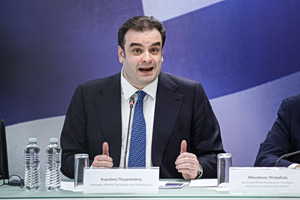
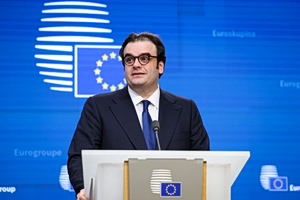
Eurogroup President and Greek Finance Minister Kyriakos Pierrakakis opened his post-meeting remarks with a blunt acknowledgment that hopes for a swift resolution to the conflict had not materialized. With oil above $125 a barrel, inflation back at 3% across the eurozone, and growth forecasts being revised downward, the question dominating Monday’s meeting was how governments should respond and how to avoid repeating the costly mistakes of 2022.
“Expectations for a rapid normalization of the crisis have not been confirmed,” Pierrakakis said. “This is the difficult reality we are facing, and we must address it with realism and responsibility.” He warned specifically that a prolonged closure of the Strait of Hormuz remained a scenario that European governments had to plan for explicitly, one that could further slow economic activity across the continent.
EU Economy Commissioner Valdis Dombrovskis was equally direct, describing what Europe now faces as a “stagflationary shock.” Energy prices are up 10.9% year-on-year, dragging headline inflation to 3%, while growth projections are moving in the opposite direction. “Higher energy prices affect every aspect of the European economy: businesses and households alike,” he said. The Commission’s spring economic forecasts, due later this month, would provide a fuller picture, he added, cautioning that “the overall outlook remains extremely uncertain.”
The 2022 lesson
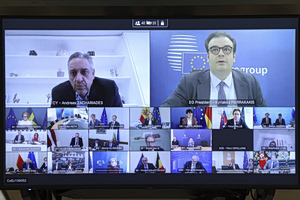
The Eurogroup met in inclusive format, with finance ministers from all 27 EU member states, to assess the impact of the conflict. Oya Celasun, Deputy Director of the IMF’s European Department also participated in the meeting. The discussion produced an uncomfortable reckoning with how Europe handled the last major energy crisis.
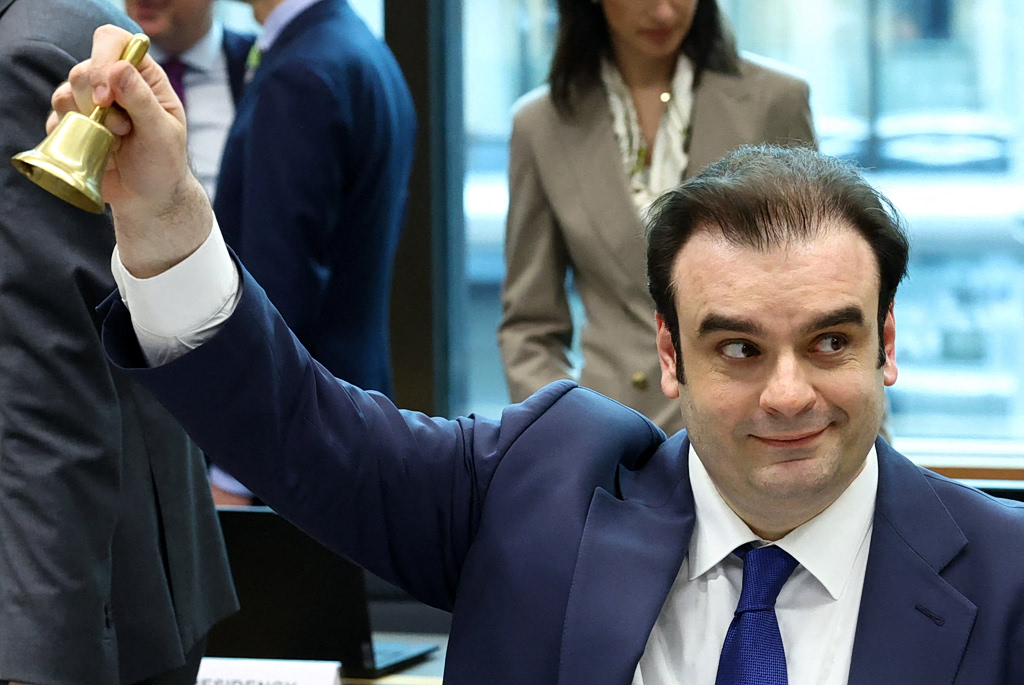
Eurogroup President Kyriakos Pierrakakis rings the bell at the start of a Eurozone Finance Ministers meeting in Brussels, Belgium, May 4, 2026. REUTERS/Yves Herman
Pierrakakis cited IMF findings showing that roughly 70% of the support measures rolled out in 2022 were either poorly targeted, distorted energy prices, or both. The distributional consequences of a repeat performance would be significant. IMF data cited by Pierrakakis shows that poorly designed electricity subsidies deliver three times as much benefit to the wealthiest fifth of the population as to the poorest. For transport fuel subsidies, the gap is even wider: the richest households capture 34% of the benefit; the poorest, just 9%.
“When measures are not targeted, they ultimately benefit the rich far more than the poor,” Pierrakakis said, calling it “an important policy lesson.” Support measures, he insisted, must be temporary, targeted, consistent with agreed fiscal rules, and aligned with the green transition. “Maintaining this balance is not easy,” he acknowledged, “but it is absolutely necessary.”
Dombrovskis echoed the warning. “We cannot repeat the mistakes of the past,” he said, noting that fiscal space is already constrained by higher deficits, elevated interest rates, and mounting defense spending.
A more resilient Europe. But not immune
Both officials were careful to note that Europe enters this crisis from a stronger position than it did in 2022, when it was still heavily dependent on Russian gas. Since then, the bloc has diversified its energy supplies and accelerated the buildout of renewables. The IMF credited those shifts with delivering a 12% reduction in household energy costs over the past five years. Still, the benefits are unevenly distributed: net energy importers and countries with limited fiscal room face disproportionate pressure, making European coordination, in Pierrakakis’s words, “an essential prerequisite.” The Commission’s “AccelerateEU” plan, investing in electricity interconnections and clean energy infrastructure, was cited as a key part of the longer-term response. “Current developments show that we must accelerate,” he said.
Markets and financial stability
Pierre Gramegna, head of the European Stability Mechanism, warned that market optimism in recent weeks had outrun the underlying reality. Progress toward reopening the Strait of Hormuz had stalled, sovereign bond spreads in the eurozone were widening again, and the risk of a sharper market repricing remained ever-present. “Even if the conflict is resolved soon,” he cautioned, “its economic consequences will last longer than the conflict itself.”
On the banking side, the heads of the Single Supervisory Mechanism and the Single Resolution Board confirmed the European banking sector remains sound. Pierrakakis nonetheless flagged that rapid advances in artificial intelligence could soon pose challenges of a “potentially systemic nature” to financial stability — a discussion the Eurogroup formally opened at Monday’s meeting. Cross-border banking consolidation was also on the agenda, with Pierrakakis arguing that a more integrated European banking sector would deliver greater stability and more choice for consumers, a topic the Eurogroup will revisit following a forthcoming European Commission report.