The Greek government is preparing a major overhaul of its Golden Visa program as part of a broader push to address the country’s housing crisis. The plan is part of the National Strategy for Housing Policy 2026 to 2035, which was approved by the Government Committee on Housing Policy and published in the Government Gazette. It sets out 50 measures with a combined budget of more than 6.5 billion euros.
A new visa category tied to long term rentals
Among the changes is a new Golden Visa category linked exclusively to long term leasing. The Golden Visa program grants residence permits to non EU nationals who invest in Greek real estate above set thresholds.
Under the planned category, investors will be able to acquire a portfolio of more than one property rather than putting their money into a single unit. The properties must be used exclusively for long term rental, with short term leasing explicitly excluded and a monitoring mechanism put in place to track how they are used.
The idea is to tie the investment directly to boosting the supply of available housing and reducing the number of vacant or idle properties.
Market sources say foreign investors are likely to be drawn to listed buildings, as well as properties that can be converted to residential use, which are currently selling at attractive prices.
Investment thresholds vary by region
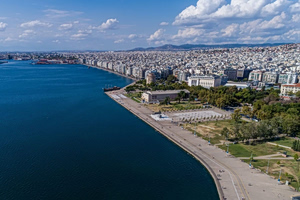
The entry threshold for these properties is 250,000 euros. In Attica, Thessaloniki, Mykonos, Santorini and islands with more than 3,100 residents, the threshold rises to 800,000 euros. In all other areas it stands at 400,000 euros.
Separately, converting office buildings, abandoned shopping centers and industrial buildings into rental apartments is being pursued as a direct route to easing the housing shortage.
Application numbers still concentrated at lower thresholds
According to Greece’s Ministry of Migration and Asylum, 2,551 new applications for an initial residence permit were submitted in the first half of 2026. Most of these applications involve investments of 250,000 euros or less than 400,000 euros, while very few reach the 800,000 euro threshold that applies to Attica, Thessaloniki and the country’s largest islands.
Most buyers want a home, not a visa
Only 7 percent of foreign investors say their main reason for buying property is to secure a residence permit through the Golden Visa program, according to figures cited in the strategy. That is partly because current rules bar Golden Visa holders from renting out their properties on short term platforms.
Greece has instead become a magnet for buyers looking to relocate permanently. Almost one in three foreign buyers, or 30.8 percent, is searching for a home in Greece with the aim of permanent settlement.
Giorgos Gavriilidis, chief executive of the real estate agency Elxis, At Home In Greece, said that share of demand comes mainly from retirees.
“That 30.8 percent of demand comes mainly from people, chiefly retirees, who want to acquire a permanent home in Greece,” Gavriilidis said. “It’s a significant share, and a particularly positive trend, since these investments carry high added value. They are not limited to the property purchase itself. These buyers go on to contribute to the local economy as new residents.”
What are foreign buyers looking for?
Gavriilidis said that preference for permanent relocation helps explain why 71.7 percent of foreign buyers want a newly built home or a property they can move into right away. Villas are in particularly high demand, sought by 68.2 percent of buyers, while only 17.2 percent are interested in apartments. Most foreign buyers have a budget of between 320,000 and 340,000 euros, he added.
Elxis attributes some of the rise in permanent relocation to a tax incentive scheme introduced in recent years for retirees moving their tax residence to Greece. Those who qualify pay income tax at a flat rate of just 7 percent for 15 years.
To qualify, applicants need a double taxation treaty between Greece and the country paying their pension, and must spend at least 183 days a year in Greece. They must also not have been Greek tax residents for five of the six years before the move.
Even so, the largest single group of foreign buyers, 44.4 percent, is still looking for a vacation home, while another 17.8 percent is buying mainly for investment purposes. Only 7 percent cite the residence permit itself as their main motivation, reflecting the restrictions now placed on Golden Visa investors regarding short term rentals.
In 2026, the strongest demand has come from the United States, the Netherlands, Germany and England, followed by Belgium and France. Buyers from Australia, many of them members of the Greek diaspora, have shown a notable rise in interest this year, with demand roughly doubling compared to last year.
There are also regional differences within Greece. English buyers show a particular preference for the Ionian Islands, an area that draws far less interest from American buyers. Crete remains the most sought after region overall, accounting for 42.9 percent of demand, followed by the Peloponnese at 22.9 percent and the Ionian Islands at 12.7 percent.
Source: OT.gr