Greece has recorded the highest average weekly working hours in the European Union, outpacing the EU average by nearly four hours, according to Eurostat data for 2025. The figures come even before the implementation of the new labor law introducing the 13-hour workday in early 2026 — legislation that grants greater flexibility to businesses while potentially exposing employees to even longer schedules.
Data covering both full-time and part-time employment among people aged 20 to 64 show that workers in Greece averaged 39.6 actual working hours per week in 2025, compared with the EU average of 35.9 hours. At the other end of the scale, employees in the Netherlands worked just 31.9 hours on average — nearly eight fewer hours per week than Greek workers.
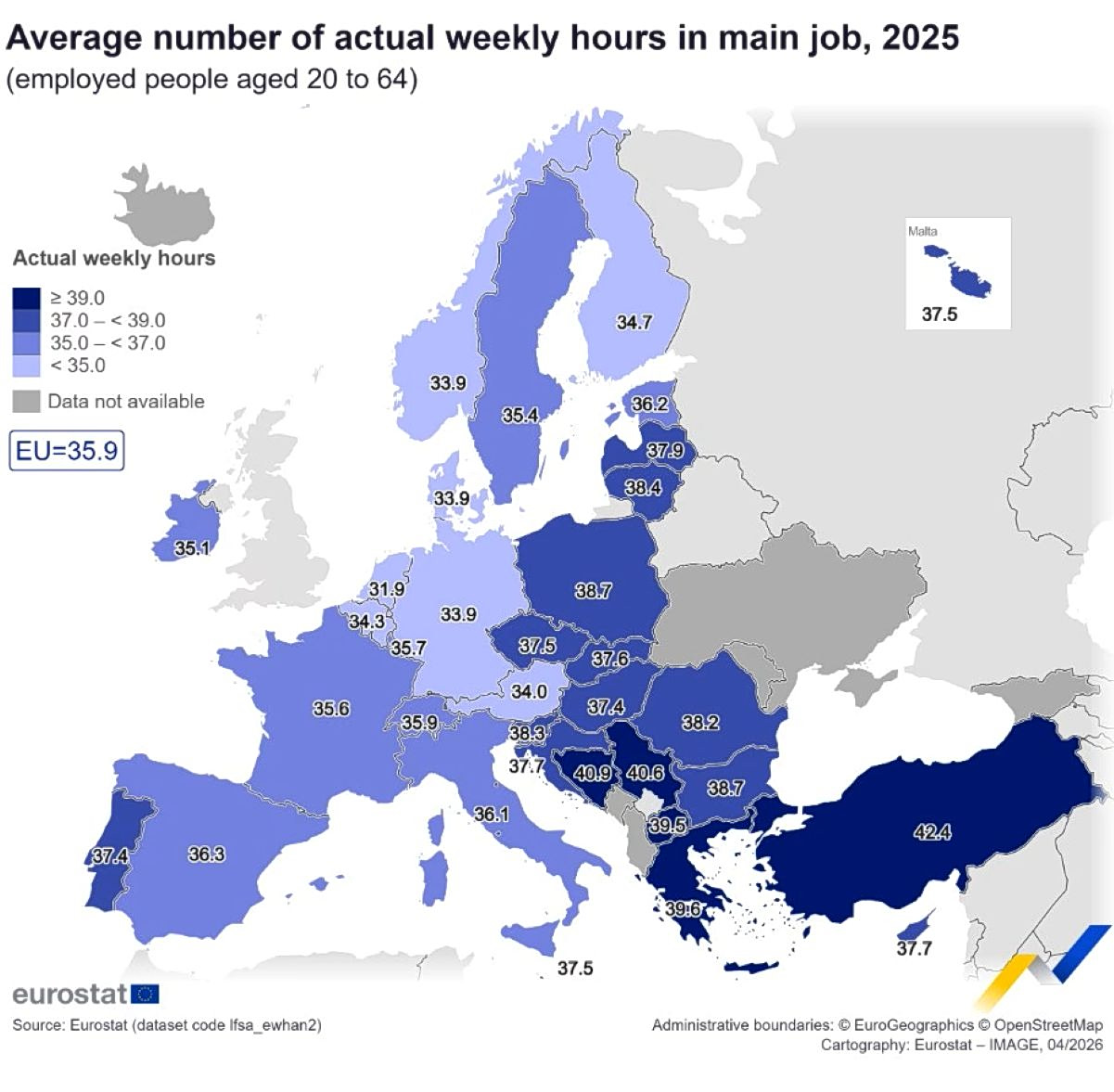
The figures also highlight a broader European trend toward shorter working weeks. Compared with 2015, the EU average has fallen by one hour, reflecting a gradual reduction in working time across the bloc. Alongside the Netherlands, the shortest average workweeks were recorded in Denmark and Germany (33.9 hours each), followed closely by Austria (34.0 hours).
Despite this shift, Greece remains at the top of the rankings, ahead of Bulgaria and Poland (both 38.7 hours) and Lithuania (38.4 hours). Eurostat notes that the data refer to actual hours worked during the survey week rather than standard contractual hours, with considerable differences observed between member states, professions, genders and employment categories.
In Greece, men in full-time employment worked an average of 41.8 hours per week in 2025 — one of the highest figures in Europe — while women worked 38.8 hours. Self-employed workers also reported significantly longer working hours than salaried employees.
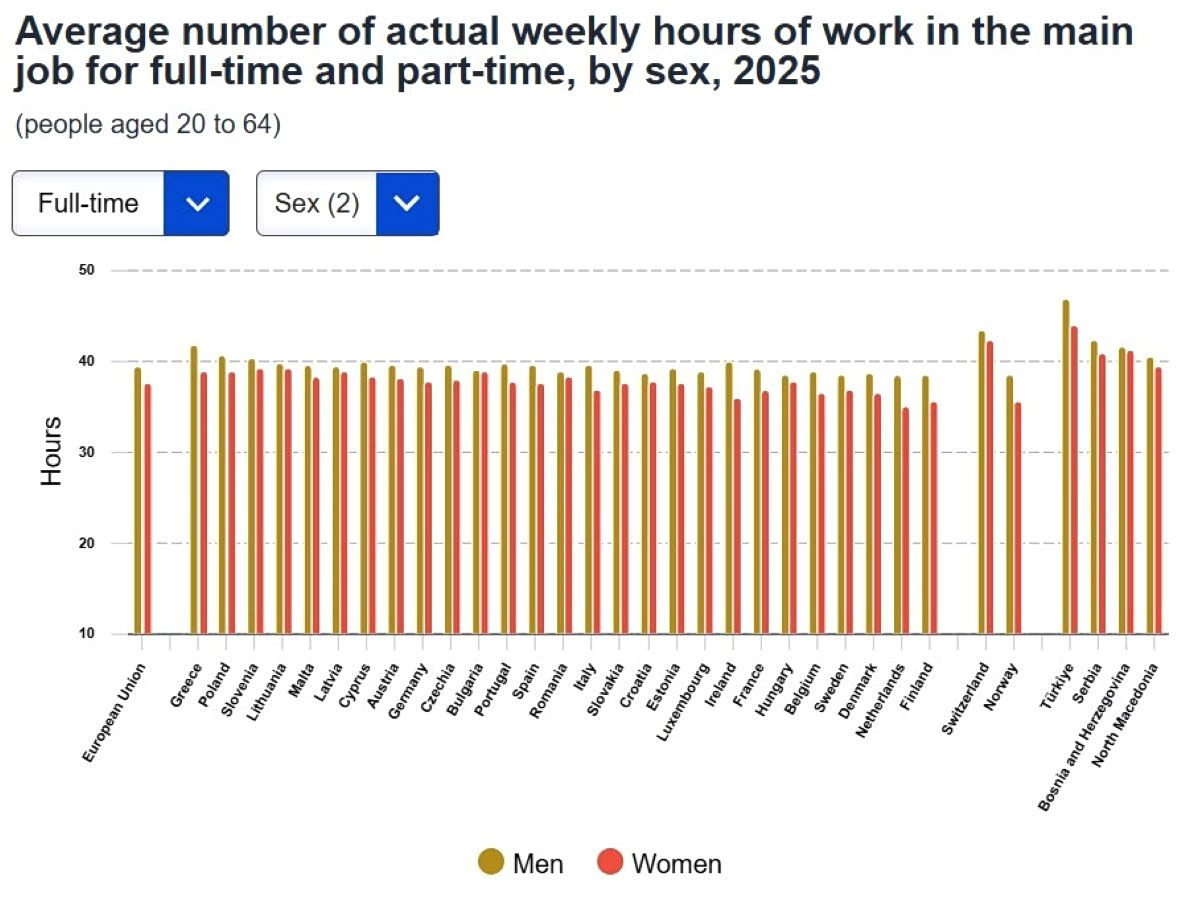
Across the EU, men working full-time averaged 39.4 hours per week, compared with 37.6 hours for women. Among women, the longest working weeks were recorded in Slovenia (39.2 hours), followed by Lithuania (39.1). The shortest female workweeks were observed in the Netherlands (35.0 hours), Finland (35.6), Ireland (35.9) and Belgium (36.4).
For men, only four EU countries recorded average working weeks of 40 hours or more: Greece (41.8 hours), Poland (40.6), Slovenia (40.2) and Cyprus (40.0). The shortest working weeks for men were found in Finland and the Netherlands (38.4 hours each), followed by Hungary and Sweden (38.5).