 Μake us preferred on Google
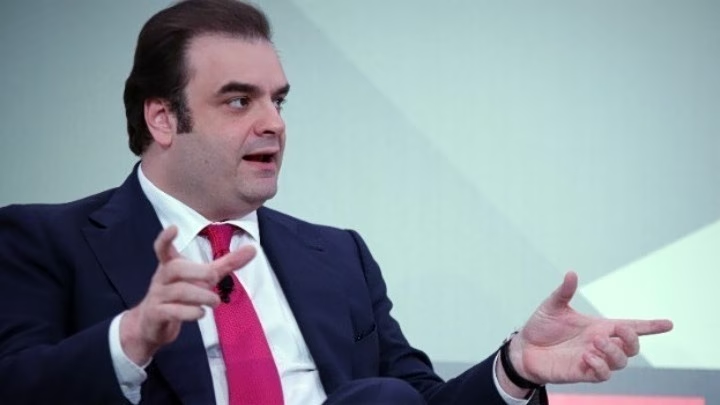
 Greece’s banking system is financially strong and well-positioned to drive the country’s next phase of economic growth, Finance Minister Kyriakos Pierrakakis said, urging lenders to make greater use of their available liquidity to support businesses and households.
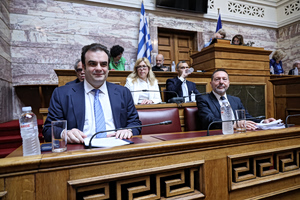
Speaking at the annual general assembly of the Hellenic Bank Association, Pierrakakis said the Greek banking sector has completed a long period of recovery following 15 years of economic crises.
“The Greek banking system is healthy today. It is well-capitalized, liquid and profitable,” he said, adding that banks have transformed from what was once considered one of the country’s biggest economic weaknesses into one of its strongest assets.
Banks should finance future growth
Pierrakakis said banks now have a rare opportunity not only to adapt to economic developments but to actively shape them by financing future investment.
He argued that banks are more than participants in the economy, describing them as catalysts capable of creating the conditions for sustainable growth.
“The long-term value of a bank is ultimately determined by the economy it finances,” he said, stressing that bank profitability and Greece’s economic growth will increasingly depend on one another.
Liquidity represents a major opportunity
The minister highlighted what he described as a significant lending opportunity for Greek banks.
According to Pierrakakis, Greek banks currently lend around €70 for every €100 in deposits, compared with a ratio close to €100 across the rest of the eurozone. He also noted that Greek banks’ loan portfolios, as a share of GDP, remain relatively low compared with many eurozone peers.
Rather than viewing this as a weakness, he said it demonstrates that substantial liquidity is available to finance future growth—an advantage that few European banking systems currently possess.
Pierrakakis also praised the success of IRIS, Greece’s instant payment system, saying the same spirit of innovation should now be applied to lending and financing. He pledged government support for initiatives aimed at expanding access to finance.
Rebuilding trust with society
The finance minister said banks’ relationship with society depends not only on major investments but also on everyday issues affecting customers.
He pointed to banking fees, returns for small depositors and access to services in areas where bank branches have closed as factors that shape public confidence.
“People will believe in the banks’ new role when they see it reflected in their own finances and in their local communities,” he said.
Bringing borrowers back into the economy
Pierrakakis also focused on borrowers whose loans are currently managed by loan servicing companies, saying millions of people and significant assets remain effectively excluded from normal economic activity.
He said many borrowers are unable to obtain new credit, while properties remain underutilized and small businesses cannot restart operations.
The minister outlined a three-part strategy involving the government, banks and loan servicers.
Under the plan, the government will continue strengthening the regulatory framework for loan servicers, banks should provide a pathway back into the financial system for borrowers who have successfully restructured and are servicing their debts, and servicers should offer sustainable restructuring solutions with greater transparency.
Measures to tackle private debt
Pierrakakis highlighted a series of government measures aimed at reducing private debt and helping borrowers return to economic activity.
These include expanding Greece’s out-of-court debt settlement mechanism by lowering the minimum eligible debt to €5,000 and accelerating procedures, while also strengthening protection for primary residences through the same framework.
The government has also increased the protected threshold for bank deposits subject to seizure to €1,600, introduced provisions allowing the lifting of account seizures for borrowers who comply with repayment agreements, activated a new 72-installment repayment scheme for older debts, and extended relief retroactively to more than 100,000 borrowers covered under Greece’s former Katseli Law.
Pierrakakis said the next decade should focus not only on stronger economic growth but also on ensuring that recovery benefits a broader share of society.
“Without inclusion, the recovery will remain incomplete,” he said, arguing that sustainable growth requires bringing more people back into the heart of the economy.