 Μake us preferred on Google
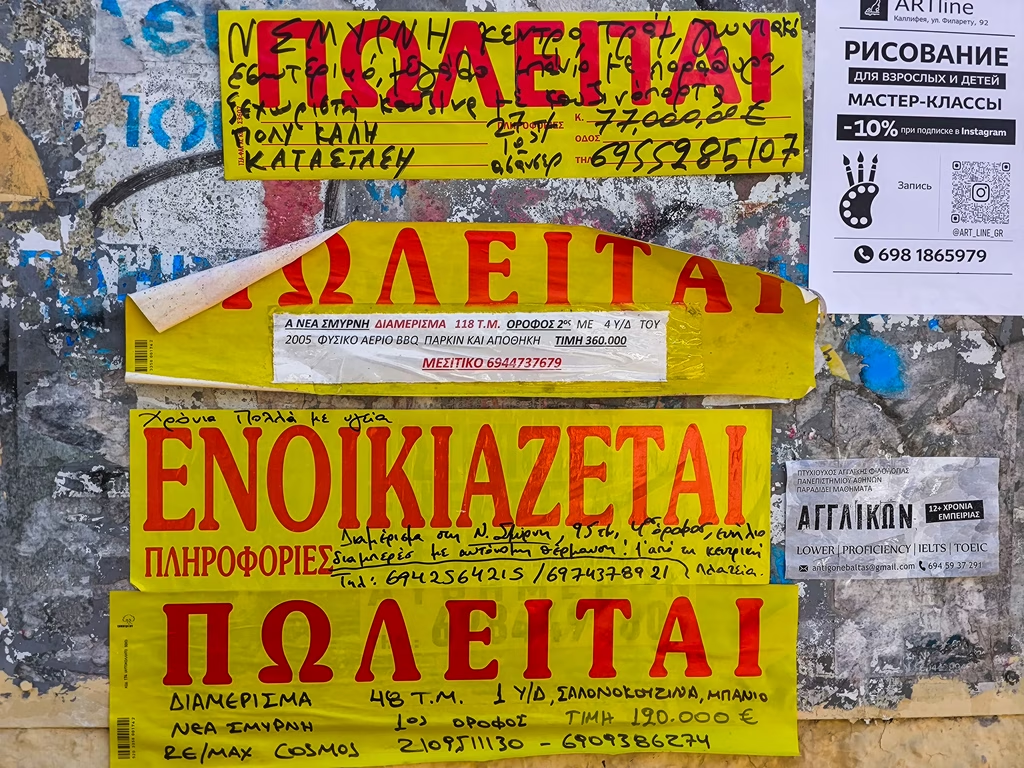
 Greece’s rental market continues to tighten, with rising housing costs reinforcing one of the country’s biggest economic and social challenges.
A study by the Centre for Liberal Studies (KEFiM) identifies the persistent imbalance between housing supply and demand as the main driver behind soaring rents, while new market data show that prices continue to climb in both Athens and Thessaloniki.
According to Eurostat, house prices across the European Union rose by 5.1% in the first quarter of 2026 compared with the same period a year earlier, while rents increased by 3%. Greece ranked among the three EU countries with the steepest annual rent increases at 5%, behind Croatia (21.9%) and Bulgaria (6.4%).
Rental prices continue to rise
Property platform Spitogatos reported that the average asking rent nationwide increased by 1.3% in the second quarter of 2026 compared with a year earlier. Although this marks a slower pace than last year’s 7.2% annual increase, rental prices remain on an upward trend.
In the Attica region, which includes Athens, average asking rents rose by 4.5% year-on-year, reflecting continued strong demand for rental housing.
Greece’s most expensive rental areas
The Cyclades islands remain Greece’s most expensive rental market, with an average asking rent of €14.4 per square meter.
They are followed by:
- Athens’ Southern Suburbs (€11.8/sq.m.)
- Central Athens (€11.8/sq.m.)
- Lefkada regional unit (€11.8/sq.m.)
- Athens’ Northern Suburbs (€11.8/sq.m.)
Halkidiki also recorded high asking rents, a trend linked to strong tourism activity and the widespread use of short-term holiday rentals.
At the other end of the market, the lowest average rents were recorded in Pella, followed by Kilkis, the rest of the Thessaloniki regional unit, Grevena, and Imathia.
Athens’ priciest neighborhoods
Athens’ Southern Suburbs continue to dominate the capital’s rental market.
Vouliagmeni remains the city’s most expensive area, with an average asking rent of €22 per square metre. It is followed by Kolonaki-Lycabettus, Palaio Psychiko, Voula, and Glyfada.
The lowest average rents in Attica were recorded in Agios Stefanos (€7.5/sq.m.), followed by Anoixi, Kamatero, Perama, and Paiania.
Meanwhile, Drapetsona posted the sharpest annual increase in asking rents, with prices jumping 29.1%, ahead of Ymittos, Penteli, Melissia, and Neo Psychiko.
Thessaloniki market remains strong
Thessaloniki’s rental market also continued to expand during the second quarter of 2026.
The highest asking rents were recorded jointly in Vardaris-Lachanokipoi and central Thessaloniki, both averaging €12 per square meter. They were followed by 40 Ekklisies-Evangelistria, Xirokrini-Panagia Faneromeni, and Triandria-Doxa-Kryoneri.
The fastest annual rent growth was recorded in Mygdonia, where asking rents increased by 25%, followed by Epanomi (23.3%) and Thermaikos (16.7%).
The lowest asking rents in the Thessaloniki area were found in Chortiatis (€4.9/sq.m.), followed by Mygdonia, Vasilika, Oreokastro, and Mikra.
The latest figures highlight that while rent growth has slowed compared with last year, housing affordability remains a major concern as demand continues to outpace supply across much of Greece.