Greece’s Public Power Corporation, known by its Greek acronym ΔΕΗ (DEI), has attracted orders exceeding €15 billion for its landmark share capital increase, with the order book oversubscribed within minutes of opening as global institutional investors competed for allocations in what market participants are calling one of the most significant energy financing transactions in southeastern Europe in years.
Banking sources described aggressive demand from large international funds, sovereign wealth funds, long-term institutional investors and portfolios seeking exposure to the energy transition, digital infrastructure and data centers. With the book covered many times over, the offering’s formal bookbuilding process has effectively become a formality — its purpose now is to map the full scope of demand and determine final allocations among investors.
A utility reinvented
Founded in 1950 as a state monopoly and still majority-owned indirectly by the Greek government, PPC spent decades as a conventional coal-and-gas utility. The company has since undergone a sweeping transformation, and the scale of investor interest in the share sale reflects how far that repositioning has advanced.
The offering is targeting gross proceeds of approximately €4 billion, with net proceeds estimated at around €3.88 billion after expenses. The capital will fund a portion of PPC’s €24.2 billion investment program for the 2026-2030 period, described in the offering prospectus as one of the largest capital expenditure plans ever presented by a listed Greek company.
The strategic plan spans renewables, flexible gas generation, energy storage, telecommunications, electric mobility and digital infrastructure. Analysts have noted that the breadth of the program effectively repositions PPC from a traditional electricity producer into a vertically integrated energy and technology conglomerate.
Where the money goes
Of the total €24 billion program, 69% will be directed at renewables, flexibility and storage assets; 19% at electricity distribution networks; 5% at data centers; and the remaining 7% at other investments.
Approximately €16.7 billion will flow into the group’s consolidated operations, covering solar, wind and hydroelectric projects, storage units and combined-cycle gas turbine plants across Greece, Romania and other Central and Eastern European markets.
PPC is targeting total installed capacity of 24.3 gigawatts by 2030, roughly double its current capacity of 12.4 GW. The company plans to expand beyond southeastern Europe into Hungary, Poland and Slovakia, through both acquisitions and organic growth.
Geographically, approximately 52% of capital will be deployed in Greece, 21% in Romania and the remaining 27% across Italy, Bulgaria, Croatia, Slovakia, Poland and Hungary.
A further €1.6 billion is earmarked for telecommunications, electric mobility and digitalization.
The data center play
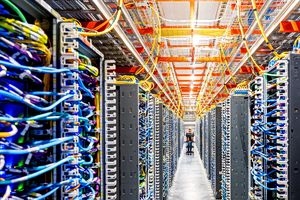
One of the offering’s most closely watched elements is a major data center project in Kozani, in the northern Greek region of Western Macedonia. The area was historically Greece’s coal heartland — home to lignite mines that powered the country for decades before a state-mandated phase-out accelerated their closure. PPC is now betting it can repurpose the region’s energy infrastructure and grid connectivity into a digital hub.
The first phase of the project involves a 300-megawatt data center facility requiring investment of approximately €1.2 billion, with full operational capacity targeted by the end of 2028. According to market sources, PPC is in advanced discussions with three hyperscalers — large cloud computing operators such as those in the tier of Amazon Web Services, Microsoft Azure or Google Cloud — about anchor tenancies, with the aim of positioning Western Macedonia as a center for digital infrastructure and artificial intelligence in southeastern Europe.
Ownership after the deal
Before the offering, PPC’s shareholder register was dominated by the Hellenic Holdings and Property Company (HCAP), the Greek state’s investment vehicle, which held a 35.3% stake. Selath Holdings controlled 10.34%, institutional and retail investors held 48.17% and treasury shares accounted for 6.19%.
Upon completion of the offering, assuming the issuance of 250 million new shares, the Greek state will retain a combined direct and indirect stake of 33.4% through HCAP and its direct participation in the process. Private equity firm CVC is expected to invest approximately €1.2 billion, acquiring a meaningful position in the restructured share register.
The prospectus sets out the following post-offering ownership structure:
HCAP: 21.05% | Greek state (direct): 12.35% | Selath Holdings: 6.17% | Aeolus Holdings: 9.81% | Existing shareholders below 5%: 28.72% | Treasury shares: 3.69% | New shareholders from the offering: 18.21%
Existing shareholders who do not participate in the offering face dilution of approximately 40% under the base-case assumption of 250 million new shares. Should PPC issue the maximum approved number of 369.27 million new shares, dilution could reach approximately 50%.
Market significance
Market participants say the transaction ranks among the most consequential capital markets events Greece has seen in recent years, and interpret the oversubscription as a signal that international investors continue to see meaningful growth potential in the Greek economy, particularly in sectors tied to green energy, grid infrastructure and digital investment.
Source: ot.gr