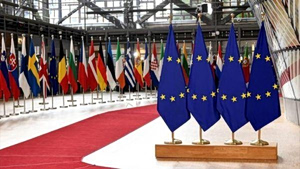
On 12 February 2026, EU leaders met for an informal leaders’ retreat, “A Strategic Brainstorming Session” in Alden Biesen-Belgium to discuss EU competitiveness. This meeting builds on previous discussions on the topic, notably: (1) the informal meeting of 22 January 2026 on transatlantic relations and trade, (2) the strategic discussion on geo-economy and competitiveness at the December 2025 European Council meeting, and (3) the October 2025 regular meeting on simplification.
Background
Enhancing the EU’s competitiveness is a key priority for the European Council in the current legislative cycle. In a complex geopolitical environment, in which the international rules-based order is increasingly undermined and core alliances are questioned, it is essential for the EU to be able to stand firmly on its own feet. Strengthening the single market and the EU economic base is ‘an urgent strategic imperative’ in the words of European Council President António Costa, to improve the EU’s competitiveness and develop its strategic autonomy.
A prosperous and competitive Europe, a free and democratic Europe and a strong and secure Europe are the three main themes of the ‘EU Strategic Agenda 2024-2029’, which guides the work of the European Council in the current legislative cycle. The years of “polycrisis”, namely with shocks for the EU such as the COVID-19 pandemic in 2020, Russia’s war on Ukraine, and the recent tensions in transatlantic relations have made the process even more urgent.
As stated by EU leaders: “Confronted with growing instability, strategic competition and security threats, we decided to take more responsibility for our security and take further decisive steps towards building our European sovereignty, reducing our dependencies and designing a new growth and investment model for 2030”.
Mario Draghi and Enrico Letta have been invited to join the retreat to share their visions and highlight developments since their groundbreaking reports. European Parliament President Roberta Metsola also addressed the meeting.
Strengthening the EU Single Market
In April 2024 the European Council convened for a special meeting on competitiveness, at which a new European competitiveness deal with nine competitiveness drivers was presented. These drivers were: (1) single market, (2) capital markets union, (3) industry, (4) research and innovation, (5) energy, (6) circular economy, (7) digital, (8) social, and (9) trade, with EU leaders asking for work ‘to be taken forward decisively and swiftly’.
Two high-level expert reports on competitiveness-related issues were published in 2024. The first one was, “Much more than a market”, by former Italian Prime Minister Enrico Letta. Two proposals were particularly noteworthy: (1) the “28th regime”, which aims to provide innovative businesses with a new legal framework to operate across the single market, and (2) the “fifth freedom”, i.e. freedom of movement of research, innovation and education, which was to be added to the original four freedoms.
Then, the much-anticipated report made by former European Central Bank President Mario Draghi on “The future of European competitiveness” warning about the EU’s slow growth, lack of productivity and other competitiveness challenges.
In recent years, several initiatives aimed at further developing the EU Single Market came from the Member States themselves. In January 2024, 15 Member States called for a new horizontal EU single market strategy. In May 2024, the Council adopted conclusions on the future of the single market. Also in May 2024, French President Emmanuel Macron and the then German Chancellor Olaf Scholz called in a joint op-ed for ‘more single market’.
The EU strategy paper, ‘The Single Market: our European home market in an uncertain world’ was published in May 2025. It focuses on seven areas: (1) removing the most harmful barriers, (2) a new approach for services, (3) supporting SMEs and mid-caps, (4) simplifying and digitalising, (5) smarter governance and stronger enforcement, (6) aligning investment and reform, and (7) shielding businesses from unfair practices.
In September 2025, President Ursula von der Leyen announced in her State of the Union speech a “Single Market roadmap to 2028” that is expected to cover increased integration in capital, services, energy, telecoms, the 28th regime, and the new fifth freedom. Similarly, President Costa indicated in his speech to the Parliament in January 2026 that ‘the EU was a powerful single market and that it is critical to deepen and complete it’, i.e. (1) making it easier for businesses, services and investments to cross borders, (2) simplifying, (3) ensuring affordable, secure and sustainable energy in a truly integrated EU energy market, (4) strengthening digital sovereignty, (5) promoting a savings and investment Union, and (6) advancing the trade diversification agenda.
Developing a strong economic base for the Industry and the Technology
Building on past work and on the Letta and Draghi reports, the Commission presented key initiatives such as the “Competitiveness Compass” in January 2025 and the “Clean Industry Deal” in February 2025, both of which the European Council has welcomed.
Since the core target of EU leaders is to ensure the EU’s industrial renewal, they invited the Commission to develop ‘a comprehensive industrial strategy for competitive industries and quality jobs’ as a matter of priority. Moreover, EU Heads of State or Government underlined the need to launch a “simplification revolution” to remove red tape and help EU companies grow. In the course of 2025, the Commission proposed 10 omnibus proposals for simplification in various fields of EU legislation.
Putting the EU at the forefront of research and innovation globally is a crucial objective for EU leaders, who have set a 3 % GDP expenditure target on R&D by 2030, in order to close the innovation gap, especially with the US and China. According to the Letta report, €33 trillion is sitting in private savings, an amount which could be better leveraged to help EU strategic needs. EU leaders have also been supportive of the work on the digital euro, as it offers an opportunity for “a resilient European payment system”, which would contribute to strategic autonomy and economic security, and strengthen the international role of the euro.
Trade as a competitiveness driver
Trade is a core component of EU competitiveness and a ‘competitiveness driver’ as defined in the new ‘European competitiveness deal’. EU leaders stressed three key themes linked to trade policy: (1) enhancing, (2) upholding an open economy, and (3) building international partnerships. Also, EU leaders have often mentioned the need for “an ambitious, robust, open and sustainable trade policy’ and ‘a level playing field both within the Union and globally‘. Currently, the EU has an extensive network of trade agreements covering 78 countries.
After more than two decades of negotiations, the EU-Mercosur agreement was signed in January 2026. The agreement was approved in the Council in January 2026, despite opposition from France as well as Austria, Hungary, Ireland and Poland.
However, the European Parliament during its January plenary session voted by a narrow majority to ask for a legal opinion from the Court of Justice of the EU on whether the deal complies with the EU Treaties, which may delay the application of the agreement.
Furthermore, the transatlantic trade environment has been turbulent under the second Trump administration. In April 2025, President Trump announced unprecedented tariffs on many countries, including the EU. On 4 February 2026, the European Parliament’s Committee on International Trade decided to resume work on the EU-US trade deal, with a possible vote at the committee meeting on 24 February 2026.
Conclusions
The EU leaders’ retreat on competiveness risked being used as a filter on EU lawmaking and not just a policy goal. This fits a broader trend toward upstream executive steering, rather than durable European commitments. The EU leaders should go beyond merely acknowledging Drahgi’s recommendations and urgently implement them for all Single Market sectors.
How can the EU do everything it can to close the technology gab with both US and China? The EU needs an ‘escape velocity’, the point at which reforms are sufficiently bold and coordinated to break free from structural fragmentation, chronic underinvestment and slow decision-making.
At Alden Biesen meeting last week where the EU leaders debated on reducing strategic dependencies, countering economic coercion, scaling EU firms and advancing a ‘Savings and Investment Union’ in a rapidly shifting geo-economic landscape, the question is still open if this retreat meeting managed to deliver real momentum before the upcoming European Council in March 2026.
*Panos Gredis is Head of the European Public Law Organization (EPLO) office in Brussels