Diplomacy must never be reduced to publicity stunts, empty slogans, or asymmetric ambitions. Yet for some time, Greece’s foreign policy toward Turkey seems to revolve almost exclusively around what has become a kind of “Herculean mission”: the lifting of Ankara’s casus belli declaration.
But what exactly is casus belli? It is nothing more than a formal expression of intent by a state — through its institutional organs — to use organized force against another, should the latter take an action deemed harmful, by subjective national criteria, to the first state’s interests.
This declaration signifies intent, not capability. Its very existence lies in the ambiguity of threat, functioning as a diplomatic bluff rather than a binding institutional commitment. Thus, it neither requires formal revocation nor merits the diplomatic attention it so often receives.
Should Greece provoke Turkey simply to see whether it would act on its threat? That might seem like a reasonable test, but it is, in fact, a dangerous fallacy — one that risks upsetting the delicate balance of power in the Eastern Mediterranean.
Greek citizens are repeatedly told that Athens is exerting diplomatic pressure on Ankara to withdraw the casus belli it issued in the event that Greece extends its territorial waters to 12 nautical miles. But does the lifting of this threat truly justify such sustained diplomatic effort? In reality, the casus belli could be withdrawn and reintroduced by Turkey with ease.
Greece has neither the legal nor the geopolitical means to prevent Ankara from reinstating it, especially once Turkey secures its desired participation in the European SAFE defense program. This Sisyphean repetition makes the entire pursuit strategically futile.
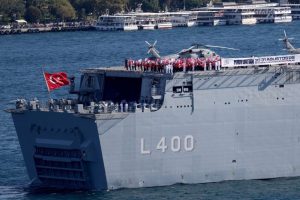
Moreover, the casus belli is only a small fragment of Turkey’s broader revisionist agenda, embodied in the doctrine of the “Blue Homeland.” This is not mere rhetoric — it represents the core of Turkey’s grand strategy for achieving maritime dominance in the Eastern Mediterranean.
The “Blue Homeland” challenges Greek sovereignty and territorial integrity across the Aegean and Eastern Mediterranean. It also undermines the strategic and economic connectivity between Greece and Cyprus, and indirectly hampers Israel’s maritime depth and regional access. Ultimately, it seeks to reduce the strategic value of Greece and Cyprus by geographically isolating them from the wider Mediterranean basin and vital trade routes toward the Horn of Africa, the Indian subcontinent, the Red Sea, and the Arabian Gulf. This strategy — unlike the casus belli — is not a threat but an active policy tool. It aims at overturning the post-Lausanne status quo in Greek-Turkish relations and establishing a new order with erga omnes application.
If Athens decides to support Ankara’s participation in the SAFE program, it must set clear conditions. a) to abandon in practice the revisionist ideology of the Blue Homeland. The first sign should be the annulment of the Turkey–Libya memorandum and formal recognition of existing treaties governing the territorial status of the Northeastern Aegean and Eastern Mediterranean islands. In the second phase, the Turkish parliament should ratify the UN Convention on the Law of the Sea.
b) The planned construction of a nuclear power plant in Akkuyu by Russia’s Rosatom should be halted. Instead, Athens and Ankara should jointly invite U.S. technical support to ensure any future entry into nuclear energy occurs under Washington’s supervision.
If Ankara meets these conditions, Greece should in turn support its participation in SAFE, with provisions for joint defense production and closer Turkey–EU cooperation.
This could mark the beginning of a genuine process toward resolving the Cyprus issue and strengthening Euro-Turkish relations — with Greece as a constructive catalyst. In the end, Athens should focus on these tangible, strategic objectives rather than investing diplomatic energy in the empty shirt of the casus belli.
Spyridon N. Litsas is Professor of International Relations Theory and Academic Director of the MA in International Studies at the University of Macedonia, Greece.