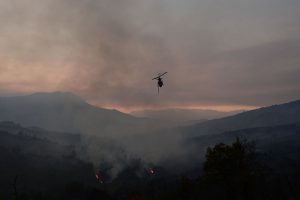
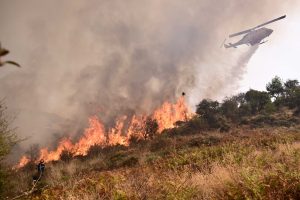
The destruction of Ancient Feneos in July 2025 was not a natural disaster but a preventable collapse of institutional responsibility. Over 11,500 acres of old-growth fir forest—one of the rarest ecosystems in Europe—were lost within hours. This was not merely environmental loss, but the erasure of a centuries-old ecological heritage: endemic flora and fauna, alpine biodiversity, and a forest that had withstood centuries of climatic and human pressure—reduced to ash through negligence.
The cause was trivial in form and devastating in consequence: two private individuals using a cutting wheel deep within the forest, despite an active level-four fire risk alert. They were fined under €12,000—an amount that renders accountability performative. Yet the institutional failure runs deeper. Days earlier, regional authorities approved a public festival under identical fire conditions, bypassing fire service warnings. No emergency planning was triggered. No operational safeguards were in place.
Feneos was not unprotected due to remoteness, but due to political choices. Institutions mandated to act were eroded by inertia, opportunism, and the systematic subordination of environmental security to convenience. Where enforcement becomes symbolic and science is sidelined, disaster ceases to be accidental—it becomes policy by omission.
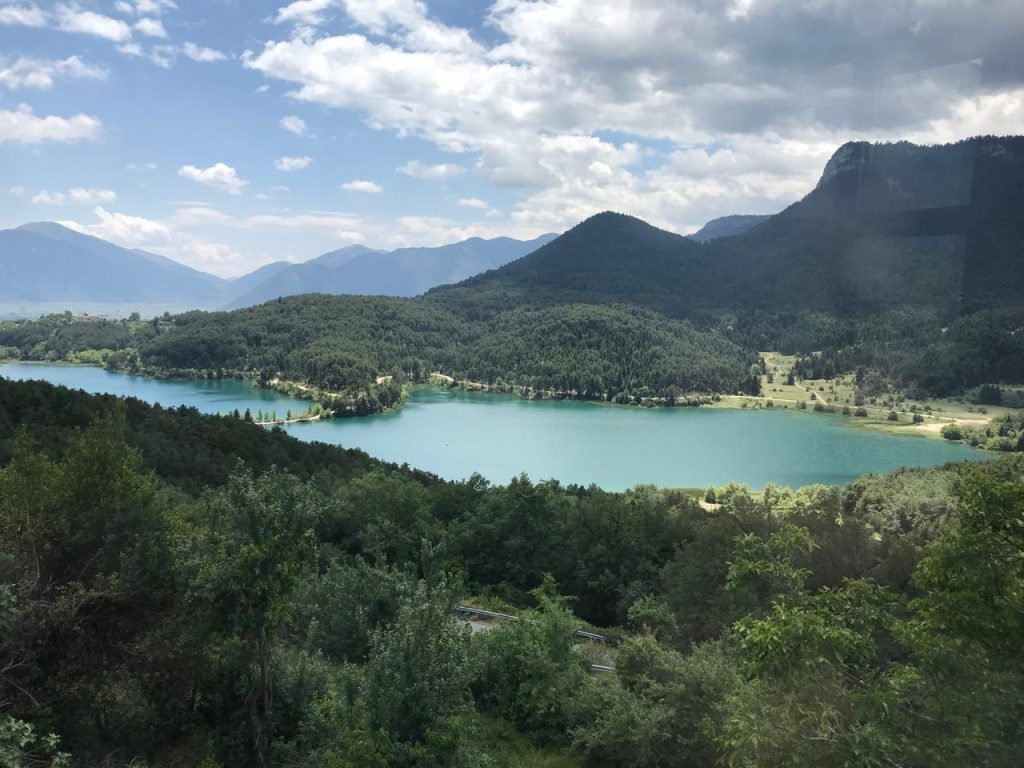
Image of Lake Doxa, in Ancient Feneos, taken before the fire. Credit: Cheryl Novak
Climate disruption has become a central force reshaping the conditions of state legitimacy and institutional survival. Its manifestations—wildfires, floods, droughts—are no longer episodic environmental events but recurring shocks with strategic implications. States, long structured around the management of external threats and internal order, must now reposition environmental risk at the core of their security responsibilities.
This transformation is unfolding within a European context defined by compounding crises—economic volatility, geopolitical fragmentation, democratic erosion, and institutional fatigue. The resulting instability has increased exposure to hybrid threats and weakened collective resilience. In this environment, climate-driven emergencies risk being instrumentalised by authoritarian regimes to exploit structural vulnerabilities. Left unaddressed, such pressures can fracture public trust, paralyse governance, and accelerate the erosion of democratic cohesion.
Effective governance under climate stress demands a recalibration of state responsibility. Protection must now encompass environmental security as a core function—on par with economic stability, rule of law, and territorial integrity. Ensuring the resilience of infrastructure, public health systems, and emergency response capacities is no longer optional. Equally essential is the active stewardship of ecosystems and biodiversity, without which societal cohesion and long-term stability cannot be sustained.
The wildfires that swept across Chios in June 2025 exposed the layered vulnerability of a region where ecological singularity, economic dependency, and geopolitical relevance intersect. Within days, thousands of acres burned, triggering forced evacuations and a declared state of emergency. Satellite imagery from Copernicus and reporting from international outlets confirmed the scale of destruction. Of particular concern was the loss of mastic groves— a globally unique crop cultivated exclusively in southern Chios and central to the island’s export economy and cultural identity.

Statement to the Prosecutor by the Suspects Arrested for the Wildfire in Feneos, Mountainous Corinthia (Vasilis Psomas / EUROKINISSI)
Chios’s strategic position at the EU’s external maritime border amplifies the stakes. Situated along key migration routes and adjacent to contested Aegean waters, the island functions as both operational node and symbolic frontier. Environmental disruption in such a setting is not a local event—it carries regional consequences and signals exposure to hostile exploitation.
While the precise cause remains under investigation, preliminary findings point to non-natural ignition. More significant, however, was the failure of the response apparatus: delayed aerial deployment, insufficient firefighting capacity, and fractured coordination. In a geopolitically exposed setting, such deficiencies are not isolated errors— they reveal systemic weaknesses with security implications beyond the immediate crisis.
Embedding environmental protection within national security strategies requires more than rhetorical alignment. It demands operational capacity: robust disaster preparedness, enforceable legal safeguards against ecological harm, and institutional coordination across borders. Without formally integrating climate security into the architecture of state accountability, short-term crises will escalate into chronic instability.
Authoritarian regimes, unbound by democratic norms or institutional oversight, increasingly exploit the strategic asymmetries exposed by climate disruption. Environmental sabotage—whether through arson or targeted ecological interference—offers a low-cost means of destabilisation, capable of overwhelming public systems, amplifying societal fractures, and exposing governance gaps. In open societies, where trust and transparency are structural requirements, even isolated incidents can cascade into systemic stress.
The risk is most acute where border exposure, ecological value, and institutional fragility converge. Islands at the EU’s periphery, high-value conservation zones, and economically strategic rural regions often lack the operational capacity to deter or absorb targeted disruption. Their vulnerability is not merely material but political: damage to such locations carries disproportionate symbolic cost, signalling weakness to both domestic and external actors. Recognising this, democratic governments must treat climate disruption not only as an environmental concern, but as a contested domain in the strategic rivalry between open and authoritarian systems.
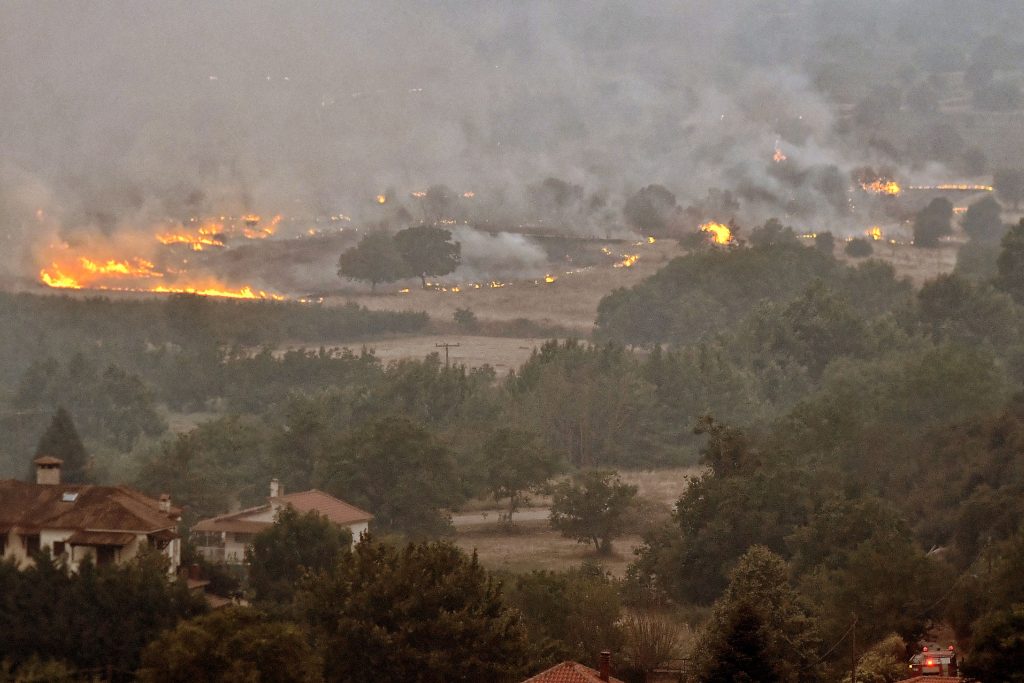
Flames rise as a wildfire burns next to the village of Karteri, in Feneos area, near Corinth, Greece, July 22, 2025. REUTERS/Vassilis Psomas
These failures are not isolated lapses but systemic outcomes of institutional erosion. State mechanisms do not falter from ignorance, but from design: prevention is resource-intensive, politically costly, and often obstructive to vested interests—whereas loss is absorbed into ritualised cycles of reconstruction. Environmental risk is routinely externalised in favour of short-term economic priorities. Permits are issued against expert advice, early warnings are disregarded, and enforcement is reduced to regulatory theatre.
This reflects a deeper condition of institutional exhaustion. Neither national governments nor the EU have developed regulatory architectures commensurate with the systemic nature of climate disruption. Existing protections remain fragmented, under-resourced, and predominantly reactive. Crises are managed as anomalies rather than anticipated as structural inevitabilities. Resilience, meanwhile, is treated as a discursive imperative— invoked in policy language but rarely operationalised in governance practice.
At the root of institutional inertia lies a conceptual failure: the persistent refusal to recognise climate breakdown as an existential threat. As long as it is framed primarily as a technical or budgetary issue, accountability is deferred, and responses remain fragmented and superficial. Yet the stakes now extend far beyond environmental degradation. The viability of democratic governance, the continuity of economic systems, and the stability of Europe’s geopolitical periphery depend on whether ecological assets are secured as critical infrastructure. Treating climate-induced destabilisation as a peripheral or technocratic issue is no longer tenable within a framework committed to democratic continuity. The lack of clear jurisdiction, binding standards, and strategic coherence creates systemic blind spots—permitting both negligence and opportunistic exploitation. What is needed is not an expansion of policy rhetoric, but enforceable mechanisms that institutionalise responsibility and preempt failure.

Emergency Sea Landing of Canadair CL-215 Firefighting Aircraft in the Corinthian Gulf – Friday, July 25, 2025
European institutions must assume direct responsibility for protecting ecologically and strategically sensitive areas through binding legal instruments and independent oversight. Where national authorities lack either the capacity or the political will to act, supranational intervention must not only be possible—it must be operationalised. Accountability frameworks require structural recalibration. Sanctions that fail to reflect the scale of ecological and societal harm entrench impunity. Legal consequences—civil, criminal, and fiscal—must correspond to both the damage inflicted and the institutional failures that permitted it.
Strategic doctrine must evolve to reflect the weaponisation of environmental disruption by authoritarian actors. Such acts should be classified and treated as forms of hostile interference. Deterrence within the climate-security nexus demands not only anticipatory capacity, but the operational ability to attribute responsibility, impose consequences, and escalate through legal, economic, and technological means. The defence of democratic resilience begins with the uncompromising protection of its ecological foundations.
Europe does not suffer from a lack of evidence—it suffers from a lack of consequence. The mechanisms exist, the risks are documented, and the failures are visible. What remains absent is the political resolve to intervene before systems pass the point of irreversibility. As the boundary between environmental collapse and strategic destabilisation dissolves, institutional inertia becomes an active threat no democracy can afford.

A man looks at a firefighting hydroplane, operating to extinguish wildfire burning pine forest in Feneos area, amid heatwave, as seen from the town of Nafplion, Peloponnese, Greece, July 22, 2025. REUTERS/Louisa Gouliamaki
The climate crisis is not an externality. It is the theatre in which the credibility of authority, the resilience of institutions, and the strategic coherence of Europe will be tested. To ignore its securitisation and systemic implications is no longer a policy failure—it is a strategic miscalculation with irrevocable costs.
This opinion piece has been selected as part of To Vima International Edition’s NextGen Corner, an opinion platform spotlighting original voices from the emerging generation on the issues shaping our time.
Thanos A. Dellatolas is a Research Assistant at the European Policy Centre (EPC) in Brussels. He serves on the Governing Board of youth-led initiatives promoting democracy in Greece. His work focuses on European security institutional resilience, and the future of the social contract in an age of systemic disruption.