
The postponement of the Sydney Delphi Forum may appear a logistical setback, but it exposes a more consequential question: can Greece convert one of its greatest assets—its diaspora—into sustained economic outcomes, or will structural constraints continue to limit its global reach?
A strategic moment in bilateral relations
Originally planned to feature Greek Prime Minister Kyriakos Mitsotakis and centered on the theme “From Ancient Hellenic Ideals to AI: Building Resilient Prosperity Through Greece–Australia Collaboration,” the Sydney Delphi Forum has been postponed for now. While its deferral underscores the current practical challenges of transnational engagement, the Forum’s strategic purpose remains clear: to advance Greece–Australia cooperation beyond cultural symbolism, focusing on economic coordination, technological governance, and institutional collaboration.
The strategic relevance of such engagement is underscored by global shifts. Geopolitical fragmentation, persistent supply chain disruption, and energy insecurity have become structural realities. Artificial intelligence is reshaping industries, labor markets, and regulatory frameworks at a pace that challenges institutional capacity, while confidence in democratic governance is under pressure across advanced economies. Strengthening ties with capable, trusted partners like Greece aligns with Australia’s broader Indo-Pacific strategy, emphasizing diversification, resilience, and institutional cooperation.
Even without the Forum this year, the Greek-Australian diaspora remains a vital network linking Hellenic heritage to Australia’s economy. The question is no longer whether these networks exist, but how effectively they can be mobilized toward measurable economic outcomes.
Diaspora as strategic capital
The Greek–Australian diaspora represents a substantial but underutilized form of strategic capital. Highly skilled and professionally integrated, it spans finance, energy, healthcare, digital services, advanced manufacturing, and maritime industries. Yet its contribution to bilateral relations has remained disproportionately cultural, reflecting a gap between capability and economic mobilization.
Comparative evidence illustrates what is possible. In The New Argonauts, AnnaLee Saxenian demonstrates how diaspora networks transfer knowledge, capital, and institutional practices across borders, accelerating innovation and economic integration. Ioanna Sapfo Pepelasis similarly shows how Diaspora Entrepreneurial Networks connect domestic economies with globally dispersed talent, creating scalable ecosystems of investment and enterprise.
These outcomes, however, depend on dual embeddedness—credible connections to both home and host economies—supported by institutions capable of converting relationships into transactions. Where diaspora engagement is fragmented, narrow, or shaped by legacy structures that do not reflect the contemporary professional base, its economic impact is constrained. The issue is not the absence of social capital, but the limited capacity to translate it into sustained economic outcomes.
Greece’s GDP and the moderating role of the diaspora
Greece’s relatively modest GDP imposes a structural constraint on trade and investment with distant partners such as Australia. Even with a diaspora exceeding 420,000 people, these networks cannot substitute for domestic productive capacity (IMF World Economic Outlook, 2025). GDP sets the ceiling for bilateral trade; diaspora networks influence how closely that ceiling is approached.
A large, professionally integrated diaspora can connect firms to foreign markets, reduce transaction costs, and facilitate investment and knowledge transfer. In this sense, it amplifies the reach of the domestic economy—but does not replace it. In the Greece–Australia context, diaspora networks operate at the margin, strengthening flows of trust, information, and cultural alignment. However, they cannot compensate for limitations in scale, export diversification, or geographic distance.
Where diaspora institutions are not fully representative—particularly of newer, globally integrated professional cohorts—their ability to convert social capital into broad-based economic engagement is further diminished.
Global growth trends reinforce this constraint. Most GDP expansion through 2030 will be driven by larger economies such as the United States, China, and India, while smaller European states like Sweden and Belgium are expected to grow steadily from stronger productivity bases. Greece, starting from a lower base, is likely to lag. The implication is strategic rather than pessimistic: productivity, institutional effectiveness, and targeted trade expansion must be prioritized, with the diaspora used to extend—not substitute—domestic economic capacity.
Comparative perspective: Greece, Sweden, and Belgium
A comparison with similarly sized European economies illustrates the practical consequences of these structural dynamics. Sweden and Belgium, with populations comparable to Greece, maintain significantly higher levels of trade with Australia.
| Country | Population (millions) | Trade with Australia (AUD bn) | Trade per Australian resident (AUD) |
| Greece | 9.9 | 2.2 | 80 |
| Belgium | 11.8 | 5.6 | 203 |
| Sweden | 10.7 | 4.1 | 149 |
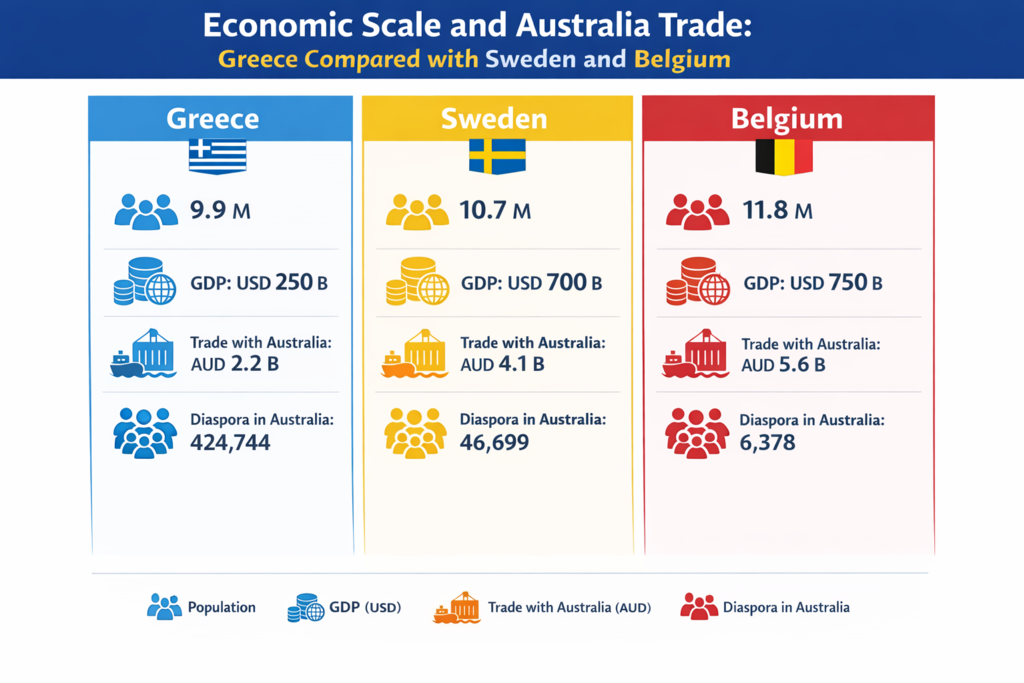
In 2024, Greece with a current population of 9.9 million Greece–Australia traded approximately AUD 2.2 billion with Australia, equivalent to around AUD 80 per Australian resident. By comparison, Belgium — with a population of about 11.8 million — traded roughly AUD 5.6 billion with Australia (around AUD 203 per resident), while Sweden — with about 10.7 million people — recorded approximately AUD 4.1 billion (around AUD 149 per resident).
These differences cannot be explained by diaspora size. Rather, they reflect deeper factors: export diversification, integration into global value chains, and institutional capacity to support internationalization. Investment flows follow a similar pattern. Australia and Sweden maintain substantial two-way investment exceeding AUD 13 billion, while Belgium’s role as a financial hub supports significant capital flows. Greece’s investment relationship remains comparatively modest and concentrated in a narrow set of sectors.
The conclusion is clear: diaspora networks can enhance engagement, but their impact is bounded by domestic economic structure and institutional capacity. GDP largely sets the ceiling for trade and investment, while diaspora networks determine how fully that potential is realized.
Toward a future forum: from dialogue to measurable impact
The postponement of the Sydney Delphi Forum is a delay, not a loss. Its strategic purpose remains clear: aligning Greece’s domestic economic policy, diaspora capability, and bilateral commercial opportunity to generate tangible outcomes. A future Forum would be most valuable not as a symbolic event, but as a platform for turning potential into measurable results.
This requires a shift from representation to functionality: identifying sectors where Greece has competitive or emerging advantages, linking them to Australian demand and capital, and embedding diaspora expertise to play a role in strengthening Greece’s domestic economy and GDP by channeling knowledge, capital, and experience associated with reforms. Institutional coordination—particularly in regulatory alignment, investment frameworks, and innovation policy—will be essential to reduce friction and enable scale.
The central insight is straightforward: GDP sets the outer limits of engagement, while diaspora networks determine how effectively those limits are approached. Networks deliver impact only when integrated into coherent policy and institutional frameworks. The challenge is therefore not identifying opportunities—already evident across energy, digital technology, infrastructure, healthcare, and maritime sectors—but creating the conditions for execution. A rescheduled Forum could convert connection into coordination, and coordination into durable economic outcomes, transforming dialogue into strategic action.