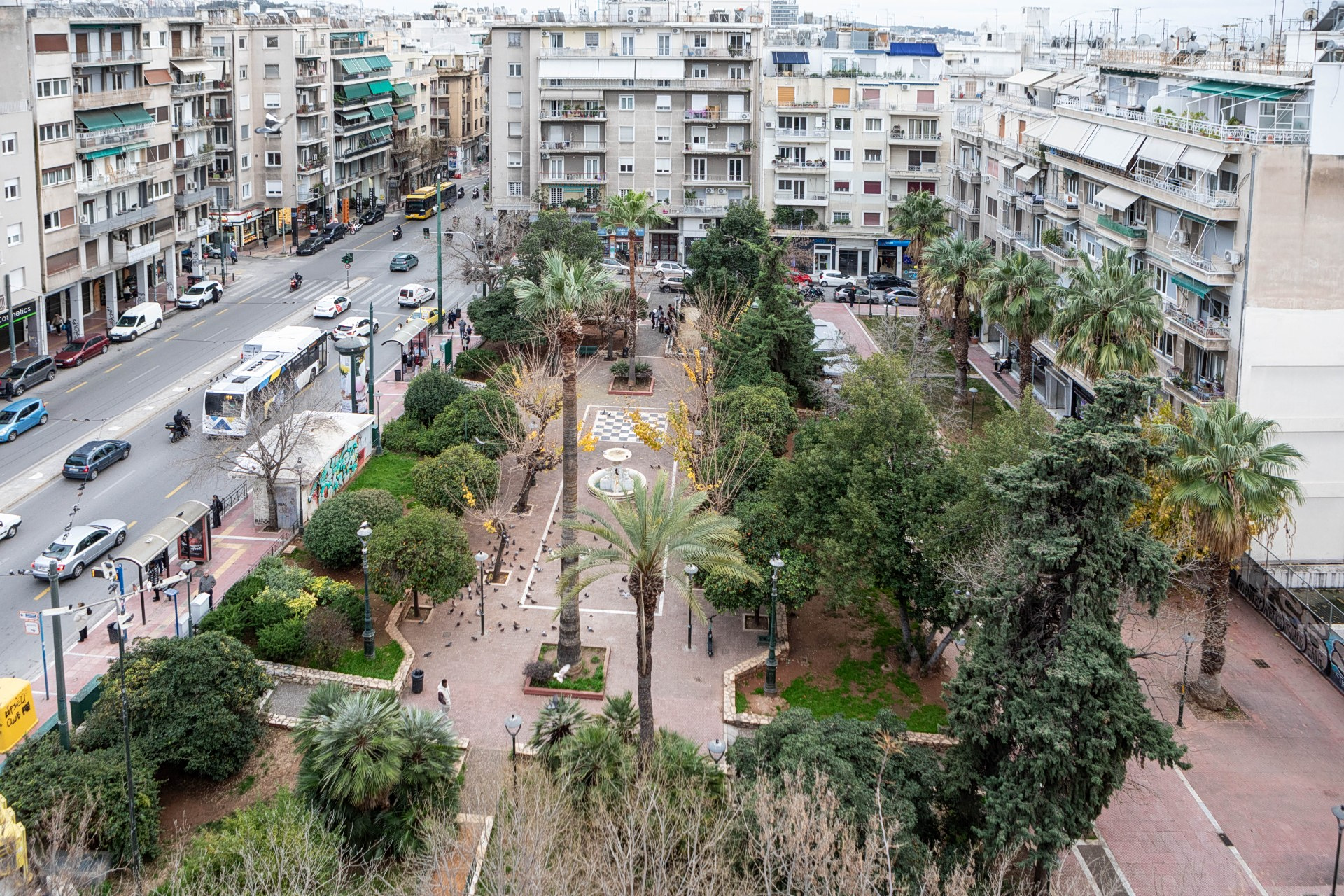
The iron shutters of the ground-floor shops rise with that dry metallic sound which, every morning, signals that the city is getting back to work. On a traffic island of Patission Street, a delivery worker leaves a box of goods on the sidewalk in haste, making a brief signal. In the greengrocers and mini-markets with imported products, employees mechanically take their positions. People who speak different languages, but move to the same rhythm.
If you look at America Square in the rush of the morning, it simply seems like a neighborhood that functions. But if you observe it a little more carefully, you realize that here, in the same apartment building, two different logics about what a home is coexist — for some it is the base of a life; for others it is a unit of return.

Photo: Sissy Morfi
On the ground floor of survival, people have lived here for years, they work, raise children, open shops, and calculate the rent month by month. A few floors higher, in the penthouse of investment, homes are treated not as residences but as products. Square meters purchased for high returns, renovated for capital gains, and kept closed until the right price arrives. Two different economies within the same building. The only thing that connects them is the elevator.
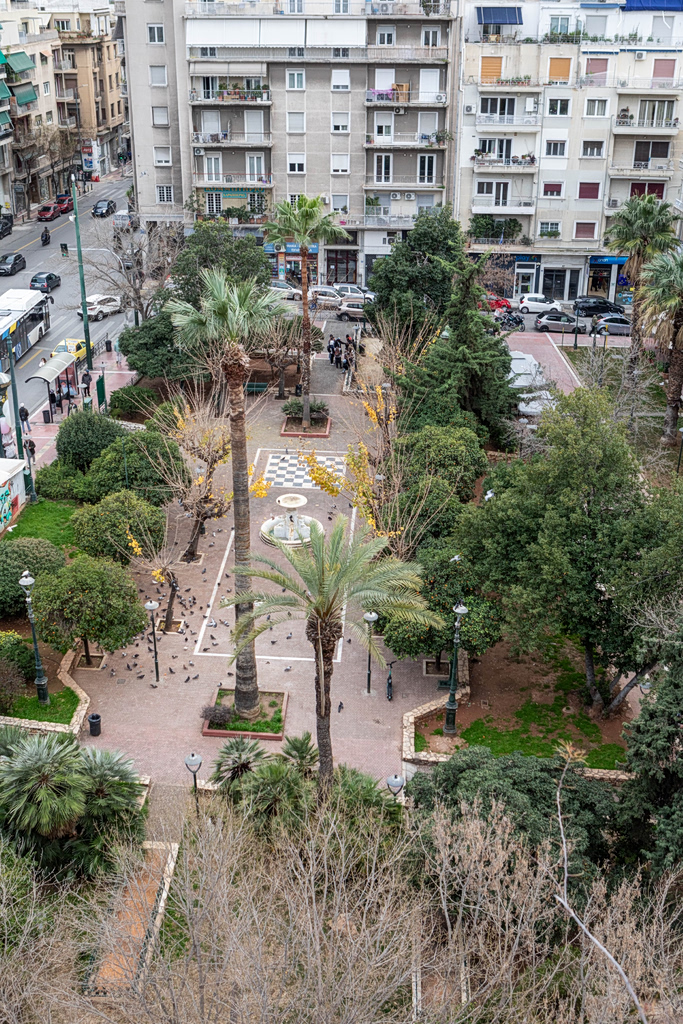
Photo: Sissy Morfi
In recent years, Athens has seen the housing market rise at rates that incomes do not follow. According to the Spitogatos index, in the fourth quarter of 2025 the asking sale prices for residences in Attica increased by approximately 8.1% year-on-year, while asking rental prices recorded an increase of about 4.8%. These percentages do not say everything, but they explain something basic. In many central neighborhoods, housing ceases to function as stability and turns into a variable.
Mr. Nikos Belavilas, professor at the National Technical University of Athens and director of the Laboratory of Urban Environment, describes it without embellishment. “The entire zone north of the Museum, Victoria Square, America Square, Kypseli and Agios Panteleimonas are gradually being incorporated into the broader historic center. They follow the course previously experienced by the historic triangle — a phase of aging population and buildings, decline in values, and settlement of low incomes and migrants. What follows will be the rediscovery of the area by real estate, resulting in inevitable gentrification and change of users,” he explains.
Mr. Belavilas insists that this is nothing new in Athens. It is, in a way, the old story of the city returning. “The Athenian apartment building was always characterized by class stratification, from basements and light wells to penthouses,” he says. “Today the phenomenon is returning fiercely. The city is reverting to a condition reminiscent of the 1960s, where incomes and quality of living change dramatically from floor to floor within the same building.”

Photo: Sissy Morfi
Mr. Giannis Petridis is 65 years old and has lived in America Square for nearly fifty years. He speaks like someone who has seen his neighborhood change many times. “There are no homes anymore,” he says. “In the past you went out to the square and it was chaos from the ‘for rent’ signs on the poles — now nothing. They hold onto the houses. They don’t give them easily. And if they do, they skin you.”
A narrow street below, Mr. Sene Bandou from Senegal unloads stacks of goods into his shop. A neighborhood grocery store, small but dense, with shelves full of packages from Mali and Guinea. He came to Greece in 2011. “I’ve had the shop for five years,” he says. The rent he pays is 330 euros. “It scares me a little…,” he admits. “It won’t be easy to stay if it keeps going up. I’ve built a life here; my children go to school.”

Photo: Sissy Morfi

Photo: Sissy Morfi
On the opposite side of the square, Mr. Naim from Pakistan, 50 years old, is currently running a small grocery store with products from India and Bangladesh. The owner is away for a while and he is covering for him. America Square is sustained like this — with networks, with substitutions, with small agreements of everyday life.
Naim has lived in the area for 22 years. When the conversation turns to housing, his expression tightens. “The rent was 250 euros,” he says. “He raised it twice.” He pauses. “Now it’s 320,” he calculates. “It’s not only the money. It’s that you don’t know what he’ll tell you next year,” he concludes.
The paradox is that the pressure does not arise only from increased demand. It also stems from a huge supply that remains outside the market. According to data based on the housing census and presented in recent analyses, in the Municipality of Athens it is estimated that more than 117,000 residences remain closed — approximately one in four homes. In a city that speaks daily of a “shortage of available apartments,” this number shows that the problem is not only economic but also institutional. There are dwellings, but there is no way for them to return to the social life of the city.
“Athens never had substantial housing policy tools,” says Mr. Belavilas. “The only relevant body, the Workers’ Housing Organization, was abolished in 2012. It was a long-term political choice.” He explains the root of the problem: “Since the 1950s, housing was based on arbitrary construction and the system of land-for-flats exchange, instead of being developed by a structured welfare state.”
How this translates into the America Square market is described by Mr. Kosmas Theodoridis, a real estate professional. “Today four categories of buyers dominate: small investors, foreign investors, Greeks living abroad, and low- to middle-budget buyers who cannot turn to more expensive neighborhoods.” What they mainly seek, he says, are small apartments of 40–70 square meters, “aimed at renting, either to students or workers,” with a common denominator of “low purchase price, satisfactory returns, and prospect of future capital gain.”

Photo: Sissy Morfi
Within this logic, a “cheap area” such as America Square functions as a signal. “It acts as a magnet for demand,” explains Mr. Theodoridis. And the domino effect is almost mechanical. “Often an increase in rents comes first, followed by an increase in sale prices within 6–12 months.”
From the owners’ side, Mr. Stratos Paradias, president of POMIDA, frames the problem differently. He insists that the “key” to lowering rents is not price controls but increasing supply. “It is expected that many thousands of closed homes will gradually enter the rental market, increasing the supply of residences for long-term lease, which is the only ‘key’ to addressing the problem of high rents,” he says. And he set a clear limit in the public debate: “As opposed to ‘ceilings’ and compulsory extensions that some ahistorically propose, opening the Aeolus’ bag of rent control…”
For the Municipality of Athens, the housing problem, beyond being a major social issue, is also a matter of competencies and available tools. The Deputy Mayor for Municipal Property of Athens, Mr. Paris Charlaftis, describes the limitations of local government in the face of a crisis evolving faster than its capacity to intervene.
“The Municipality cannot shoulder the burden of the housing crisis alone,” he says. “Without institutional tools and resources, our possibilities are very limited.”
In America Square, the city is being quietly redistributed, floor by floor. There is no single event that explains it, nor a moment that marks it. There is only a steady shift — homes that remain closed, prices that rise, people suspended between a life they built here and a market that treats them as temporary.