For decades, Germany prided itself on being Europe’s economic engine. Its industrial strength was matched by a political stability that many neighbors admired. Whenever Paris, Rome, or Athens struggled with political or economic turmoil, Bonn and later Berlin were widely seen as Europe’s dependable anchor.
That reputation has faded. Germany’s economic model is under unprecedented strain. High energy prices following Russia’s invasion of Ukraine, U.S. tariffs, and a surge of inexpensive Chinese imports have put many of the country’s flagship companies under pressure. Warnings of gradual deindustrialization have become commonplace.
Not all of Germany’s problems are imported. Excessive bureaucracy, slow digitalization, and, above all, high labor costs have steadily eroded the competitiveness that once defined Europe’s largest economy. The generous welfare state – financed largely through payroll contributions – has become part of the problem by driving up the cost of production.
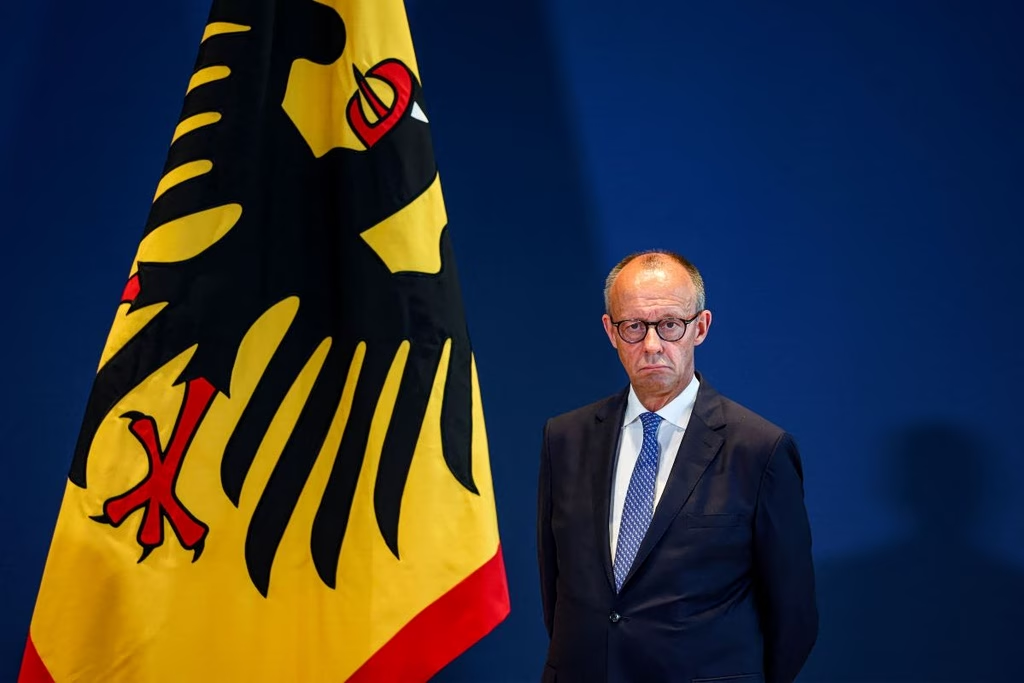
Friedrich Merz won last spring’s election promising to reverse this trend through sweeping economic reforms. Yet his political room for maneuver was limited from the start. His parliamentary majority depends on a coalition with the Social Democrats, who have predictably resisted or watered down many of the market-oriented reforms championed by the conservatives.
Coalition government has always required compromise in Germany. In Merz’s case compromise has come at a steep political price. Much of his reform agenda has fallen victim to the compromises of coalition government.
That gap between promises and performance explains much of the government’s unpopularity. Seven in ten Germans now say that both the coalition and Chancellor Merz are doing a poor job. “The image of the CDU-SPD coalition is catastrophic, and the chancellor has a credibility problem,” says Mathias Jung of the Forschungsgruppe Wahlen, one of Germany’s leading polling organizations.
More troubling still is the collapse of confidence in the state’s ability to cope with mounting challenges. Nearly four out of five Germans believe the government is overwhelmed. Distrust cuts across party lines but is especially pronounced among supporters of the far-right Alternative for Germany (AfD). Only two percent of AfD voters still express confidence in the state.
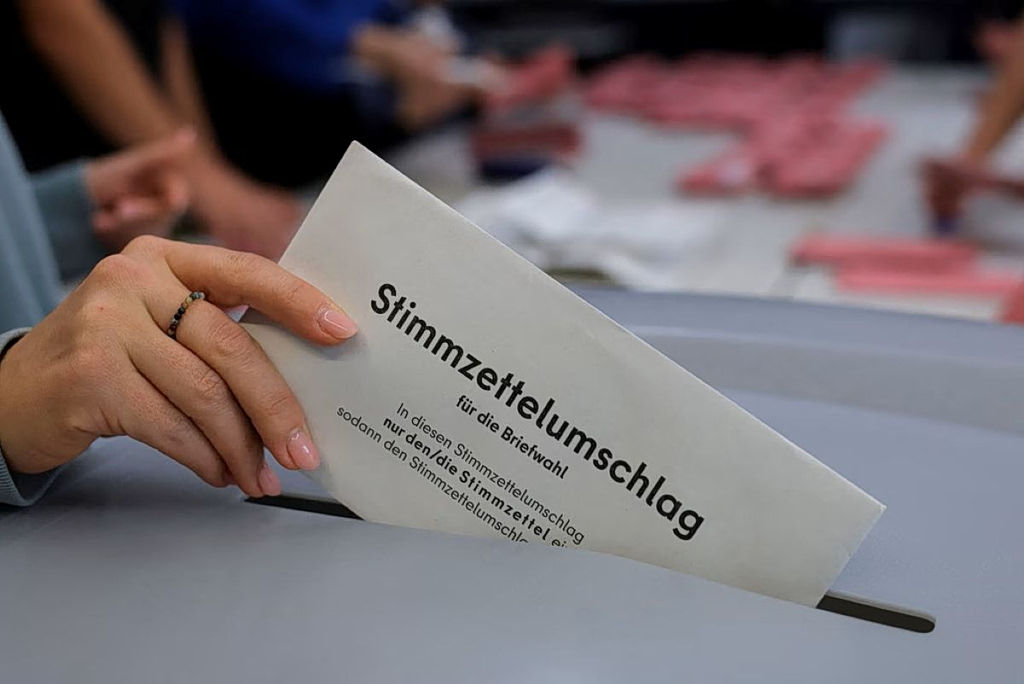
As Germany heads toward important elections in September, one finding appears consistently across every major opinion poll: the AfD has become the country’s strongest political force. Were a federal election held today, the party would win roughly 27 percent of the vote, comfortably ahead of Merz’s Christian Democrats at about 23 percent. The once-dominant Social Democrats have fallen to just 12 percent, while the Greens and the Left perform only marginally better.
The AfD’s dominance is even more striking in the eastern state of Saxony-Anhalt, where voters elect a new parliament on September 6. There, the party is polling above 40 percent. The question is no longer whether the AfD will finish first. It is whether it will win enough seats to govern. A far-right government – even at the level of one of Germany’s sixteen states – would mark a historic watershed and, for many Germans, the breaking of a long-standing political taboo.
There is no shortage of warnings about the far right, but there is little sign of a coherent strategy to stop its advance. The government insists that the best antidote to extremism is effective governance that improves people’s lives. In theory, that is persuasive. In practice, it is far less convincing. Serious economic reform inevitably requires painful – and therefore unpopular – changes to Germany’s expansive welfare system. Such measures are unlikely to win votes in the short term.
Meanwhile, attention has turned to calls for banning the AfD altogether. Germany’s Constitutional Court has the authority to outlaw parties that seek to undermine the democratic order, although the legal threshold is intentionally high. Whether it is politically – or democratically – wise to remove a party supported by nearly one-third of the electorate through judicial action is another matter entirely. For that reason, most of Germany’s political establishment opposes initiating such proceedings.
For the foreseeable future, then, the AfD has little to fear from the courts. Its greatest ally remains the government’s inability to deliver on its promises. Public frustration with Merz has spread well beyond the opposition to include many of his own supporters. Much of the German media has already begun to speculate openly about his political future. Der Spiegel, under the headline The Downfall, recently described a “rapid loss of authority within his own ranks” adding that few senior figures in his party expect him to remain in office until Christmas.
Such speculation is common during periods of political uncertainty. Germany’s constitution, however, makes it difficult to remove a chancellor against his will. Merz has been in office for less than a year and a half and has given no indication that he intends to step aside.
For much of the Federal Republic’s history, lengthy chancellorships symbolized Germany’s political stability. Konrad Adenauer governed for fifteen years, while Helmut Kohl and Angela Merkel each served for sixteen. Olaf Scholz, Merz’s immediate predecessor, lasted just three and a half years. Merz may consider himself fortunate if he reaches even that mark. That possibility alone says much about today’s Germany. The era in which political stability could be taken for granted is over.
Dr. Ronald Meinardus is a Senior Research Fellow at the Hellenic Foundation for European and Foreign Policy (ELIAMEP).