 Μake us preferred on Google
 Among our strongest memories is sharing a meal with family and friends at the end of the week. Sunday, of course, is both the end of one week and the start of the next: an accounting of what has passed on one side, a plan for what lies ahead on the other.
At those Sunday gatherings, you shared more than the food. You shared your grandmother’s pride in the meal she had cooked, your mother’s emotion as she never stopped doting on you, and your father’s irritation at something that was always bothering him, though even he could not say what.
Family Sundays were not ideal, but they were authentic. Sometimes you felt pressure to be there, yet something was being built through the sharing. Those shared moments shaped, and still shape, our identities: who we are, who the people around us are, and who we want to become. We grew up at those tables, and as we grew, the tables shrank. Seats emptied. Loss is always heavy. But as the tables shrank, something inside us grew. The memories piled up, and they make us who we ultimately are.
You wake late, far from obligations and worries. The smell of food roasting in the oven finds you in bed. Slowly, you consider getting up and joining your family at the table. That unforgettable luxury of slow living defines the Sunday table, and it is exactly what we so badly need to revive. We return to it and step back into the same play, trying to recover the intimacy we have lost.
Memories of childhood
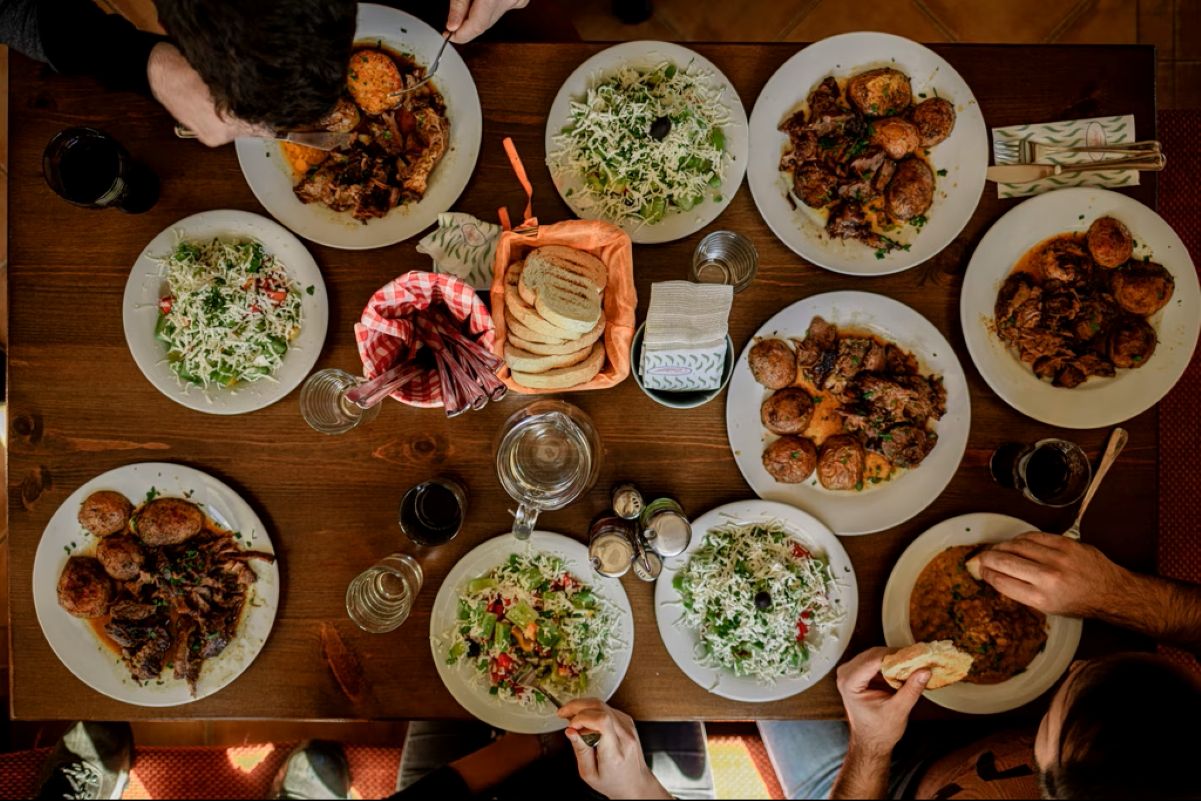
They say smell is the strongest of the senses. The aromas of Sunday gatherings stay etched in memory. Giouvetsi, kid goat fricassee and veal stewed in tomato sauce with rice were among the dishes with the most distinctive scents. The sense that a dish is homemade, just like mom’s, arrives with the very first whiff.
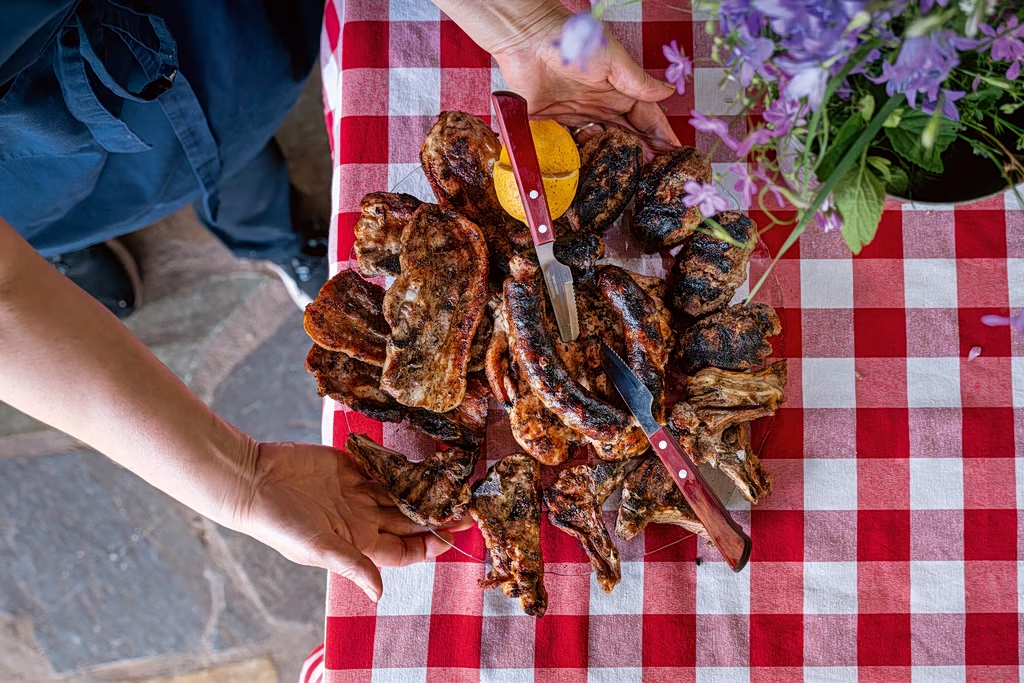
On weekdays, time in most households was tight. There was little of it for cooking and little for eating. We often ate at different hours anyway. The food waited in the kitchen, and each person visited it as their schedule allowed. The oven was lit mainly on Sundays. Baking trays, grills and clay casseroles filled with quantities that could hardly be eaten in a single day. Big pots, pressure cookers and plenty of cutlery took center stage. Sunday’s food stayed with us for the days that followed.
The Sunday table was a collective effort from beginning to end. There was plenty of bread, sesame seeds scattered everywhere, and aromas flooding every room near the kitchen. The plastic tablecloth of questionable taste wasn’t laid by chance. It simply wiped clean easily, a practical choice rather than an aesthetic one. Yet it took hold and became part of the folk vernacular of the Sunday table.
We played musical chairs at these gatherings without ever saying so. Someone was fixated on a particular seat and never gave it up. Someone else insisted on sitting next to a specific person. The rest of us kept changing places, every Sunday and even within the same afternoon. Sometimes we split into two camps: the adults’ table and the children’s table. Somewhere around then came the craving for something sweet: jellies, custards or ice cream. For the ice cream, the adults would usually send the children to the kiosk. Choosing a dessert is always a weighty responsibility, all the more so for a child standing before a freezer full of ice cream.
Sometimes we ate first and talked afterward. Other times we talked first, and silence settled in as we ate. Conversation at the table seemed to follow a script with a set course: general assumptions, clichéd exchanges, indifferent remarks, awkward questions, stories “from the old days” and political clashes. The political talk in particular remains unforgettable. Paradoxically, those arguments, with their passion, inaccuracies and non sequiturs, somehow initiated us into politics. Perhaps, at the Sunday table, that could serve as a definition of politics: something with passion, inaccuracies and discontinuity.
Sunday tables never had a fixed duration. Some ran from early to early, others from early to late. The gatherings ended as they began, with a Greek coffee, and its preparation was treated as a ritual in its own right. There was a theory that the more bubbles a coffee had, the more luck it would bring whoever drank it. Through such small details, we nurtured our hope for better fortune. That was where the talk turned to what we most wished would come true, and we finally asked the question: “If you could, what would you really like to have?”
Sunday gatherings today
Do Sunday tables still exist the way they once did? In the rhythm of modern life, we tend to eat fast food in front of screens, conditions at odds with the reunion of the Sunday gathering of old. Even if we no longer have such feasts, in recent years there seems to be a need to recreate them. We need a break from the noise of digital life and the culture of constant availability. We return tο tables with friends whom we have chosen as family. The shared effort, from gathering the ingredients to cooking to the final washing-up, brings us closer. We share tasks, and the walls people otherwise raise between themselves come down. That is where there is room for real connection, set against the loneliness and alienation of individualistic modern life. After all, human needs remain unchanged. We need nourishment, warmth and, above all, one another.
The Sunday gathering resonates within us in the present, the past and the future. We find ourselves back in the rituals in which we grew up, and we make room for our identity and feelings to develop authentically today. We step back from the pressures of everyday life so that we may “find ourselves,” if only for a while.