The spark for the September 1955 pogrom against Istanbul’s Greek minority was a bomb placed at the house in Thessaloniki where Mustafa Kemal Atatürk was born. The Turkish government of Adnan Menderes rushed to claim Greeks were behind it, but Athens firmly rejected the accusation. Years later, it was revealed the bombing had been staged by the Turkish authorities to put pressure on Greece, which at the time strongly supported the struggle of Greek Cypriots. Menderes, by contrast, insisted Cyprus was part of Anatolia and therefore belonged to Turkey. Even the Turkish man who planted the bomb eventually confessed.
Two days later, the violence erupted, culminating in the pogrom of September 6–7 against the “Romioi,” as Istanbul’s Greeks are still called. My family and I were then spending the summer at our house on the island of Halki, one of the Princes’ Islands, which remained untouched. We followed the news mainly by radio. On September 8 my father went into Istanbul to check our office and home near İstiklal Avenue. He returned reassured: nothing had been damaged. A day later, I went myself. What I saw shocked me. All the Greek shops on İstiklal, the city’s main avenue, had been destroyed. And it wasn’t just there: mobs had also attacked homes and businesses in neighborhoods with large Greek populations, such as Tatavla (today Kurtuluş) and Feriköy.
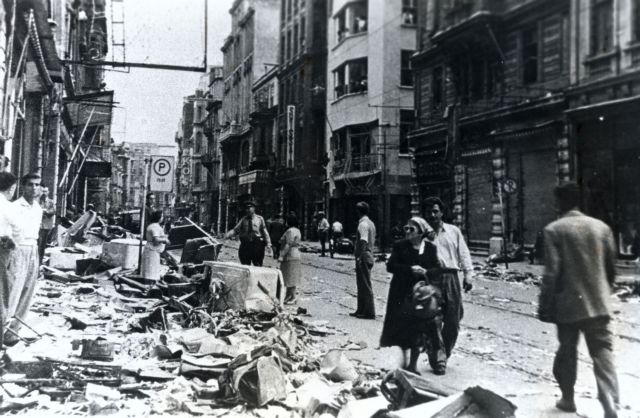
When schools reopened two weeks later, I returned to the Austrian high school I attended. My Turkish classmates said nothing about the pogroms; they only asked about my holidays. The only exception was a teacher of Turkish literature, who approached me during a break and said quietly: “I will only say one word. I am ashamed.” Officially, the government claimed thugs from Anatolia were responsible. No one believed this—not even Turks. How could outsiders know exactly which shops and houses belonged to Greeks?
In 1960, after the military coup that deposed Menderes, he and other officials were put on trial. The prosecutor prepared charges over the pogroms, but General Cemal Gürsel, the coup leader, instructed him to seek only a one-year sentence without further detail. The prosecutor complied but filed the complete dossier with the Turkish Historical Foundation in Istanbul. Years later, researcher Dilek Güven, working on her doctorate at Bochum University, found the file. She studied it and later published a book in Turkish titled The Events of September 6 and 7, the official term in Turkey. Photographs from the file show even fashionably dressed women among the mobs smashing shops.
The pogrom triggered the first mass exodus of Greeks from Istanbul, with nearly half the community leaving. The tragedy was completed by the expulsions of 1963–64 under Prime Minister İsmet İnönü.