NATO policy towards Turkey rests on an expired warning: pressure Ankara and it may turn towards Moscow, Beijing or Tehran. That future has already arrived. Turkey is strategically external and institutionally internal, building security arrangements outside NATO while retaining power inside it.
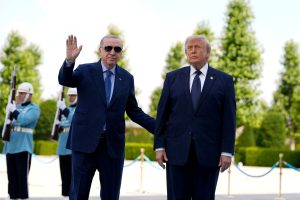
At the Ankara Summit in July, every Ally, Turkey included, reaffirmed an ironclad commitment to Article 5, identified Russia as a long-term threat to Euro-Atlantic security and reiterated that Iran must never acquire a nuclear weapon. Weeks later, Turkey signed the Makkah Joint Defense Agreement with Saudi Arabia and Pakistan, under which an armed attack on one is regarded as an attack on all three. Foreign Minister Hakan Fidan described the clause as “technically the same as NATO’s Article 5”. This week, President Recep Tayyip Erdogan said Turkey would consider full membership of the Shanghai Cooperation Organization, led by China and Russia, while insisting that this need not alter Turkey’s ties with NATO or the West.
Ankara accumulates security systems, extracting value from each without depending exclusively on any. NATO gives it access to Western decisions, intelligence, interoperability and blocking power within consensus. Makkah adds a mutual-defense framework with Saudi Arabia and nuclear-armed Pakistan. Shanghai offers institutional reach alongside China, Russia and Iran. Turkey’s expanding defense industry reduces Western leverage. Moscow supplies energy and nuclear infrastructure while widening Ankara’s latitude.
Turkey does not need to leave NATO. Leaving would be a demotion.
No other arrangement gives Ankara the same combination of Western access and power over Western decisions. Membership allows Turkey to enter rival systems without surrendering its seat inside NATO. Turkey selectively resists Moscow where interests diverge, supporting Ukraine in important areas and restricting warship passage under the Montreux Convention. At the same time, it bought the S-400 system NATO could not integrate, was removed from the F-35 program, placed Rosatom at the center of the Akkuyu nuclear plant, preserved Russian energy corridors and stayed outside the Western sanctions regime. Turkey-based entities have repeatedly figured in American and European actions against networks supplying Russia’s military-industrial base or circumventing restrictions. At Bishkek this week, as Erdogan opened the door to full SCO membership, he also signaled further nuclear projects with Russia.
Subordination is not the test. Ankara cooperates where Russian ties create advantage and externalizes the cost to NATO.
Ankara and Tehran compete across the region, yet Turkish networks repeatedly figure in US cases involving Iranian oil, the Islamic Revolutionary Guard Corps, missile components and weapons procurement. Halkbank, Turkey’s state-controlled lender, faced years of prosecution over an alleged multibillion-dollar Iran sanctions-evasion scheme before the case was dismissed in June 2026 under an agreement with the Trump administration, without an admission of wrongdoing. A defense pact partly shaped by anxiety over Iran has not closed the channels from which Tehran benefits. Turkey need not ally with Iran to enable it.
Makkah creates a second collective-defense obligation. Turkish forces can now be committed under an Article 5-style guarantee involving Saudi Arabia and nuclear-armed Pakistan, outside any NATO decision.
If Makkah draws Turkish forces into a Gulf war, NATO has no obligation to follow but must absorb the consequences of a major Ally entering a conflict under an external guarantee. If Ankara uses force against Greece under its standing casus belli, the issue is coercion by one Ally against another, not collective defense against an external aggressor.
NATO nevertheless fragments the Turkish problem into separate files: the S-400 as procurement, Russian sanctions leakage as enforcement, Iran as sanctions, Greece as an Aegean dispute, Cyprus as a frozen conflict, Makkah as regional diversification and Shanghai as diplomatic balancing.
The fragments look manageable. Their sum is not.
The Washington Treaty begins with obligations, not geography. Article 1 requires the parties to settle international disputes peacefully and refrain from threats or uses of force inconsistent with the purposes of the United Nations. Since 1995, Turkey has maintained a formal casus belli authorizing military means against Greece if Athens extends its territorial waters in the Aegean beyond six nautical miles. A standing threat of war against another Ally strikes directly at that obligation.
Article 1 does not stop at NATO’s borders. Cyprus lies outside the Alliance; the restraint on threats and uses of force does not. Turkey’s continuing military presence and effective control in northern Cyprus cannot be treated as external to that obligation. NATO membership cannot rewrite sovereignty, absorb occupied territory into Article 5 or exempt coercion against a third state from Article 1.
The Treaty’s preamble names democracy, individual liberty and the rule of law; Article 2 commits Allies to strengthen free institutions. Turkey’s democratic regression departs from that settlement.
Article 3 requires Allies to maintain and develop their individual and collective capacity to resist armed attack. The S-400 impaired interoperability. NATO itself treats resilient energy supplies as an Article 3 requirement; Akkuyu embeds a Russian state operator inside infrastructure the Alliance defines as essential to collective defense.
Article 8 bars a party from assuming an international engagement that conflicts with the Treaty. Full Turkish membership of the Shanghai Cooperation Organization would engage it directly. SCO accession rules require an applicant’s international security commitments to conform to SCO treaties and instruments, confronting Ankara with rival compatibility regimes.
Persistent Turkish conduct engages the doctrine of material breach.
Article 60 of the Vienna Convention allows the other parties, acting unanimously, to suspend or terminate treaty relations with a state in material breach, including breach of a provision essential to the treaty’s object or purpose. Turkey is not a party to the Vienna Convention, but the doctrine substantially reflects customary international law.
The defaulting state has no veto over the consequences of its own material breach.
NATO has never used this route. Absence of precedent is not legal incapacity. The Treaty’s silence on expulsion creates no immunity from general treaty law.
The obstacle is dependency. Ankara monetized it.
By delaying Sweden’s accession, Turkey used Allied unanimity to bargain over the US F-16 sale. Earlier, it held up NATO defense plans for Poland and the Baltic states while pressing the Alliance over its treatment of the Kurdish YPG in Syria.
Article 5 no longer anchors Ankara’s security policy. It cannot reliably shield Turkey from wars generated by its own coercion, yet functions as a credit line behind a security policy the Alliance neither designs nor controls.
Alliance value is net security.
Turkish geography is a fixed asset Ankara rents back to the Alliance. The Straits, bases, airspace and logistics become political tollbooths only because NATO lacks alternatives. Consensus is the institutional tollbooth.
A military that helps deter Russia while its government deepens dependence on Russia, threatens another Ally and obstructs Allied planning cannot be credited at gross value.
Turkey is now a net strategic liability to the Alliance.
The answer to Turkish indispensability is redundancy.
The Constantinople Protocol makes that operational: no Turkish gate remains singular. NATO must learn to move, supply, decide and, if necessary, fight without Turkish permission. Consensus minus one should apply when an Ally’s own obstruction or material breach is at issue, denying it a veto over the response. Greece, Romania and Bulgaria should absorb more of NATO’s southeastern posture, while Eastern Mediterranean logistics, energy, intelligence and industrial capacity move beyond Ankara’s control. The Allies should prepare the legal basis for suspension or termination.
The question is no longer how to keep Turkey in NATO. It is whether NATO should keep Turkey at all.
Shay Gal is Founder and Principal of Line of State, a strategic practice working with governments, institutions and decision-makers on strategy, risk, access and security in high-stakes environments.