“Victory was to be bought so dear as to be almost indistinguishable from defeat.” Winston Churchill wrote that about the First World War, but the observation has not dated. Wars do not always produce winners. Sometimes they produce a hierarchy of losers. The Middle East in 2026 is beginning to look like one of those cases, and the country that stands to lose the most is not the one absorbing the heaviest bombardment.
The conventional narrative runs something like this. The United States and Israel have dealt Iran devastating blows: its supreme leader assassinated, its missile forces shredded, its nuclear program set back by years. Iran, battered but standing, has survived. Survival, in this telling, is a form of victory. The Islamic Republic endured. The regime did not fall.
This is too easy. Surviving a war is not the same as emerging from it stronger. And Iran, whatever the final military ledger shows, is exiting this conflict in a strategically worse position than it entered. Not ruined. But diminished in ways that will take years to recover from, if recovery is possible at all.
Start with the proxy network. Before October 2023, Iran’s model of regional power rested on a coherent architecture: Hezbollah in Lebanon, Hamas in Gaza, the Houthis in Yemen, assorted militias across Iraq and Syria. The Axis of Resistance was not just a military instrument. It was a deterrent, a source of strategic depth, a way of projecting power without direct confrontation. That architecture has been systematically dismantled. Hezbollah, once the region’s most formidable non-state military actor, lost roughly 45 percent of its fighters and 80 percent of its rocket stockpile. Hassan Nasrallah is dead. His successor is weak. The Lebanese government has formally tasked its army with disarmament. In Gaza, Hamas retains weapons but its command structure has been gutted and its political future is in the hands of others. The Axis of Resistance is not transforming. It is dissolving.
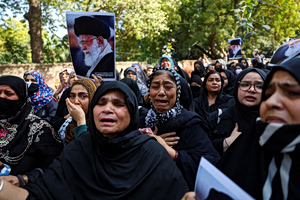
Then there is the question of command coherence. The assassination of Ali Khamenei on 28 February was not just a military event. It was a rupture in the logic of the Iranian state. His son Mojtaba was swiftly installed as supreme leader, but swiftly is not the same as legitimately. Killing a supreme leader does not kill a regime. But it does something else: it forces the succession question into the open before the institution is ready, and it does so under fire. When President Pezeshkian ordered the armed forces to halt missile strikes on Gulf states, the Revolutionary Guards continued firing. That detail will not be forgotten. It was broadcast to every regional capital, every intelligence service, every government that had been watching. Iran’s command structure cracked under pressure, publicly, in real time.
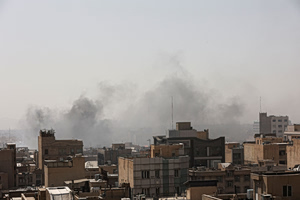
The Gulf dimension is where the strategic damage cuts deepest. For years, Iran’s regional influence rested partly on the acquiescence of its neighbors. Saudi Arabia, the UAE, Qatar: they had pursued détente, calculated that accommodation was cheaper than confrontation. That calculation is now gone. Iran’s decision to strike Gulf cities that had refused to facilitate the US-Israeli campaign, hitting Dubai’s airport, lighting fires near Doha’s financial district, targeting Saudi oil infrastructure, was not a show of strength. It was a strategic error that converted neutrals into adversaries. Riyadh and Abu Dhabi, already closing the gap between them, now share a specific grievance against Tehran. The GCC states are drawing conclusions about what a cornered Iran actually does when pressed.
None of this means Iran has lost in any simple sense. The regime has not collapsed. The Strait of Hormuz remains a weapon. The new supreme leader has consolidated enough authority to keep fighting. And Iran’s decision to widen the conflict, strikes across nine countries, oil prices past a hundred dollars a barrel, global supply chains in disruption, demonstrates that it retains the ability to impose costs. A weakened Iran is not a harmless Iran.
The United States and Israel have their own problems. Washington went into this war with objectives that do not quite fit together: nuclear degradation, regime change, missile force elimination, unconditional surrender. A strategy needs an endpoint; a list of goals is not the same thing. Congress is asking for an exit plan. The Strait of Hormuz cannot be reopened from the air. Trump may yet decide that a degraded Iran, stripped of its nuclear ambitions and most of its missiles, is victory enough and move to close the file. Israel will resist that. The gap between them is already visible and will widen. Whatever the outcome, neither country’s fundamental power is at stake in this war. That cannot be said of Iran.
Israel has achieved real things since October 2023. Hezbollah degraded. Hamas’s command structure broken. Iranian forward positioning across the region rolled back. These are not nothing. But achievement is not the same as resolution. Gaza remains ungoverned. The West Bank is hardening. Hezbollah, battered as it is, has not disarmed. And Israel is now a party to an open-ended war against a state of eighty million people, with no agreed definition of success and no obvious exit.
Here is what has actually been destroyed in this war. Not Iran’s capacity to cause harm, which persists. Not the regime, which survives. What has been destroyed is the model: the carefully constructed posture of proxy depth, strategic ambiguity and calibrated coercion that underwrote Iranian regional influence for two decades. That model depended on opacity, on neighbors calculating that Iran was too formidable and too unpredictable to confront directly. The war has burned through that opacity completely. The proxies are gone or hollowed out. The ambiguity is stripped away. And the coercion, turned against Gulf states that had chosen neutrality, has produced not deference but fury.
What Iran is left with, if it survives this war, is survival itself. That is not nothing. But it is considerably less than what it had before October 2023. The mask is off. And the region has seen what is underneath.