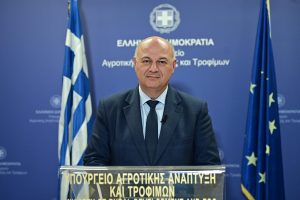
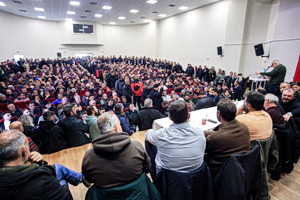
“Do we have a crisis de-escalation strategy?” This question was posed by Makis Voridis last Wednesday during the meeting of ND (New Democracy) MPs with Kostas Tsiaras. A former Minister of Rural Development asked the question, and before the current minister could answer, the former minister answered himself: “I,” he said, “don’t see anything like that.”
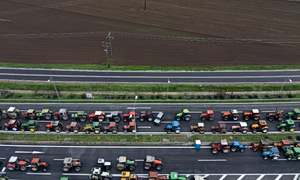
The truth is, we do have one. For thirty years, the “de-escalation strategy” has been the same and unchanged. A monoculture that another ND government, “under Karamanlis’ mandate,” once condensed into the slogan, “all the kilos, all the money.” Almost every year, farmers reaped the benefits of their road blockades. They received their subsidized wages and withdrew their tractors from the national roads.
So, atavistically, returning to the path of monoculture would have been enough to solve the problem—at least until around this time next year. Only the wound has festered too much to be healed with a similar “Mitsotakis mandate.” It festered not only because the OPEKEPE scandal erupted, but also because the agricultural sector itself has all the characteristics of chronic pathology. For decades, it has remained unreformed. And, as tragically proven in Tempi with the Greek railways, what is not reformed takes its revenge.
It seems a tragic irony. A government formed as a reformist one is dragged into reforms either through tragedies or prosecutorial orders. It was supposedly going to overturn the norms of the clientelist state. On the contrary, it served them, as in the case of OPEKEPE and the coffee breaks. And when the time for tragic irony arrives, it indulges in exercises of “communication management.”
This is how government MP Zetta Makri phrased it during the meeting with the minister: “What went wrong, and why did the situation get out of hand communication-wise?” Exactly. In public discourse, various communication models have emerged. The most hardline accuses farmers of being accomplices to the clientelist state and lazy, sitting in cafés all year in the uncultivated valleys until nature’s alarm clock signals it’s time to drive tractors onto the roads. They are also criticized as being addicted to subsidies and as archaic land cultivators. Why insist on small plots instead of forming cooperatives? Why grow cotton instead of filling households, supermarket carts, and office containers with Turkish lemons and Canadian lentils?
Those who demand farmers self-regulate harm the primary sector just as much as those who, with agricultural sentimentality, defend the “rural workers of life” and the justice of their struggles. From this perspective, it would be worthwhile to listen to those who speak not in slogans but with the numbers of others. Spanish, Dutch, or Israeli farmland, says one such statistic, yields more than 1,000 euros per stremma, while Greek farmland doesn’t even reach 300 euros. Why?
The answer here cannot be “who knows?” The explanation exists, not in the theory of counterproductive communication management, but in the reality of productive activity. It is explained by a reform that allowed the regions of other countries not to become deserted but to survive and flourish as centers of entrepreneurship advancing with cutting-edge technologies.
None of this was discussed during the meeting of angry government MPs with the responsible minister, nor is it discussed by opposition parties jockeying for position alongside the farmers. Why? Who knows. It’s probably the monoculture.