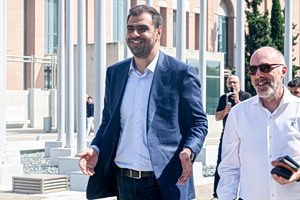
With the parade of political leaders before the cameras at the Thessaloniki International Fair (TIF) now at an end, we start, as we do every September, to encounter “politics on the ground.”
All the more so, given that few jaws dropped at the revelations the leaders made there. Because, while the parties promised “visions,” in reality they hardly strayed at all from a traditional programmatic agenda. And this at a time when the electorate is demanding—with far more urgency than even in the recent past—not just ideas or declarations, but evidence of coherent and comprehensive plans. This holds true even if their sparring focused more on the price tags of the suggested measures than their actual content.
This is both reasonable and to be expected. The managerial logic now prevalent in domestic politics does not allow for major deviations or drastic upheavals. At least not at the level of the three largest parties, which, according to the polls, are New Democracy (ND), Greek Solution (EL.LY), and PASOK. Obviously, there are disagreements, and substantial ones at that. But the impression gleaned was that they relate more to the “how,” the “how much,” and the “when.”
This—albeit programmatic—convergence is not a bad thing for Greek politics. Quite the opposite. Provided, of course, that it manages to rise above the usual partisan mudslinging, which, particularly with elections looming, is becoming increasingly unsavory.
Naturally, no one is under the illusion that political brawling can be transformed into something more decorous just months or weeks before an election. Especially at a time when the parties are barely on speaking terms.
On the other hand, reality itself is imposing some unexpected convergences and interactions. It is certain, for instance, that a national crisis (which we all hope to avoid) or a prolonged period without a government in place (which many fear) would put the debate back on a more rational and less politically charged footing.
But we are not there yet. And there is still some time until the elections.
If the TIF proved that the programmatic differences between the parties have been minimized, it is the job of politics to prove it has got the message.
So far, we have seen nothing to indicate it has, and this cannot be attributed solely to our being in the run-up to a general election.
Toxicity (from which even Alexis Tsipras felt the need to distance himself in his TIF speech) has burdened the face-off with an element of destructiveness.
The problem, then, is not the clashes themselves. They are integral to the cut-and-thrust art of politics. The problem is that they are not accompanied by efforts to find common ground where such a thing is feasible.
This year’s TIF provided many examples of this— of great expectations doomed to remain in the realm of the unattainable…perhaps most of all for those who proposed them.