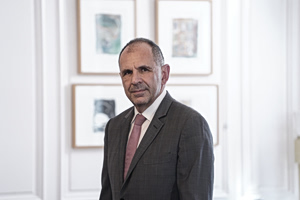
Greek Foreign Minister Giorgos Gerapetritis is scheduled to travel to Tripoli Monday in order to complete his second mission to Libya, following the first round of contacts with both sides in July 2025, within the framework of the diplomatic rapprochement between the two countries.
According to a briefing yesterday from the Greek Foreign Ministry, the head of Greek diplomacy is expected to hold separate meetings in Tripoli with the President of Libya’s Presidential Council Mohamed al-Menfi, the Prime Minister of the Government of National Unity Abdul Hamid Dbeibeh, the acting Minister of Foreign Affairs Al-Taher Salem Al-Baour, as well as the acting Minister of Oil and Gas Khalifa Rajab Abdulsadek.
High on the agenda of the meeting with eastern Libya—the side that has ratified the illegal and unfounded Turkey-Libya maritime memorandum—will be the setting of a timetable for the next round of technical talks on the delimitation of the continental shelf and Exclusive Economic Zone (EEZ), while at the same time procedures are underway for the political process that will reunite the two opposing sides.
During the visit of Libya’s acting Foreign Minister Al-Baour to Athens in September 2025, the start of negotiations on the delimitation of the EEZ between Greece and Libya was declared during his bilateral meeting with Gerapetritis.
What is jointly sought in Monday’s meeting is to reach a “white smoke” outcome regarding the timing of the next round of technical talks on EEZ delimitation, which this time is expected to take place in Tripoli.
Other issues that will certainly be put on the table concern the economy, migration flows, as well as the assistance that Greece can provide to Libya as a member of the European Union and as a member of the UN Security Council.
It is considered certain that the Greek side will reiterate that the country supports resolving the Libyan issue through the holding of fair and free elections without external interference, for the emergence of a representative government.
Greece consistently places great importance on maintaining active channels with both sides of Libya, with Benghazi and Tripoli, with the aim of curbing further Turkish influence as well as preventing the ratification of the Turkey-Libya memorandum by the western side as well.
Athens appears to be accelerating its pace regarding the resolution of pending issues with countries in the wider neighborhood, prioritizing—under the pressure of its role as an energy pillar of stability in the region with the backing of the United States—the delimitation of the remaining maritime zones with states with opposite coasts such as Libya.
A few hours before Gerapetritis’ arrival in Tripoli, Libyan media reported on the one hand that the eastern side (Dbeibeh) rejects the “Boulos project” for the region and on the other that “Athens is sending a coast guard mission to Libya to curb migration flows.”
Assessment of Macron Visit – Next Diplomatic Milestones
Having completed the chapter of Greek-French cooperation and following the holding of the Greece-Turkey High-Level Cooperation Council, which had been repeatedly postponed, Greece is setting its next diplomatic goals, which concern both Europe—with an upcoming mission to the Western Balkans—and the renewal of the Greece–US defense agreement, scheduled to be signed in 2026 within the framework of the sixth round of the Greece–US Strategic Dialogue.
As emerged from the recent statements of Prime Minister Kyriakos Mitsotakis during the visit of Emmanuel Macron, despite the uncertainty projected regarding US intentions both for the future of NATO and for transatlantic relations, Greece appears to be looking steadily at the “big picture” and beyond current crises, identifying opportunities for further mutually beneficial cooperation with the United States, especially under the threat of China.
The country is moving toward its next diplomatic milestones, having clearly entered a new era of Greek-French relations, as was strongly reflected during Macron’s recent official two-day visit to Athens.
In the aftermath of what took place during the French president’s presence in the Greek capital, competent sources speak of a “multifaceted visit” which, beyond the nine agreements it produced with the backbone being the “enhanced comprehensive strategic partnership,” also clearly reflected Macron’s “very positive assessment” of Greece as well as the “very good interpersonal relationship” at the level of leaders and ministers of the two countries.
As the same sources comment, at a particularly critical juncture for the European continent and the world in general, Greece and France strengthened their bilateral cooperation, gaining a clear lead regarding the next day in Europe, while at the same time jointly forging a model of cooperation in defense, diplomacy and security for Europe’s immediate future.