
 Μake us preferred on Google
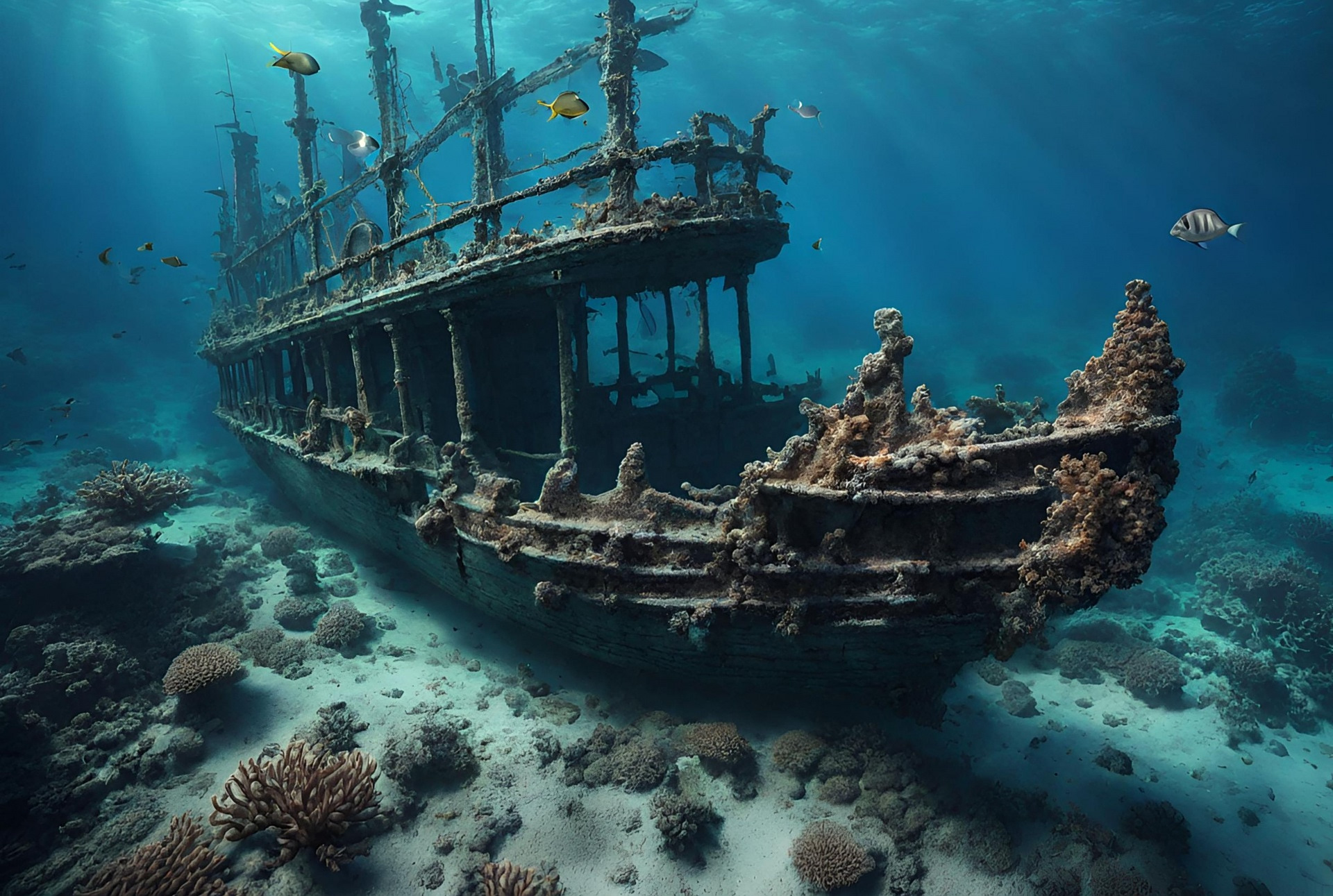
 Spanish archaeologists have located more than 30 shipwrecks in the bay between the port of Algeciras and the Rock of Gibraltar, in an area identified with the ancient Pillars of Hercules. The finds span a period from the 5th century BC to World War II, revealing the region’s long maritime history.
The bay, at the northern end of the Strait of Gibraltar separating Europe from Africa, has for millennia served as a passage for trade and war. Phoenician and Roman ships have sunk there, as have British, Spanish, Venetian, and Dutch vessels, and even some aircraft.
As part of a three-year research programme by the University of Cádiz, 151 archaeological sites were identified, of which 134 are shipwrecks. So far, 34 have been documented, in collaboration with the University of Granada.
The oldest wreck belongs to a ship from the Phoenician period of the 5th century BC. Among the other finds are 23 Roman ships, two from the late Roman period, four medieval vessels, and 24 from the early modern era.
Among the most impressive underwater discoveries are a Spanish 18th-century gunboat and the engine and propeller of a 1930s aircraft. These objects tell a story of wars, trade, and exploration around one of the world’s most strategically important maritime passages.
The “Aquatic Crossroads” of Civilisations
Professor of Archaeology at the University of Cádiz, Felipe Cerezo Andreo, who heads the Project Herakles programme, describes the bay as an aquatic crossroads of civilisations. “It is one of those bottleneck points through which ships always had to pass, whether on commercial voyages, exploration missions, or due to armed conflicts,” he stated.
According to him, few places in the Mediterranean present such a great variety of archaeological remains. “We have Dutch, Venetian, Spanish, and of course English ships, almost every nationality, as all of them crossed the strait, either heading towards the Atlantic or entering the Mediterranean,” he noted.
From the Islamic Middle Ages to 18th-Century Warships
Of particular interest is the documentation of three medieval ships that may shed light on navigation during the late period of Islamic rule in southern Spain. Among the most significant finds is the wreck of the Puente Mayorga IV, a small gunboat from the late 18th century, used for surprise attacks against British ships around Gibraltar.
These vessels disguised themselves as fishing boats before revealing their cannons and attacking. Although they are mentioned in historical sources, they have been little studied by archaeologists. Cerezo humorously described an incident during excavation when a wooden box shaped like a book was initially thought to be a spy object, but turned out to contain two wooden combs.
Risks and Protection of the Wrecks
Cerezo and his team are calling on the regional government of Andalusia and Spain’s Ministry of Culture to take protective measures for the sites in the Bay of Algeciras, also known as the Bay of Gibraltar. These areas are threatened by port construction works, dredging, and the climate crisis, which is raising sea levels and altering sediments, while an invasive algae is covering the wrecks.
To raise public awareness, the researchers have created virtual models and 360-degree videos, available online and in local museums. “We bring special glasses so that those who don’t dive can experience a ‘dry dive’,” said Cerezo, adding that although the wrecks don’t resemble “treasure vaults” as in stories, showcasing them boosts interest in their preservation.
A Mirror of Naval History
The seabed of the bay offers, according to Cerezo, a unique microcosm of thousands of years of maritime and cultural evolution. “In a very small space we can analyse the evolution of the naval history of the Iberian Peninsula and North Africa,” he stressed.
Studying these remains, he added, allows scientists to reconstruct the relationship of coastal societies with the sea and to tell the story of the people who lived and travelled upon it.