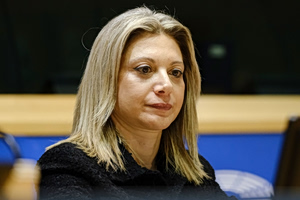
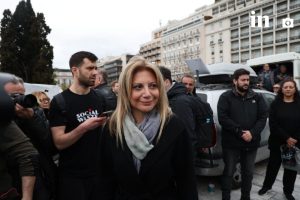
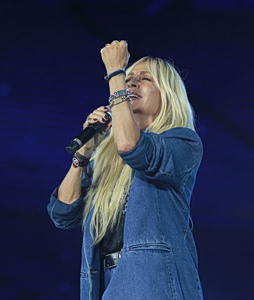
Maria Karystianou officially unveiled her new political party, “Hope for Democracy,” at an event in Thessaloniki on Wednesday, marking the movement’s first public appearance. However, the gathering fell short of the expectations of party organizers, who had anticipated a much larger turnout.
Party volunteers had been stationed outside the Olympion cinema from early afternoon, assisting attendees and collecting signatures in support of the party’s founding declaration. Organizers had reportedly expected between 2,000 and 3,000 people to attend, even installing a giant screen outside the venue to accommodate the anticipated crowd. Yet when the event was scheduled to begin, the auditorium was only partially filled, highlighting a gap between the party’s online popularity and its real-world mobilization.
Delayed Arrival and Diverse Supporters
Karystianou arrived at the venue approximately 45 minutes after the official start time, accompanied by music from the iconic soundtrack of Zorba the Greek. Earlier, songs by singer-songwriter Nikolas Asimos had been played over the loudspeakers, while live music was also performed by a participant known from a popular television talent show.
The audience reflected a broad mix of backgrounds and viewpoints. Before the event began, supporters addressing the crowd included a farmer-poet, a fashion designer and a healthcare worker who had previously staged a hunger strike during the COVID-19 pandemic. Volunteers also included figures associated with Greece’s anti-austerity protest movement of the previous decade.
Among those present was former regional politician Panagiotis Psomiadis, who expressed optimism about Karystianou’s political initiative. One attendee wearing a shirt bearing the name of Russia described the new party as “our last hope.”
Presenters and Symbolic References
The event was hosted by journalist Thanassis Avgerinos, a longtime correspondent in Moscow, and actress, producer and activist Katerina Moutsatsou, who previously stood as a candidate in the 2024 European Parliament elections with a smaller political movement.
Moutsatsou spoke about what she described as the need to restore democracy, while Avgerinos drew attention with a T-shirt featuring Russian literary figures Fyodor Dostoevsky, Leo Tolstoy and Anton Chekhov. He remarked that he hoped even those names had not become “forbidden words,” adding that he had chosen to highlight Dostoevsky because of the novel Crime and Punishment.
“Those who committed crimes should know that punishment is approaching. That is how democracies work,” he told the audience, drawing loud applause.
Music, Patriotism and Messages of Support
The event also featured pre-recorded video messages from members of the Greek diaspora, young people, farmers and other supporters of the new party. Among those appearing in the videos was Stavros Kalenderidis, the son of commentator Savvas Kalenderidis.
When the song “Kai Na Aderfe Mou” by renowned Cretan singer Nikos Xilouris was played, many attendees applauded and quietly sang along. In another video segment, the Greek national anthem was played, prompting the audience to stand. When the recording ended before the anthem was completed, some attendees called out for it to continue.
Karystianou’s Speech
Karystianou received a warm reception when she took the stage, with supporters chanting slogans such as “Go forward, Maria” and later “With you, Maria, let the mafia go.”
She began by reading large sections of the party’s founding declaration, which had been published on the movement’s website earlier in the day. “We are facing attacks and ridicule. They will try to divide us, but they will not succeed. We are not professional politicians afraid of losing our seats,” she said.
“Today, hope for democracy is born. Without hope, societies die and people suffocate. It suited some interests to keep us divided.”
Karystianou described herself as “a mother and a person who was forced to confront the dysfunctions we have experienced for years,” adding that efforts to seek justice had encountered what she called “dark mechanisms” designed to prevent society from learning the truth.
“Millions of people took to the streets not because they were called by a political party,” she said. “It is not normal for the powerful to feel untouchable. This is not the Greece we deserve or want to leave to our children.”
She argued that justice must return to its rightful place “above everyone and for everyone” and insisted that the movement’s goal was not to manage decline but to change the country’s direction.
“I am not asking you to believe in saviors, but in the power of citizens,” Karystianou concluded. “This movement does not belong to interests or political machines. You see me standing here alone, but I am not alone. Beside me stand those who were unjustly lost.”