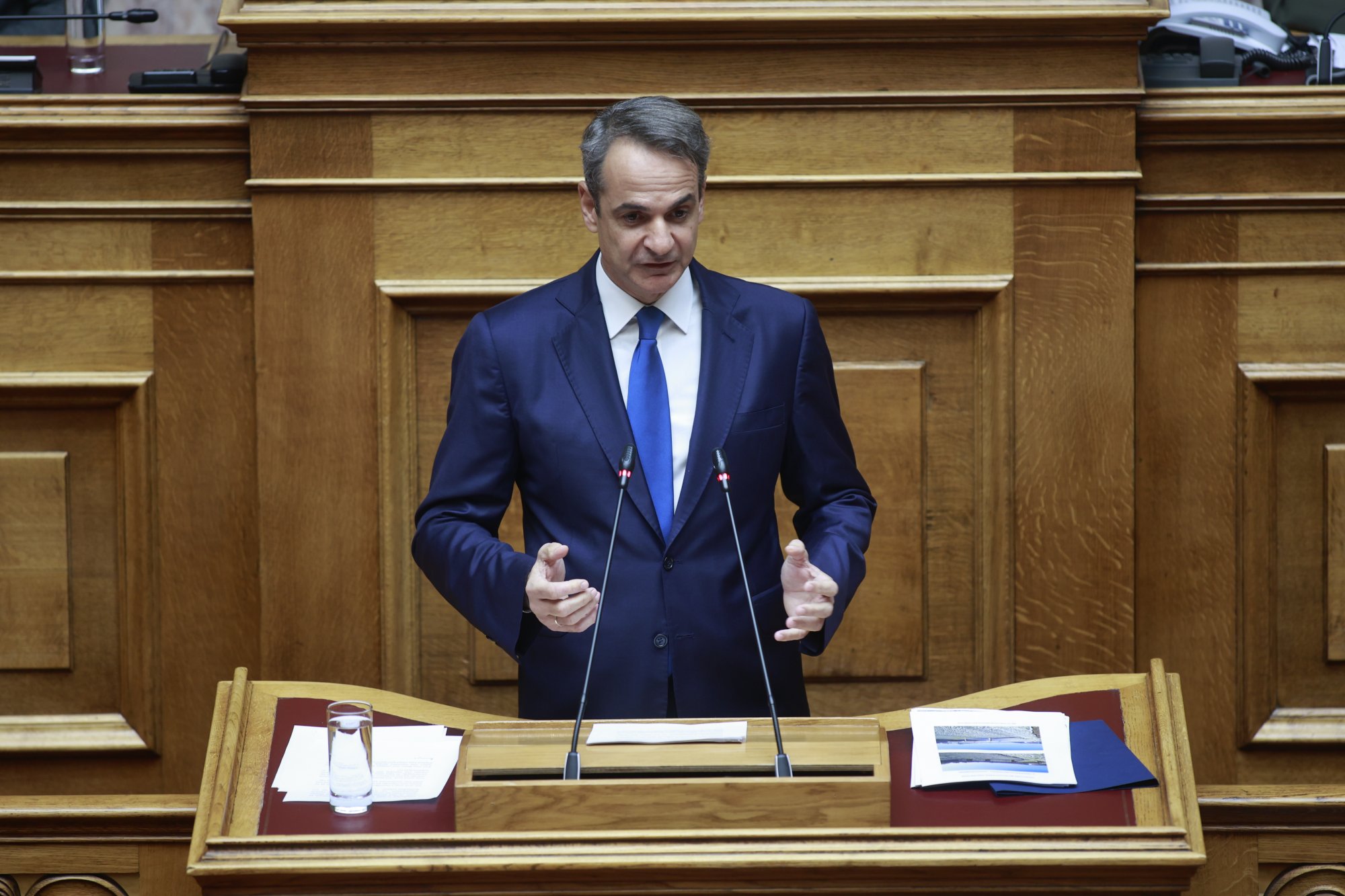
A heated exchange over Greece’s cost-of-living crisis unfolded in Parliament on Friday, as Prime Minister Kyriakos Mitsotakis and Nikos Androulakis, leader of the main opposition PASOK party, traded accusations over who is to blame for soaring prices and mounting private debt.
The debate, triggered by a question from Androulakis on inflation and household obligations, was the first leaders’ confrontation held under a new “time-cutter” rule that strictly limits speaking time. Within that compressed format, the two men offered sharply contrasting stories of where the Greek economy stands, and whom it serves.
Competing narratives on what is driving high prices
Mitsotakis opened by placing the current squeeze on Greek households in a global context. He reminded lawmakers that his center-right government took office in 2019 after what he called an “unnecessary” decade-long crisis, and argued that today’s inflation is primarily the result of external shocks.
He cited the wave of government spending during the pandemic, the surge in demand once restrictions were lifted, the energy shock following Russia’s invasion of Ukraine and what he described as a “global battle over tariffs” as the main drivers of higher prices.
“The roots of the price increases go back in time,” he said, insisting that Greece’s position “is certainly not what some claim.” He rejected as a “myth” the idea that Greece has the most expensive electricity in Europe, saying data place the country in the middle of the European pack, and in an even better position once purchasing power is taken into account.
Androulakis countered that this global framing ignores the daily reality of Greek households. “Society is outraged by the cost of living and the cost of production,” he said. “It is outraged with you, because you keep announcing measures that do not solve any problem, with the result that daily life becomes more difficult.”
He pointed to what he said is a 34 percent increase in living costs, especially for food, and noted that half of Greek families can no longer afford vacations. Farmers, he argued, are losing out while intermediaries profit, and small businesses are being “choked” by debt and energy costs.
Wages, rents and the question of who is falling behind
At the heart of the clash was a simple but politically explosive question: Are Greek incomes keeping up with prices?
Mitsotakis insisted that the government’s strategy is working. “The best answer to high prices is the permanent increase of incomes,” he said. He cited an 11 percent rise in real per capita income and a 38-billion-euro increase in household deposits over six years as evidence that the overall picture is improving. He also pointed to a fall in unemployment from 18 percent to 8 percent and said his government has enacted eighty-three tax cuts, measures he described as structural support rather than “tips” for the middle class.
Androulakis challenged that narrative, arguing that official averages conceal a large portion of society that is barely scraping by. He referred to data indicating that 62 percent of households say they are “just getting by” and that Greece is one of the few countries in the eurozone with negative savings, meaning many families are drawing down reserves to cope with everyday expenses.
He cited statistics he said come from Eurostat suggesting that Greece now has the second lowest average wage in the European Union for 2024, adding pointedly that “even Hungary has surpassed us.” For the poorest three million citizens, he argued, the government’s tax measures offer “no relief.”
Housing, taxes and who benefits from policy
Rising rents — a pressing concern in Greece’s big cities and tourist areas — provided another flash point. Mitsotakis acknowledged that rents have spiked but described this as “the other side of an economy that is doing well.” He noted that the state spends 250 million euros a year on rent subsidies and signaled that he is ready to go further.
“I am prepared next year to reduce even more the tax on rental income,” he said, presenting that move as part of a broader effort to ease the burden on tenants without jeopardizing fiscal stability.
On taxation, Mitsotakis defended a new bill that, he said, focuses heavily on young workers. He reminded Androulakis that PASOK backed roughly three quarters of its provisions and accused the opposition leader of trying to both support and denounce the same measures. The government, he insisted, must respect the limits of the “fiscal space” available, arguing that promises of additional relief must be matched with clear ideas on how to finance them.
Androulakis replied that the government has left Greece’s long-standing imbalance between direct and indirect taxes largely untouched and that this “sick relationship,” as he described it, has “become worse.” He said the latest package does not touch “big interests” and instead creates “huge new inequalities,” while the poorest see none of the benefits.
On banks, he accused the government of allowing them to present themselves as benefactors in schools “with the people’s money,” and argued that PASOK’s proposal for a one-off tax on bank profits would have been a fairer path.
Markets, oversight and the battle over credibility
Beyond income and taxes, the two leaders clashed over how tightly the state should police markets.
Mitsotakis said his government has strengthened oversight with a unified market authority and that enforcement is producing results. He told lawmakers that 20 million euros in fines related to profiteering have been collected and said the state reclaimed 90 percent of excess profits from electricity producers. He argued that some proposals from the opposition, such as broad cuts in value-added tax, sound appealing but in practice mainly benefit retailers rather than consumers. “The Greek economy cannot withstand a horizontal reduction in VAT,” he said.
Androulakis accused the government of “believing that the market regulates itself” and therefore failing to set real limits on excessive pricing. He derided a recent list of 2,000 products targeted for price reductions as poorly designed, saying basic fresh foods such as meat, fish and fruit were absent while symbolic items appeared, and pressed Mitsotakis to explain why a government price-monitoring platform had gone offline.
He called for a genuinely independent consumer protection authority “with real power,” accusing the government of merging services “without independence and therefore without strength,” and repeatedly demanded more transparency on how many fines have actually been collected.