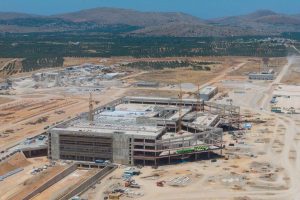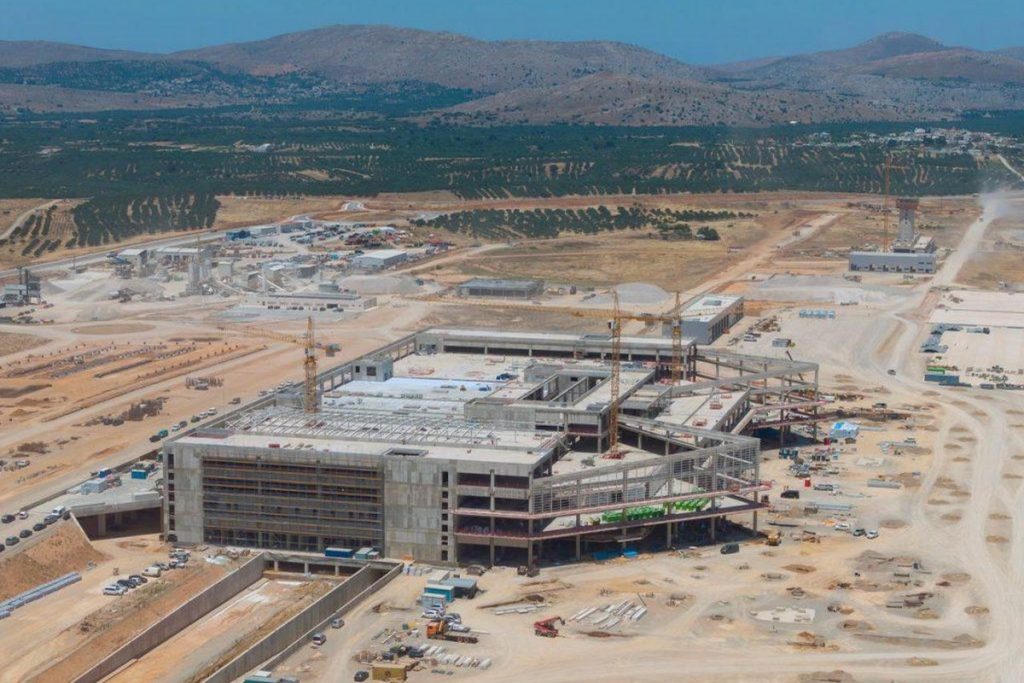
Prime Minister Kyriakos Mitsotakis visited the construction site of the new Heraklion International Airport in Kasteli on Friday, marking the launch of a key international tender for the airport’s aeronautical systems and reaffirming the government’s commitment to begin operations in 2028.
Describing the project as “the most important construction site in the country,” Mitsotakis said the new airport would be “the most modern in the Mediterranean” and a catalyst for Crete’s long-term development.
Government Signals Commitment to Crete Project
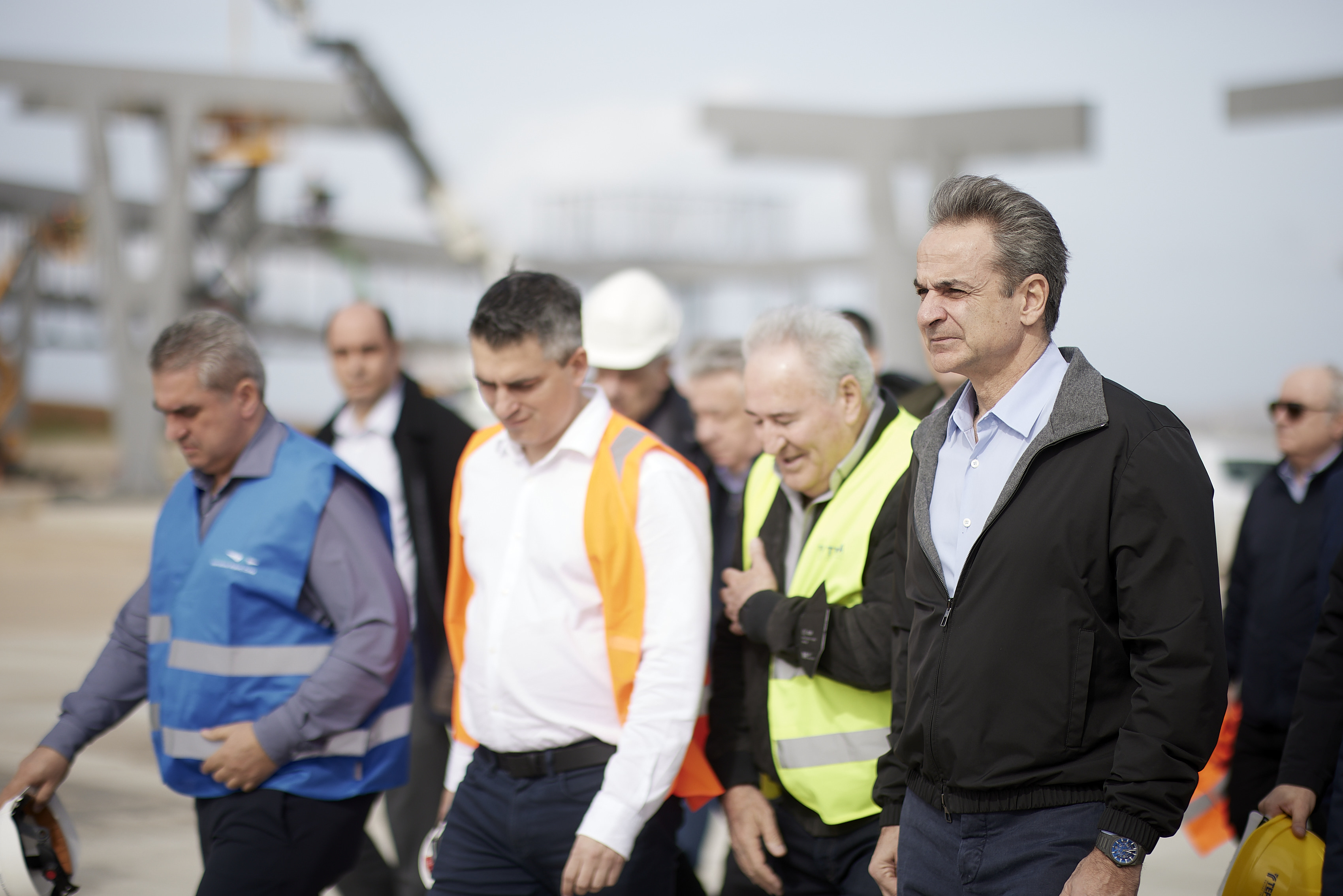
Mitsotakis arrived in Crete on Friday morning and toured the site alongside Infrastructure and Transport Minister Christos Dimas, Climate Crisis and Civil Protection Minister Giannis Kefalogiannis, Crete Regional Governor Stavros Arnaoutakis, GEK Terna CEO Georgios Peristeris, as well as local lawmakers, officials and the Metropolitan of Arkalohori, Kasteli and Vianos.
“The Cretan air always fills us with optimism,” he said upon arrival, according to Creta Live News.
Speaking at the site, Mitsotakis said Crete “is entering the third decade of the 21st century at great speed, resolving pending issues from the past and shielding itself with infrastructure projects that will give it unprecedented growth and momentum.” He referred not only to the new airport but also to the Northern Road Axis of Crete, another major infrastructure project on the island.
Noting his personal ties to the island, the prime minister said he feels “special satisfaction” as both head of government and a Cretan that long-standing infrastructure gaps are being addressed.
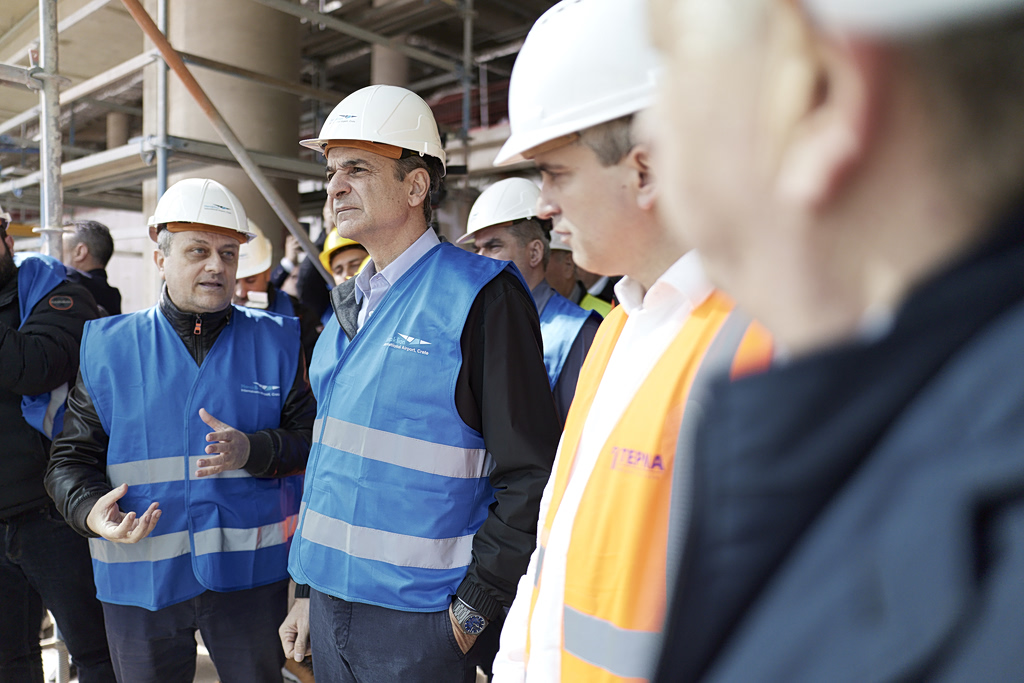
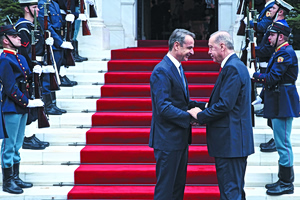
Prime Minister Kyriakos Mitsotakis visits the construction site of the new international airport in Kasteli, Heraklion regional unit, Crete, Friday, Jan. 30, 2026. (Prime Minister’s Press Office / Dimitris Papamitsos / EUROKINISSI)
He also said the new airport will handle more than double the number of flights currently served by Heraklion’s existing “Nikos Kazantzakis” Airport, adding that the future redevelopment of the current airport site would benefit the city.
Construction of the new facility has reached 67%, according to Minister Dimas, who confirmed that operations are expected to begin in 2028.
Key Aeronautical Systems Tender Launched
The focal point of the visit was the signing of an agreement enabling an international tender for the airport’s aeronautical systems, a phase considered essential for certification and the safe start of operations.
According to ot.gr, the agreement allows Heraklion International Airport S.A. (DAIK) to proceed with an international competition for the procurement of air navigation and related operational equipment that will equip the new airport.
The contract was co-signed by Dimas, acting Civil Aviation Authority Governor Georgios Vagenas and Nikos Anastasiou, general director of GEK TERNA Group Chairman and CEO Georgios Peristeris was present at the signing.

Prime Minister Kyriakos Mitsotakis visits the construction site of the new international airport in Kasteli, Heraklion regional unit, Crete, Friday, Jan. 30, 2026. (Prime Minister’s Press Office / Dimitris Papamitsos / EUROKINISSI)
This signing of the tender has been described as one of the most “sensitive” components of the nearly €1 billion investment, which is being implemented under a concession agreement by the GEK TERNA–GMR consortium. The Civil Aviation Authority has approved a strict timetable for the tender process, leaving limited room for delays. Timely completion is seen as critical to keeping the 2028 launch target intact.
A New Gateway for Crete
The Kasteli airport complex will span 93,000 square meters and, once completed, will be Greece’s second-largest airport and among the most modern in the Mediterranean.
In its initial phase, it is expected to serve between 9.5 million and 10 million passengers annually, with expansion capacity reaching up to 15 to 20 million passengers per year.
The new airport will replace the existing Heraklion facility and will include a 3,200-meter runway capable of accommodating wide-body aircraft such as the Boeing 747 and Airbus A330.
It will also be the first airport in Greece equipped with a MARS (Multiple Apron Ramp System), allowing greater flexibility in gate management, along with two passenger boarding bridges. The infrastructure will enable the handling of Code D and E aircraft, according to International Civil Aviation Organization classifications.
The terminal will extend across seven levels and incorporate intelligent operational and passenger service systems, positioning the airport as a next-generation hub for Crete, one of Greece’s most popular tourist destinations.
Legal and Timing Challenges
Despite steady construction progress, the project faces procedural and legal hurdles.
Creta Live News reports that a legal appeal remains pending before Greece’s Council of State, the country’s highest administrative court. The Municipality of Minoa Pediada has challenged the planned location of a radar installation on Papoura Hill, where archaeological excavations have uncovered significant Minoan-era remains.
Mitsotakis said the chosen solution balances the protection of important cultural heritage with the operational needs of the airport, adding that the matter will ultimately be decided by the court.
Later on Friday, the prime minister is scheduled to travel to Zagreb for a meeting with Croatian Prime Minister Andrej Plenković and to attend a two-day gathering of European People’s Party leaders.
Source: amna.gr, ot.gr, cretalive.gr