Six years after Greece and Egypt signed their landmark Exclusive Economic Zone (EEZ) agreement, Athens continues to pursue maritime boundary agreements with neighboring countries, maintaining that international law and diplomacy remain the foundation of its strategy.
On August 6, 2020, the foreign ministers of Greece and Egypt signed the EEZ agreement in Cairo. According to the Greek government, the deal effectively nullified the illegal and legally unfounded Turkey-Libya maritime memorandum while affirming the sovereign rights and maritime entitlements of Greek islands, including Crete, Rhodes, and Karpathos, over their continental shelf and EEZ.
At the time, Greece’s Foreign Ministry said the agreement reaffirmed that adherence to the Law of the Sea is both a necessary and sufficient basis for delimiting maritime zones between countries in the region.
Following the same approach, Greece—which also signed an EEZ agreement with Italy in June 2020—continues to seek the completion of its remaining maritime boundary agreements through diplomatic channels, with the long-term goal of promoting lasting peace in the region.
According to the report, the Greek government’s preferred outcome would be to conclude agreements during its current term with all three neighboring countries with which it has expressed interest in EEZ negotiations: Turkey, Libya, and Albania. However, political disagreements, geopolitical developments, and other factors have slowed progress, although officials see cautious reasons for optimism in some cases.
Libya talks continue
Greece is currently holding technical talks with Libya on EEZ delimitation. It has completed a third round of discussions with authorities in Tripoli while also maintaining communication channels with Benghazi.
A key obstacle remains Libya’s political division.
Nevertheless, Greek diplomacy says its renewed engagement with Libya since last summer has prevented Benghazi from ratifying the Turkey-Libya maritime memorandum. At the same time, Athens has continued building a dialogue with the Tripoli-based authorities that, according to diplomatic sources, “does not start from scratch.”
The report says Greece views Libya’s apparent respect for the so-called median line in its recent offshore licensing process as a positive sign and believes Libya is seeking a “genuine dialogue.”
As technical discussions continue, Athens is also closely monitoring efforts to reunify Libya while remaining in close contact with the United Nations and U.S. regional official Massad Boulos.
Albania and Turkey
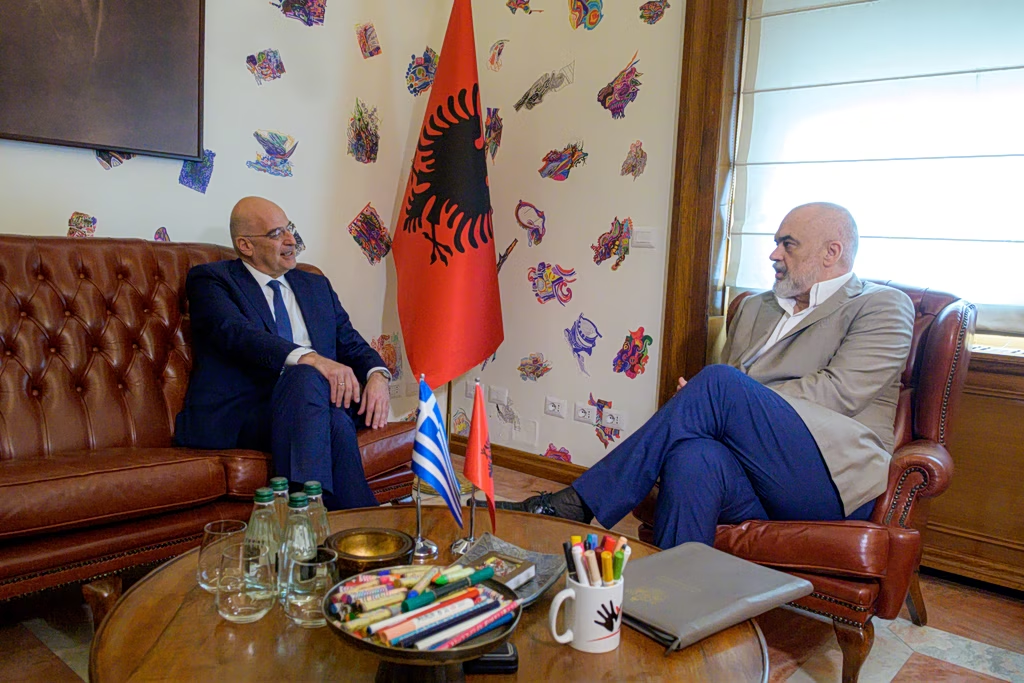
Regarding Albania, Prime Minister Edi Rama has previously stated that all outstanding bilateral issues should be resolved by the end of 2026. However, according to the report, there are currently no preparatory steps underway in Tirana toward an EEZ agreement with Greece.
The article notes that negotiations could regain momentum from September, potentially leading to renewed discussions on signing a special agreement that would refer the dispute to the International Court of Justice in The Hague, in the context of Albania’s European Union accession process.
Turkey remains the most challenging case for maritime delimitation.
Although the leaders of Greece and Turkey publicly signaled goodwill for dialogue on maritime issues during the recent NATO summit in Ankara, the Greek side says there is currently no realistic prospect of a bilateral EEZ agreement because the two countries disagree over the scope of negotiations.
Greece maintains that the only outstanding issue is the delimitation of maritime zones in the Aegean Sea, while Turkey insists on discussing what Athens describes as “interlinked issues.”
According to a Greek official cited in the report, discussions on an EEZ will not begin “unless the Turks first come to the Greek side,” while Turkey is simultaneously preparing legislation related to its “Blue Homeland” maritime doctrine.