 Μake us preferred on Google
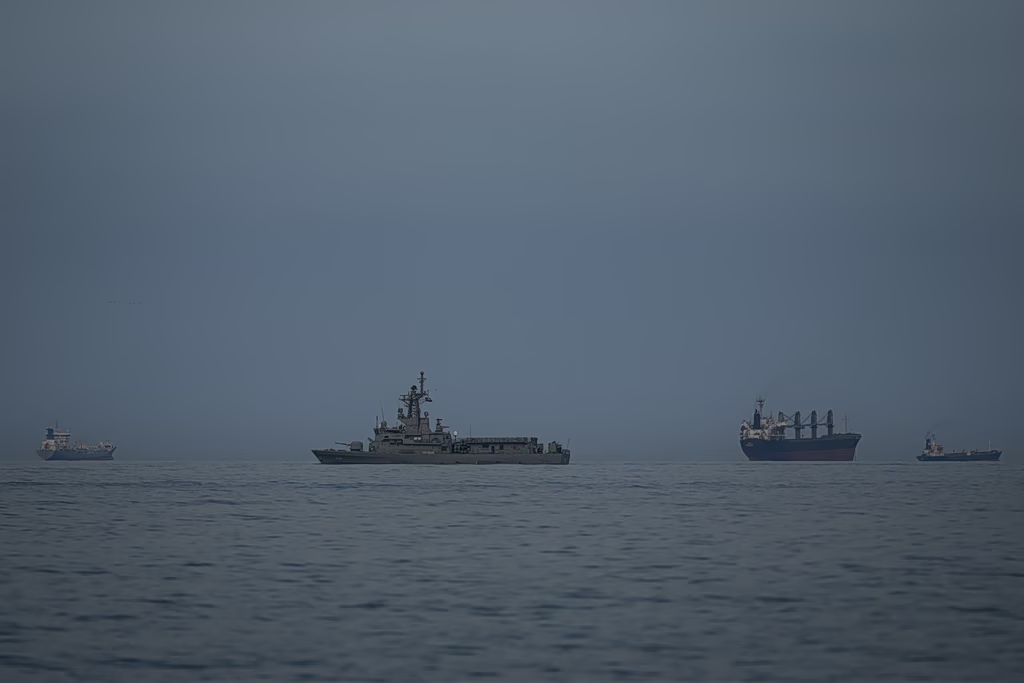
 For Athens, the de facto closure of the Strait of Hormuz and, by extension, the entrapment of Greek-owned vessels in the Persian Gulf is evolving into a major problem with no realistic prospect of resolution in the near term.
Beyond the understandable concern it causes within Greece’s shipping community—home to the world’s most powerful merchant fleet—the situation undermines Greece’s longstanding priority of safeguarding free navigation. It creates a troubling fait accompli in global maritime trade routes and highlights Athens’ limited ability to influence Tehran’s policy.
Meanwhile, US President Donald Trump is increasing pressure on Europeans and NATO to protect their interests—and therefore their vessels and cargo—in the Strait of Hormuz. At the same time, the number of countries interested in participating in a force that would deploy to the region—only after hostilities cease—continues to grow. However, as days pass and the scale of the damage becomes clearer, Iran is developing and implementing additional mechanisms of control over the Strait, regardless of how the war unfolds.
On the opposing side
Despite the adverse environment, Athens is orienting itself toward new diplomatic initiatives in order to secure the exit of ten Greek vessels and 89 Greek seafarers who remain inside the Persian Gulf. Foreign Minister George Gerapetritis is in regular contact with all his counterparts. However, his first attempt—an exchange on Saturday, 28 March with Iran’s Foreign Minister—did not yield the desired outcome.
According to cross-checked information, Abbas Araghchi explained that only vessels from “friendly countries” pass through the Strait of Hormuz unhindered. Greece, clearly, does not belong to this category. Tehran, despite long-standing diplomatic channels that had remained open for years (through the Greek embassy and with shipping and trade as the backbone of bilateral relations), has now placed Athens in the opposing camp.
This development is attributed both to Greece’s close ties with Tel Aviv and Washington—Gerapetritis notably met US Secretary of State Marco Rubio at the White House just hours before the outbreak of war—and to the government’s official position on the need to control Iran’s ballistic and nuclear program as a precondition for regional peace. The activation of a Patriot missile battery against Iranian missiles, in protection of Saudi territory, and the publicity surrounding the incident further irritated Tehran.
According to a Greek diplomat who recently served in Iran, Araghchi is not known for his conciliatory approach. “He is a veteran of the diplomatic corps, has served in key positions, and above all he is tough and suspicious,” he tells To Vima. He adds that “he is fully accepted by the Revolutionary Guards, who now effectively control everything taking place in the Strait of Hormuz.” It is recalled that the Mitsotakis government has had limited engagement with Iran, while on 12 March the Greek embassy in Tehran was withdrawn for security reasons.
The problem, however, is not limited to the immediate fate of the ten Greek vessels. In Athens there is a prevailing view that the relationship with the United States, Israel, and the Arab world should not in any case be jeopardized in exchange for protecting the Greek-owned fleet. Even though shipping is widely recognized as a defining element of national identity and a potential instrument for expanding Greece’s diplomatic footprint, the government’s priority remains the preservation of strategic alliances with key regional powers.
The situation is further complicated by recent Iranian parliamentary legislation foreseeing transit fees for passage through the Strait of Hormuz, which Tehran considers part of its territorial waters. In other words, Iran would decide who passes, when, and at what cost through this critical chokepoint—unless a foreign power manages to take control of the area, a prospect widely considered unlikely.
Concern within the shipping industry has intensified further after a Kuwaiti-flagged tanker was struck by a missile off the coast of Qatar last week.
“If we move toward a toll-based system, where fees today could exceed $2 million per transit, costs will be fundamentally transformed for Greeks as well,” a shipping market executive told To Vima, adding that such a development would reduce the competitiveness of the Greek-owned fleet compared to Indian and Chinese operators, who maintain strong relations with Iran.
It must be made clear that the Persian Gulf is not only used by tankers carrying Iranian oil, but by hundreds of vessels transporting a wide range of goods to and from Arab countries. The broader picture is that the disruption in the Strait of Hormuz breaks critical links in the global supply chain. This is why in recent days Saudi Arabia and the United Arab Emirates have been leaning toward offering support both to the United States and to any potential international maritime protection force in the Gulf.
The “35” and the Security Council
At the same time, Greece joined on Thursday the initiative of 35 countries willing to deploy naval forces to the Strait of Hormuz, provided that a ceasefire is first achieved. These include Europe’s major powers (the United Kingdom, France, Italy, Germany, the Netherlands), as well as Canada, the UAE, and the Scandinavian countries.
Gerapetritis participated the same day in a video conference of the 35, where he outlined the implications of the strait’s closure for Greece. According to To Vima, the Foreign Minister proposed that the mandate for deploying the naval force in the region should, in the long term, acquire a more permanent character. Athens recognizes that even if hostilities subside, reopening maritime trade routes will not be a simple task. Iranian actions in the Strait of Hormuz point precisely in that direction.
Meanwhile, Bahrain, acting as rotating president of the UN Security Council, promoted a draft resolution on how best to address the closure of the strait. The initiative ultimately failed due to objections, mainly from China and Russia and secondarily from France, although Council members (including Greece) remain in continuous consultations to break the deadlock.
While it is desirable for the international naval coalition to be backed by a UN resolution, disagreements persist over the mandate’s nature and scope, particularly regarding the use of force, ahead of the Security Council’s convening. Similarly, differing views exist among the 35 countries themselves. The nature of such a heterogeneous coalition, after all, could hardly suggest otherwise.