

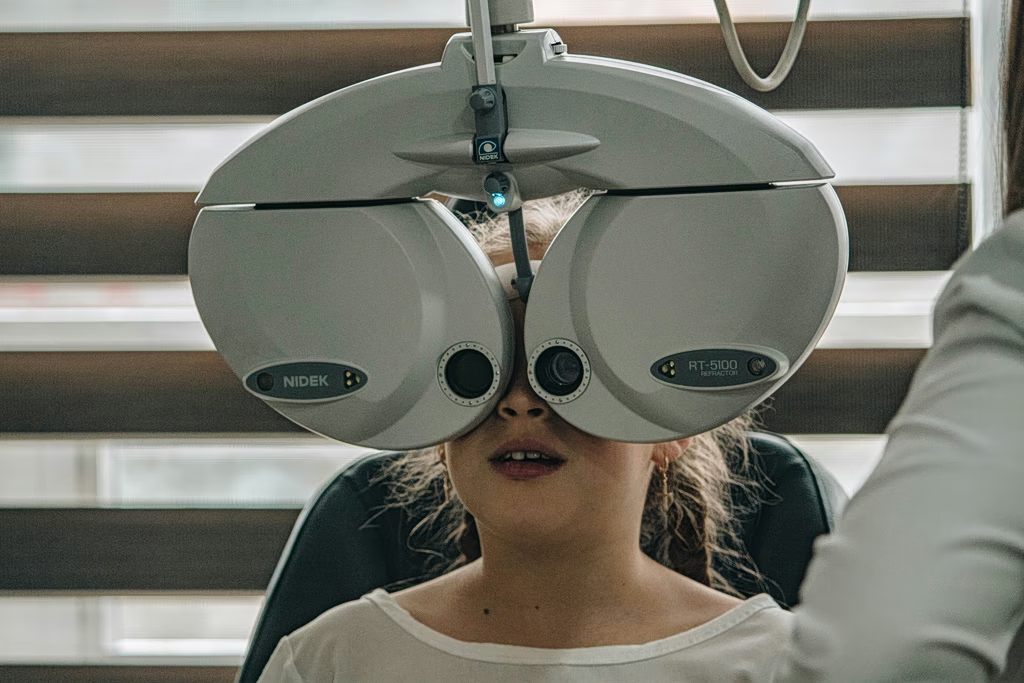
Significant gaps in the prevention and early diagnosis of vision problems in children are being created by the absence of organized ophthalmological screenings conducted by eye doctors, warns the Hellenic Ophthalmological Society.
As the Society notes, in the past, widespread screenings were carried out among students across the country. Today, however, this practice appears to have been largely abandoned, resulting in many eye conditions going undetected at an early stage.
International experience, meanwhile, shows that vision screening between the ages of 3 and 5 is particularly important when performed by ophthalmologists—not by other related professions—as it allows for early diagnosis and treatment before the critical period of visual system development is completed.
Based on recommendations from the U.S. Preventive Services Task Force, all children aged 3 to 5 should undergo at least one vision screening by an ophthalmologist. This helps detect amblyopia—commonly known as “lazy eye”—as well as the risk factors associated with it.
Scientific studies show that approximately 1% to 6% of children under the age of 6 develop amblyopia or risk factors for it, such as strabismus (eye misalignment) or anisometropia (unequal refractive power between the eyes). Systematic reviews and meta-analyses indicate that the prevalence of amblyopia typically ranges from 1% to 5%, while in Europe it is estimated at around 2.6% of the child population.
The effectiveness of population screening is also reflected in specific indicators. Studies have shown that vision screening at ages 3–4 can prevent one case of amblyopia for approximately every 48 children examined.
Good vision plays a direct role in the learning process. Children with learning difficulties or autism spectrum disorders, in particular, should undergo a full ophthalmological examination to rule out vision-related factors that may hinder their educational progress.
Recent epidemiological data indicate that specific learning disorders affect approximately 5% to 15% of school-aged children, while autism spectrum disorder occurs in about 1 in 31 children. For this reason, international scientific bodies such as the American Academy of Pediatrics, the American Academy of Ophthalmology, and the American Association for Pediatric Ophthalmology and Strabismus emphasize that every child with learning difficulties should undergo a comprehensive eye examination to exclude underlying ophthalmological conditions that may affect school performance.
Screening is the first step in identifying potential problems and should not be confused with a full medical diagnosis. A simple measurement of visual acuity alone is not sufficient for a complete assessment of visual function.
An ophthalmological examination is not an invasive medical procedure. Organized preschool screening is aimed solely at early detection of conditions and does not involve treatment interventions or restrict individual rights. On the contrary, it helps prevent delayed diagnoses in cases where early treatment is crucial for proper visual development.
A full vision assessment is a medical act carried out by an ophthalmologist. It includes, among other things, evaluation of eye movement and strabismus, examination of the eye’s structures, assessment of the anterior and posterior segments, as well as specialized tests such as cycloplegic refraction when necessary. This comprehensive approach allows for early diagnosis not only of amblyopia but also of other eye conditions.
Greece has a significant number of ophthalmologists and the capacity to ensure universal access to full medical eye examinations before children begin school. Utilizing this capacity could reduce delayed diagnoses, prevent permanent visual impairment, and ensure equal educational opportunities for all children.
The Hellenic Ophthalmological Society stresses that preschool vision screening is not a mere formality, but an essential measure for prevention and public health.
In this context, it proposes the reinstatement of organized, universal, and mandatory preschool vision screening before enrollment in primary school; ensuring that the examination is performed by an ophthalmologist as a full medical procedure; and recording the results in each child’s official health record.
Every child deserves to start school with the assurance that their vision has been properly assessed—early, responsibly, and based on solid medical evidence.