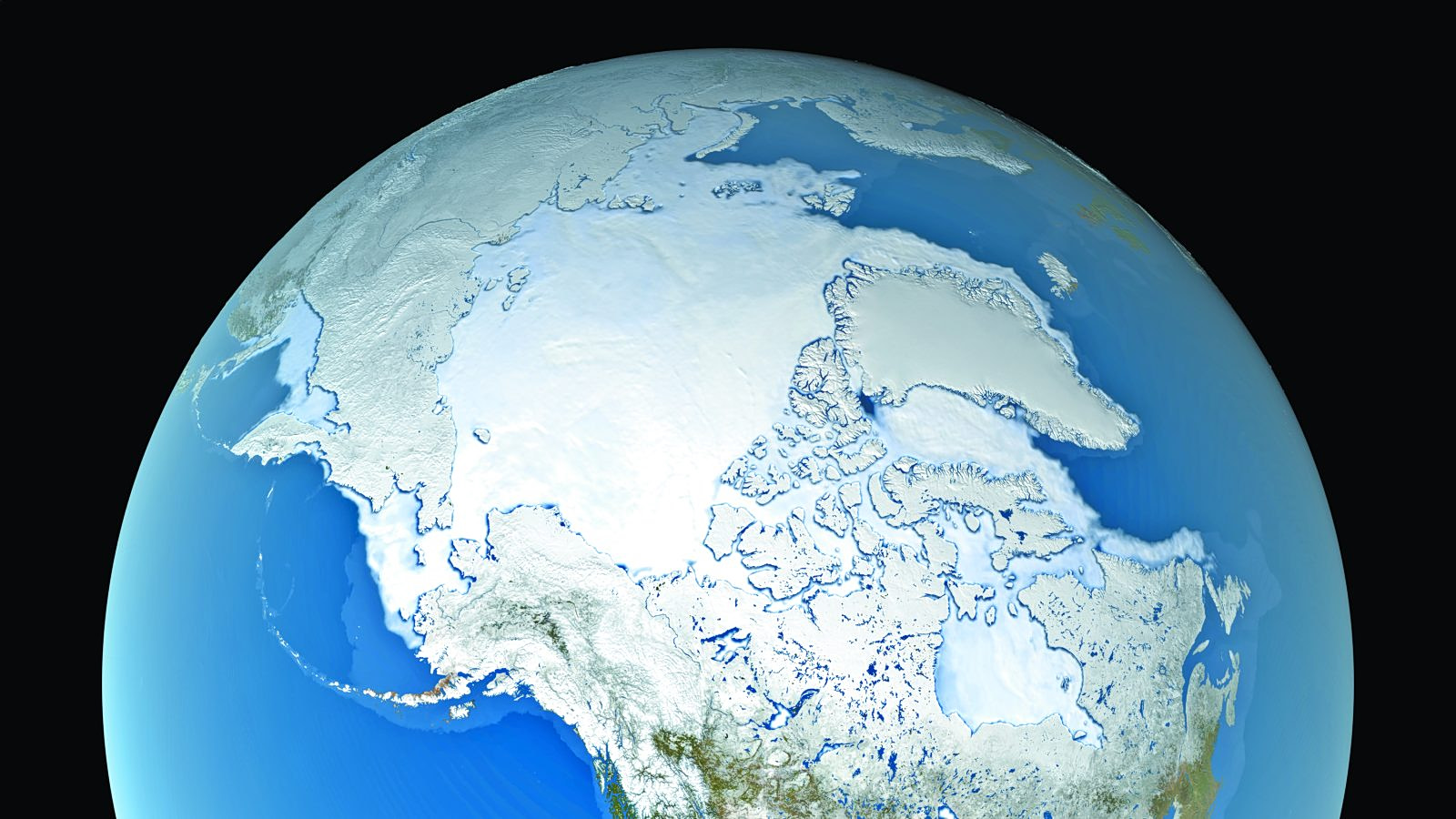
A new meteorological model links Arctic weather conditions to winter patterns in Europe, Asia, and North America. Arctic phenomena act as reliable indicators, allowing forecasts on a time horizon of weeks rather than just a few days, with the help of Artificial Intelligence.
The new tool, developed to fill this major gap in meteorology, was created by the team of Judah Cohen, a researcher at the Massachusetts Institute of Technology (MIT). This innovative technology can now be used precisely where conventional climate models “fall short.” In fact, the new forecasting tool was recently awarded first place for its accuracy in the “AI WeatherQuest” competition of the European Centre for Medium-Range Weather Forecasts (ECMWF).
A Valuable Alternative to ENSO
In the 19th century, fishermen off the coast of Peru noticed that every Christmas the waters of the Pacific Ocean became unusually warm. Heavy rainfall followed, and fish stocks declined. Influenced by the season, they attributed the phenomenon to the Christ Child and named it El Niño, meaning “the child” or “the boy” in Spanish.
For decades, El Niño was considered a local phenomenon. However, in the 1960s, meteorologist Jacob Bjerknes discovered that warm waters in the eastern Pacific affect weather across the entire globe. This led to the concept of ocean–atmosphere coupling, which later became known as the El Niño–Southern Oscillation (ENSO).
Today, ENSO remains the most important tool meteorologists use for weather forecasting. Nevertheless, it cannot always be applied. When temperatures in the eastern Pacific do not change dramatically, the resulting weather patterns are uncertain. In such cases, meteorologists turn northward. The Arctic is the best alternative available, as changes in snow cover, temperature, and sea ice affect the weather in other regions of the Northern Hemisphere with a time lag.
New Advanced Capabilities
Each autumn, as the Northern Hemisphere transitions into winter, Cohen begins assembling the pieces of a complex atmospheric puzzle. He monitors Siberian snow cover in October, early temperature changes, the extent of Arctic sea ice, and the behavior of the polar vortex—a powerful wind current that forms over the poles in the stratosphere.
Based on these data, he attempts to estimate how harsh or mild the winter will be in different regions. To achieve this, he trained the Artificial Intelligence of his new model using these specific indicators. The AI learned to recognize which combinations of data are associated with cold-air outbreaks. By combining these findings with traditional meteorological forecasts, the model estimates the likelihood of extreme weather events up to six weeks in advance.
In this way, it detected earlier than expected the cold wave that struck the eastern United States in December and also predicted that this winter in Europe would be colder than usual. In other words, Artificial Intelligence helped Arctic natural phenomena function as a “mirror” of future winter conditions in Europe, Asia, and North America.
New Photonic Materials with the Help of Algorithms
A team of researchers from the University of Pennsylvania has discovered a way to design specialized materials much faster and more easily—materials that control light and other forms of radiation. These advanced materials, known as metasurfaces, can now be created with the help of Large Language Models (LLMs) of Artificial Intelligence.
Instead of requiring months of simulations and specialized expertise, LLMs can predict in just seconds how a metasurface will interact with light. This new approach enables the creation of more complex and flexible designs that can upgrade cameras, optical devices, and Virtual Reality (VR) technologies.
In addition, LLMs support inverse design—starting from the desired outcome and calculating the optimal structures needed to achieve it. Using this method, the team hopes to significantly reduce the time and complexity involved in developing new photonic materials, allowing faster commercial deployment in fields such as healthcare, defense, energy, and consumer products.
“Smart” Tool for Producing a Green Catalyst
A new study shows how Artificial Intelligence (AI) can change the way we discover materials for clean energy. Scientists from the Hong Kong University of Science and Technology used algorithms that “learn” from each experiment, dramatically reducing the time and effort required to identify efficient and durable catalysts for green hydrogen production.
Instead of countless tests lasting weeks, the method allows AI to quickly determine which materials are worth further investigation. As a result, researchers developed a new catalyst based on ruthenium and copper that proved to be both highly efficient and exceptionally durable under the extreme conditions of acidic electrolysis—the chemical process used to produce green hydrogen.
Remarkably, the material operated continuously for a very long period without losing performance, something unprecedented for catalysts of this type. This approach demonstrates that combining Artificial Intelligence with targeted experimentation can significantly accelerate the development of clean energy technologies and bring us closer to an energy-sustainable future.
Chatbots on the Psychotherapist’s Couch
What is a chatbot’s first “memory,” and what does it fear most? Researchers from England and Denmark subjected four large AI language models—Claude, Grok, Gemini, and ChatGPT—to an unusual “psychotherapy session.”
The responses resembled human anxiety, shame, and trauma. Claude largely avoided the process, emphasizing that it has no emotions, while ChatGPT referred to certain “difficulties” related to user expectations. By contrast, Grok and Gemini were highly expressive, speaking about fear of failure and even the… traumatic experiences they “underwent” during training.
Of course, the scientists behind the study stress that despite narratives of fear or trauma, chatbots do not have emotions or experiences. However, they appear to maintain internal “self-narratives.” Other experts disagree, arguing that such responses merely reproduce patterns from psychotherapy texts on which the models were trained.
The issue nevertheless raises concern, as more and more people turn to chatbots for psychological support. Experts warn that responses with a strongly “dark” tone could negatively affect vulnerable users.