It was a dark day in Earth’s history when an asteroid the size of Mount Everest slammed into Chicxulub, in what is now Mexico, wiping out three-quarters of all living organisms, and leading to a dinosaur extinction event.
The impact is believed to have killed everything within thousands of kilometers, raised a massive tsunami, triggered earthquakes worldwide, and wrapped the planet in a veil of dust that brought on a long “nuclear winter,” setting off a mass extinction over the following years.
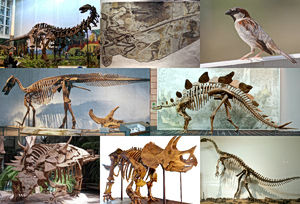
Collage of various dinosaurs. Clockwise from top left, Apatosaurus louisae, Microraptor gui, Passer domesticus, Stegosaurus stenops, Plateosaurus engelhardti, Triceratops horridus, Gastonia burgei, and Edmontosaurus regalis. Source: Wikimedia Commons
According to a new study, though, the destruction came much faster. Across the planet, “everything may have been killed within the first hour or two,” said Brandon Johnson of Purdue University in Indiana, who led the study published in the Journal of Geophysical Research: Biogeosciences.
Johnson and his team calculate that the dust that enveloped the planet acted like an insulating layer, turning the entire planet into an oven and roasting the dinosaurs alive.
The researchers combined geological data with impact simulations and estimated that the strike instantly vaporized 1,000 cubic kilometers of material, five times more than earlier estimates suggested.
A rain of fire
All that material, roughly 1.6 trillion tons, was blasted tens of thousands of kilometers into the air and spread across the globe. Some of the vaporized rock cooled and formed small droplets that began falling back to Earth like meteorites, heating up from friction with the atmosphere and releasing heat as they fell.
Earlier studies estimated that this heat was enough to kill most animals, but not enough to trigger widespread wildfires.
The new estimate suggests the destruction was made worse by the thick dust cloud surrounding the planet, which acted as insulation and blocked heat from radiating out into space, similar to the greenhouse effect that traps heat in the atmosphere.
Because of that dust blanket, the researchers calculate, ground-level heat became 3.5 times more intense than it would have been without that insulating layer.
“Because of the fine-grained dust, animals in the Cretaceous period received 17 times the dose of thermal radiation that would be 100% lethal to humans,” Johnson said.
The heat “was enough to set grass, pine needles, and lichens on fire, and possibly enough to directly ignite wood,” he said.
The wildfires that broke out across the planet as a result would have been enough on their own to drive most land organisms to extinction.
For marine organisms, which were shielded from the deadly heat pulse, the destruction unfolded more slowly.
“Once the droplets stopped falling and the fires began to die down, the massive dust clouds blocked the sun’s heat for years or decades and triggered a nuclear winter,” Johnson said.
As a result of the darkness, phytoplankton died off, dragging the entire ocean food chain down with it.
In other words, the destruction on land was almost instantaneous, while in the sea it played out as a slow ordeal. The clearest evidence for this two-phase scenario, the researchers said, would be finding the ash layers left behind by the global wildfires.