 Μake us preferred on Google
Greek Prime Minister Kyriakos Mitsotakis has again described the Turkey-Libya maritime memorandum as “null and void” and “completely illegal,” arguing that it disregards the rights of Greek islands and violates international law.
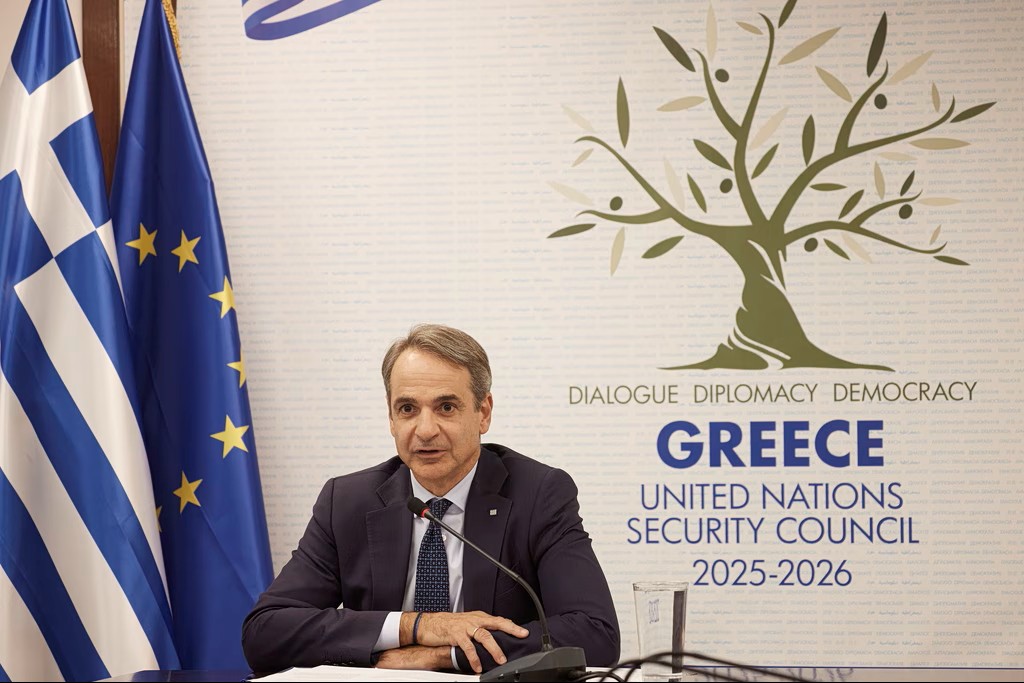
Speaking via videoconference at the IISS Manama Dialogue 2026 in Bahrain on Friday, he said maritime boundaries must be established in accordance with international law, not political alliances.
Responding to a question from Bastian Giegerich, director-general and chief executive of the International Institute for Strategic Studies (IISS), Mitsotakis said Turkey and Libya could not legitimately draw a maritime boundary between them while ignoring the Greek islands lying between their coastlines. He cited the islands’ entitlement to an exclusive economic zone (EEZ) and continental shelf under international law and compared the memorandum to a hypothetical agreement between Greece and Tunisia that disregarded Libya or Italy.
Referring to the 2020 maritime delimitation agreement between Greece and Egypt, Mitsotakis said the two countries had reached a mutually acceptable solution by applying international law. He also warned that connectivity projects should not be used as geopolitical instruments or held hostage to unresolved maritime disputes, arguing that such projects were too important to the region’s economic and strategic future.
Mitsotakis reiterated his position on the Turkey-Libya memorandum at the United Nations Security Council on Thursday, Oct. 29, when he chaired a high-level debate on emerging technologies and maritime security during Greece’s presidency of the council. He argued that the 2019 agreement attempts to establish a maritime boundary without accounting for Greek islands, including Crete, Rhodes, Karpathos and Kasos, and cannot override Greece’s sovereign rights.
The prime minister also cited the 2020 Greece-Egypt agreement as an example of maritime delimitation based on international law. His remarks linked the dispute to wider concerns about freedom of navigation, maritime trade and regional stability, while reinforcing Athens’ position that unilateral maritime claims should not obstruct strategic connectivity projects in the eastern Mediterranean.
His entire statement: https://www.primeminister.gr/en/2026/10/30/39638