
 Μake us preferred on Google
Before a round of golf at Askernish, on the Isle of South Uist in Scotland’s Outer Hebrides, course manager David Shawish explained a local rule in a Scottish lilt. Translated: “If your drive’s perfect, but you can’t find the ball, it’s gone down a rabbit hole.” In that case, he said, you can place a new ball near where you think the other disappeared, without penalty.
A perfect drive swallowed by a rabbit hole? You bet! The course really is that quirky. And, over an eight-day golfing adventure to 10 courses in the remote Inner and Outer Hebrides, Askernish was the most groomed.
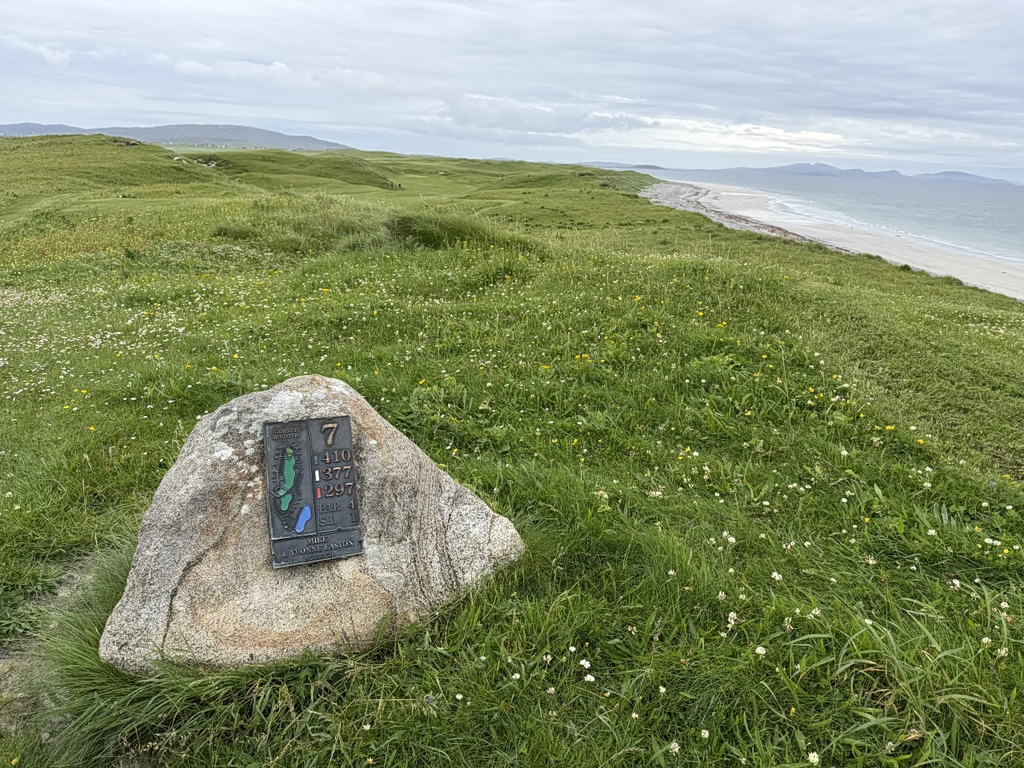
The 7th tee at Askernish, a course laid out by ‘Old’ Tom Morris in 1891. It reopened in 2008 and is now a pilgrimage for golf connoisseurs.
Photography by James G. Reichert for WSJ
Six golfing strangers from different generations and backgrounds (five Swedes and myself, an American) were brought together by Ingvar Ritzén, who periodically takes small groups to explore Scottish courses. I learned of Ingvar in 2018, while playing in the World Hickory Open Championship, in Scotland. We kept in touch over the years. And this July, I joined him on a trip to the Hebrides to discover the roots of Scottish golf.
Six men taking several ferries, driving in a van over 1,200 miles on one-lane roads shared with cows, hiking miles of rugged terrain, all while carrying our clubs. It meant embracing uncertainty, discomfort, wildly unpredictable weather, and limited accommodations in remote villages. No valet parking, turndown service, caddies, pushcarts or golf carts. We all needed to be fit enough to carry our clubs 27 holes a day.
This was not for 99 out of 100 golfers. For me, it was the trip of a lifetime. And a bonding experience like no other.
It’s all rough
Other courses in Scotland are more famous. Arnold Palmer said of the St. Andrews Old Course, which bills itself as the oldest course in the world, “This is the origin of the game…seemingly untouched by time.” But, with modern agronomy and irrigation, the Old Course absolutely has been touched by time.
Golf is vastly different in the Hebrides, two archipelagoes off the west coast of Scotland, all but one of the islands accessible only by ferry. These courses remain relatively untouched by modern technology, due to their remoteness and limited funds.
On this trip, many of us played with hickory-shafted clubs, the equipment used before the steel shaft was introduced in the 1920s. Hickory clubs are heavier than modern ones, and harder to play since they have a tiny sweet spot, about the size of a dime.
Playing with hickories in primitive conditions would give us a true sense of what golf was like before course designers reshaped landscapes and mowers meticulously smoothed out their surfaces.
Photography by James G. Reichert for WSJ
Photography by James G. Reichert for WSJ
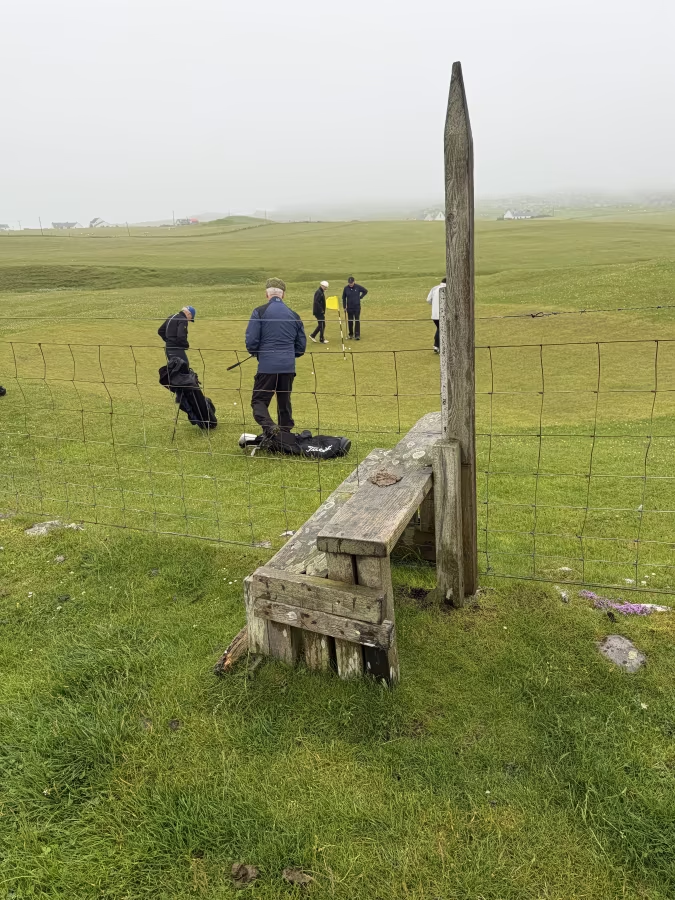
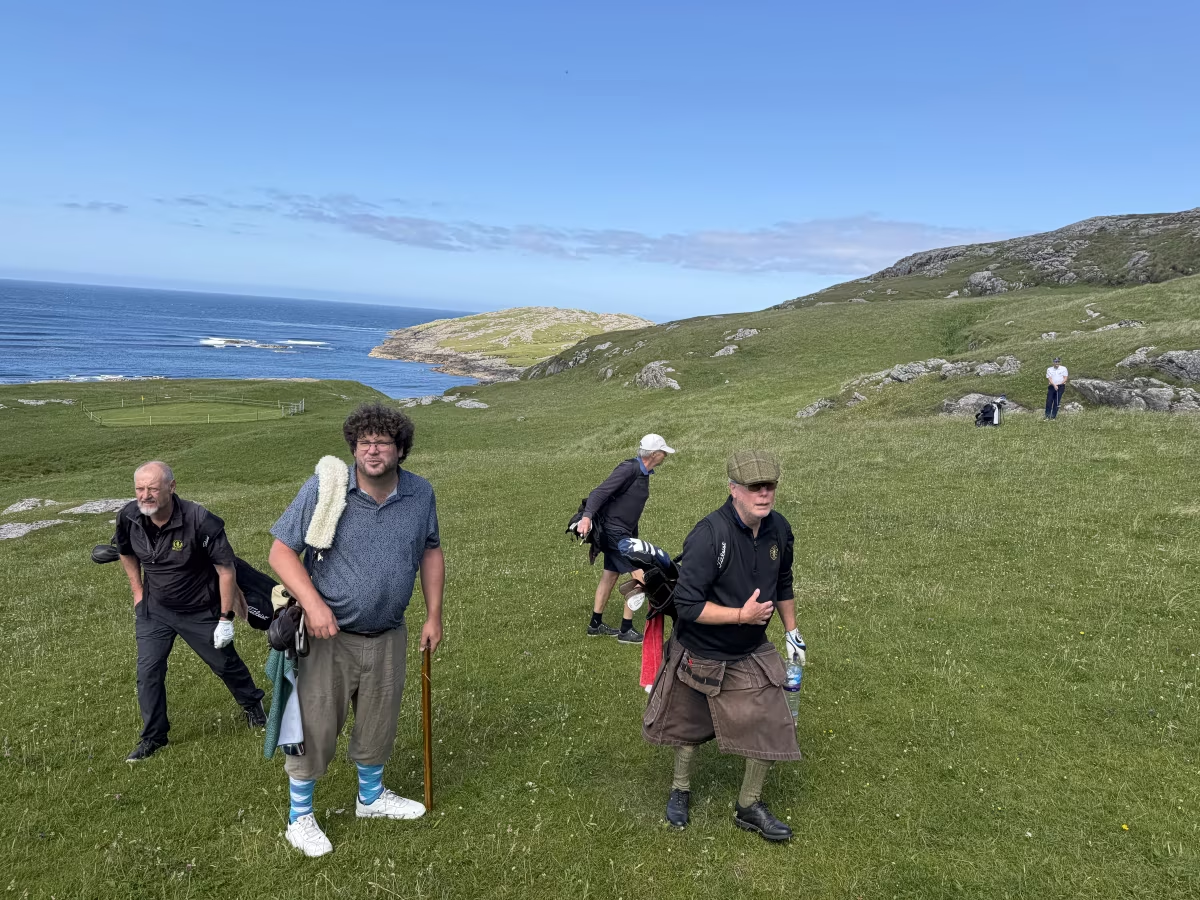
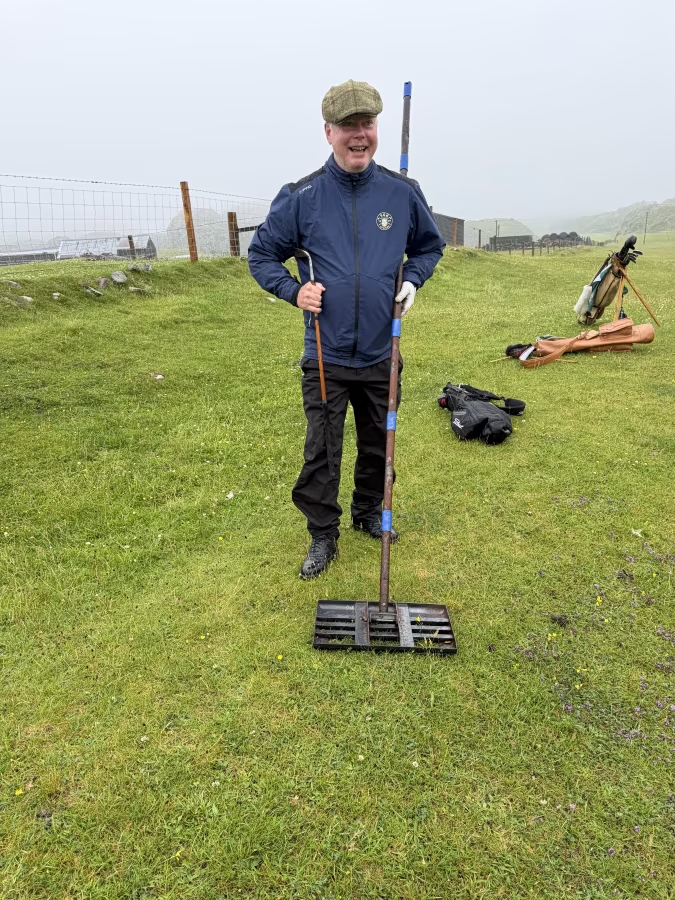
From left: Mats Gjothlén, Andreas Nilsson, Lars Emitslof and Hans Arvidsson, as Ingvar Ritzén hits at the 5th hole at Barra. At Iona, Hans Arvidsson with a tool to smooth the greens, including dealing with livestock-excrement obstacles. Steps help golfers cross a fence between cattle and sheep grazing areas. Photography by James G. Reichert for WSJ
Our journey began with a three-hour drive from the Edinburgh airport to Oban, a seaport town on the Scottish west coast that would be our hub. A 2½-hour ferry ride brought us to our first round at Colonsay Golf Course, a 200-year-old course overlooking a sandy beach, situated on machair grassland, found only on the western coasts of Scotland and Ireland.
This shortish grass growing in sandy soil, tended by sheep, offered a natural style of play. A caretaker cleans the greens of sheep manure, but he seemed to have been on vacation for months. The “clubhouse” is a bench with boxes for scorecards and an “honesty” box to pay the fee of 15 pounds (about $20). Walking was akin to avoiding land mines, stepping around and over rabbit holes and sheep manure. On the eighth hole, I rolled my 6-foot par putt over a pile of sheep manure smoothed over by my right foot. It rained the entire round.
Ferry to the fairway
Iona was next. Reaching the course began with an 80-minute ferry from Oban to the Isle of Mull, then 75 minutes driving one-lane roads across the island to take a 15-minute ferry trip to Iona. Then walking five minutes to the post office, where you pay £1 per scorecard, and finally a 1¼-mile hike to the course.
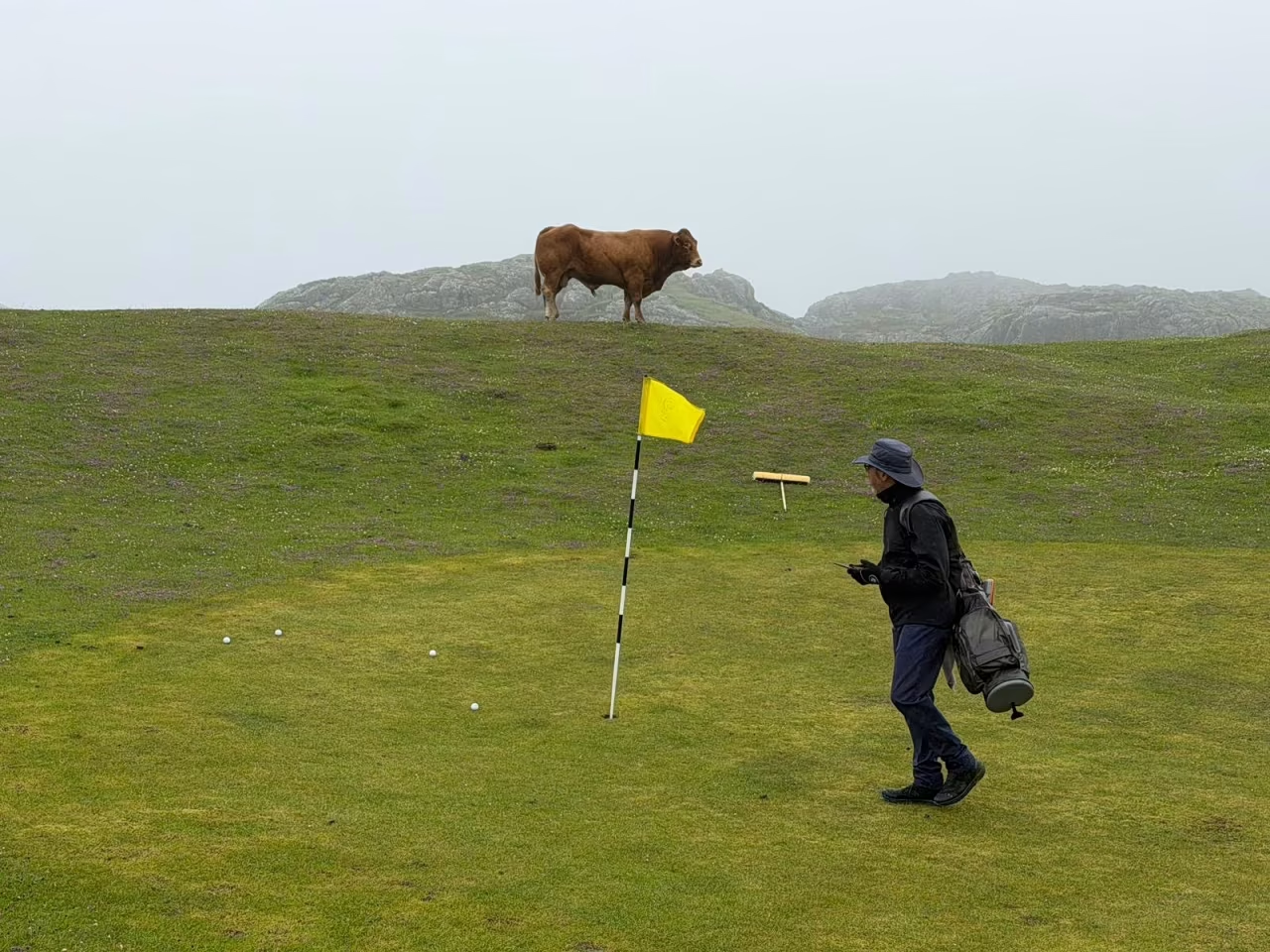
At the Iona course, sheep graze on the first seven holes. The remaining 11 holes have enormous cows. The 10th hole is a stellar 325-yard par 4. Your second shot is blind—you can’t see the green, which is set between large, jagged rock formations. Mats, a 23 handicap, astonishingly had three birdies in a row. He said he never had three birdies in a row before, and at that handicap he probably never will again. His feat was even more impressive since the rain, at times, was sideways.
The next day we went to Glencruitten, just outside of Oban. This roller-coaster of a course is home to Scotland’s current top golfer, Robert MacIntyre. On the 17th hole, the sun made its first appearance in the first 53 holes of golf on this trip. It was still shining on 18, but then disappeared.
The following days we played at an array of courses—at Traigh, the Isle of Skye, Askernish and finally to Barra, for a two-night stay at a local B&B to experience the most primitive of the courses we played.
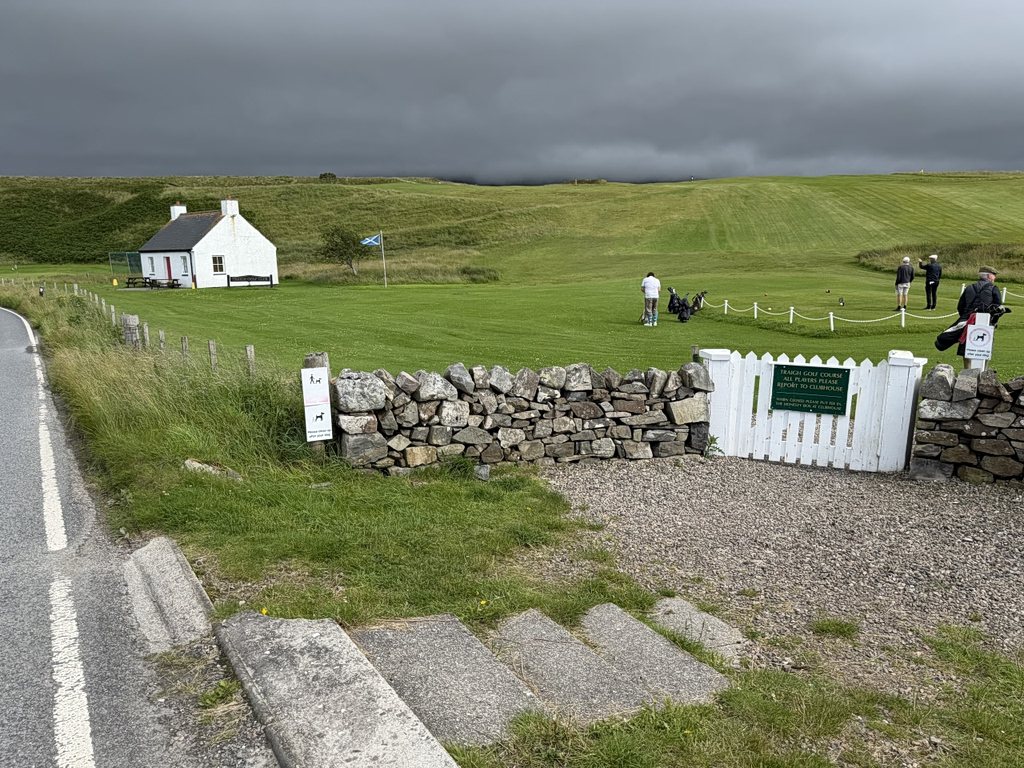
Traigh golf course and clubhouse. Photography by James G. Reichert for WSJ
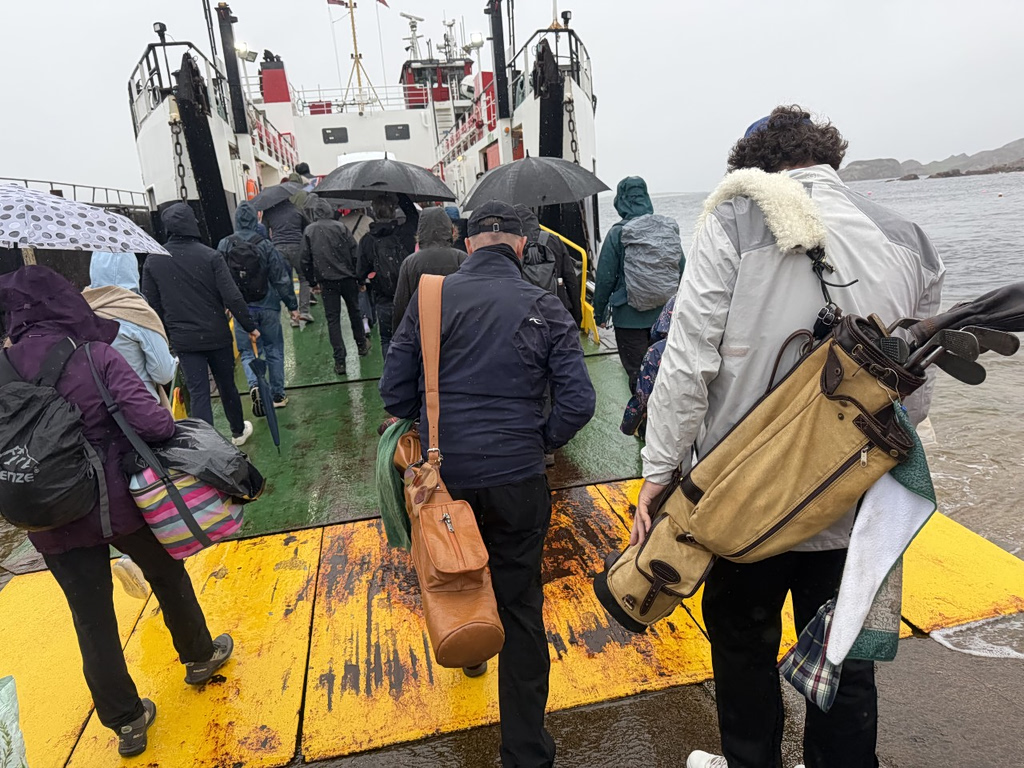
Mats Gjothlén, left, and Andreas Nilsson board the ferry at Fionnphort, Mull, en route to Iona. Photography by James G. Reichert for WSJ
Barra Golf Club, the most westerly course in Scotland, is best played in hiking boots. If I ever think to complain about the distance from a green to the next tee, I will remember Barra, particularly the climb from the fourth green to the fifth tee, a 200-yard hike uphill, then another 150 yards along a narrow ridge. The greens on Barra were protected from the cows by fences, and you entered the greens through a turnstile.
From Barra we went to a jetty of land on the island of Vatersay, where we invented a golf course, playing around cows to reach objects in the distance. “See that ditch? Let’s play to that.” “That rock in the distance? That’s our target.”
One last ferry back to Oban and a short drive to our final course, Seil Golf Club. I had my best shot of the week on the fifth hole, missing a hole-in-one by 6 inches.
It’s about the journey
More important than the golf, the trip fostered camaraderie. Being willing to chase something completely unreasonable, with golf as the catalyst, and choosing to spend more than a week together, these five Swedes and I had become brothers. As men age, true connections are a rare find.
I enjoyed classic Scottish food like full Scottish breakfasts with haggis and blood pudding; chicken rumbledethumps, a dish with mashed potatoes, cabbage and cheese; Tennents lager and single-malt Scotch.
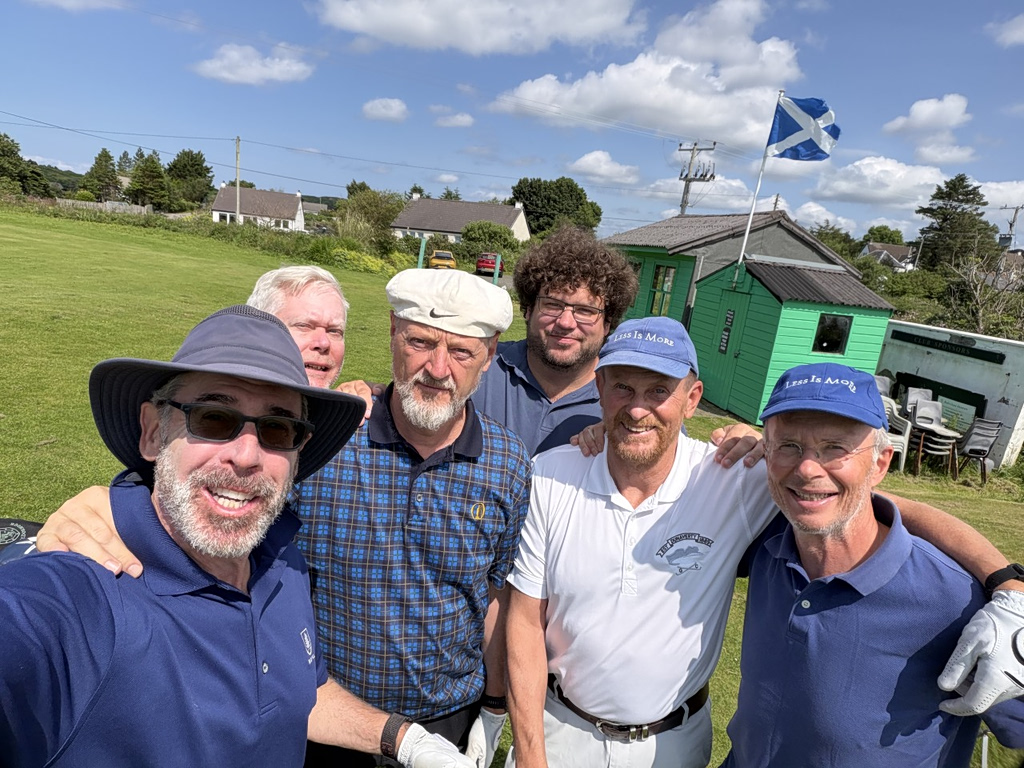
The golfers at Seil after the group’s final round. From left: James Reichert, Hans Arvidsson, Mats Gjothlén, Andreas Nilsson, Ingvar Ritzén and Lars Emitslof. Photography by James G. Reichert for WSJ
I always felt you cannot play golf with tension, or trying to exercise control. Life is about accepting the good and bad bounces. Sometimes you do the right thing but get a lousy result. These Scottish courses forced me to play by that rule if I wanted to make it through the day in one mental piece: On many of these golf courses you can hit a perfect drive and still go down a rabbit hole. The key is to relax, deal with what just happened and focus on the next shot.
Having previously spent months in the U.K. and Scotland at the big-name courses, I believe we can learn something from playing these no-frills courses: The biggest experiences can come from the smallest places. Less really can be more.