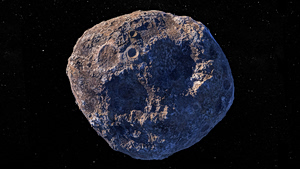
A rare meteorite discovered in the Sahara Desert appears to offer the first conclusive evidence of a lost planetary world, possibly comparable in size to the Moon. According to a new scientific study, this planet formed just a few million years after the birth of the solar system, roughly 4.5 billion years ago.
The meteorite, known as Northwest Africa (NWA) 12774, was found in the Sahara in 2019 and weighs about one kilogram. Scientists classify it as an angrite, an exceptionally rare type of meteorite considered among the oldest volcanic rocks in the solar system. The sample displays an unusual chemical signature, suggesting that some early planets developed along very different paths from Earth and Mars.
“The materials that formed the angrite parent body are fundamentally different from the building blocks of Earth and Mars,” said lead researcher Aaron Bell, a geoscientist at the University of Colorado Boulder. “These meteorites preserved evidence of an entirely different developmental pathway through which early planets evolved.”
By measuring radioactive elements that function as natural clocks, scientists know that angrites formed more than 4.5 billion years ago, alongside the young Sun. They therefore preserve valuable clues about how planets were born and evolved, according to NASA.
Only 68 out of more than 80,000 meteorites ever identified on Earth belong to this category, making them extraordinarily rare and scientifically invaluable.
A Revealing Chemical Makeup
What makes angrites unique is their chemistry. Unlike Earth, Mars, and other rocky worlds, they contain very little silica, a key component of planetary crusts. For that reason, scientists had long assumed they came from small asteroids.
During analysis of NWA 12774, Bell and his colleagues identified crystals of the mineral clinopyroxene that were “exceptionally rich” in aluminum, a sign that the rock formed under enormous pressure.
By reconstructing the conditions of formation, the research team calculated that pressures of at least 17.5 kilobars were required, more than 17 times the pressure at the bottom of the Mariana Trench. Such values could not exist inside a small asteroid, pointing instead to a much larger parent body.
A World Lost in Time
The meteorite’s crystals retained sharp edges and chemical patterns that would have been altered had they spent a long time inside a hot planetary core. This suggests they formed at relatively shallow depths, meaning the celestial body had to be large enough to generate such pressures close to its surface.
According to the study, this lost world may have had a radius greater than 1,800 kilometers, a size comparable to the Moon and potentially close to that of Mars. “It’s incredible to think that there was once a world this large,” Bell said. “We only know of its existence because a few fragments of it made it to Earth.”
What became of this ancient world remains unknown. One likely explanation is that it was destroyed by the violent collisions that shaped the young solar system, with pieces of it, including NWA 12774, later incorporated into other rocky planets, Earth among them.
“There are many meteorites sitting in collections that haven’t been fully studied, so it’s possible there were more such protoplanetary bodies that we don’t yet know about,” Bell added.
The research was published in the journal Earth and Planetary Science Letters.