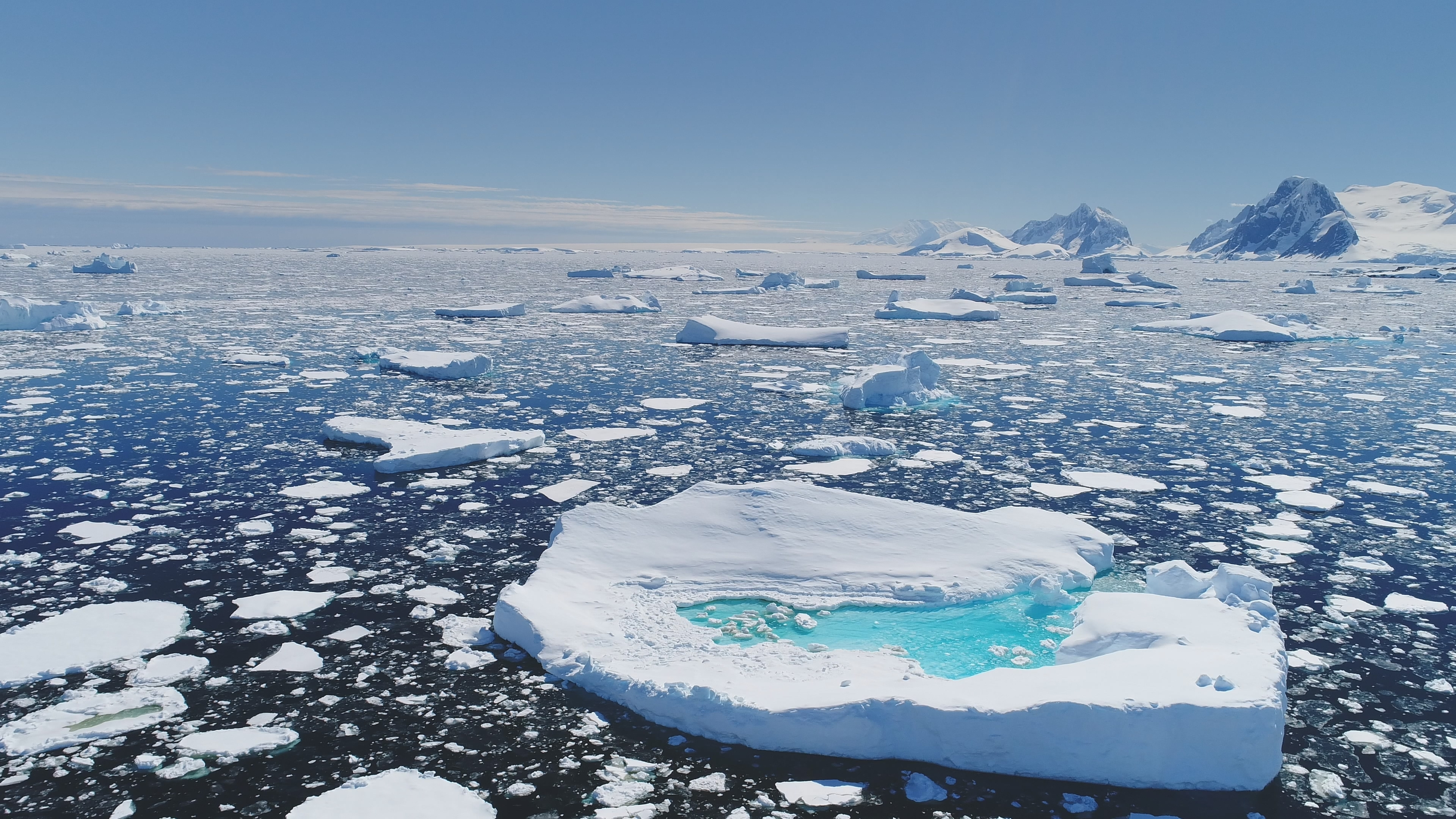
The Antarctic Circumpolar Current (ACC) current encircles the Antarctic continent without being blocked by any landmass, making it a fundamental component of the global climate system.
In a recent study published in the journal Proceedings of the National Academy of Sciences, a research team from the Alfred Wegener Institute describes how and when this powerful circular current developed in Earth’s history.
Earth’s climate underwent its most significant shift approximately 34 million years ago, during the transition into the Oligocene period. At that time, the planet’s environment cooled from a “greenhouse” state without extensive ice sheets into a “glacial” system with permanent polar ice.
The sea passages between Australia, Antarctica, and South America widened and deepened, allowing the ACC to form and the Antarctic ice sheet to begin developing. Atmospheric carbon dioxide concentrations at the time are estimated to have been around 600 ppm, a level not seen since, but one that could be exceeded by the end of this century under some climate change scenarios.
A Look at the Past to Understand the Future
“To predict future climate, it is essential to examine the past through simulations and data, so that we can understand the Earth under warmer and CO₂-richer conditions than today,” explains Hanna Knahl, climate modeller at the Alfred Wegener Institute and lead author of the study. “However, we must be careful, as past climate cannot be projected directly onto the future. Our research shows that the circumpolar current in its ‘early steps’ influenced the climate very differently from the fully developed ACC of today.”
For this study, Knahl and her team analysed the formation of the ACC through simulations based on the geographic arrangement of the continents 33.5 million years ago, when Australia and South America were closer to Antarctica. The scientists connected the Antarctic ice sheet model from a 2024 study in Science with ocean, atmosphere, and land systems, in order to analyse the evolution of currents around the continent. The results were compared with geological data from the same period.
How the Current Formed
Knahl notes that “there were already indications that the winds at the Tasmanian Passage played a decisive role in the formation of the ACC. Our simulations confirm this: only when Australia had moved far enough from Antarctica and the powerful westerly winds passed directly through the Tasman Gateway was the current able to fully develop.”
Remarkably, the Southern Ocean at that time appears to have been divided into two entirely different zones. Although the sea passages around Antarctica had already opened, the model simulates intense circulation in the Atlantic and Indian Ocean sectors, while the Pacific remained relatively calm.
New Knowledge from Combined Models
Simulations that combine climate and ice sheet models are particularly complex and relatively recent. To investigate the ACC’s “childhood” under realistic conditions, the Paleoclimate Dynamics and Marine Geology research teams at AWI collaborated with international partners, including the Australian Centre of Excellence in Antarctic Science and the Antarctic Research Centre Wellington.
“With this study in PNAS, we show for the first time how valuable combined, high-resolution simulations are for understanding the climate of the distant past,” explains AWI palaeoclimate modeller Prof. Dr. Gerrit Lohmann, co-author of the study. The analyses revealed how the formation of the ACC was linked to an overall reorganisation of global ocean circulation.
AWI geoscientist Dr. Johann Klages, also a co-author, emphasises that “this understanding is crucial, as the formation of the ACC made a decisive contribution to the ocean’s absorption of carbon. The reduction of greenhouse gases in the atmosphere had the potential to trigger the colder climate of the Cenozoic Ice Ages, which continues to this day.” According to him, these new findings will help produce more reliable interpretations of recent changes in Southern Ocean circulation.
Source: phys.org