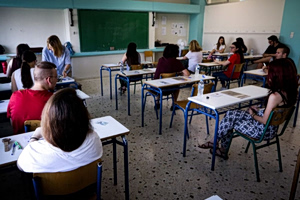
Adult education and training has shown steady growth across the EU over the past decade, according to new Eurostat data. In 2025, 13.7% of Europeans aged 25 to 64 reported having received formal or non-formal education and training, up from 10.1% in 2015. Formal education refers to instruction delivered through official institutions like schools and universities, while non-formal includes any other organized educational activity, such as tutoring centers or lifelong learning programs.
Sweden (38.2%), Denmark (31%), and Finland (28.1%) recorded the highest rates of adult education participation. Greece, by contrast, ranks last among EU countries at just 5.2%, trailing even Bulgaria (6.1%) and Croatia (6.5%).
Compared to 2015, adult education participation increased in nearly every EU country, with the largest gains seen in Malta, Estonia, Belgium, and Slovenia, all rising by 10.9 to 12.3 percentage points. The only exceptions were France (-3.1 points), Luxembourg (-0.6 points), and Denmark (-0.5 points). Greece recorded only a modest increase of 1.9 percentage points over the decade.
In 2025, participation in education and training was 2.5 percentage points higher among women than men (14.9% versus 12.4%, respectively). Women’s participation also grew faster, rising 4 percentage points between 2015 and 2025, compared to 3.2 points for men.
Participation also varies by degree of urbanization. Adults living in cities were more likely to take part in education programs (16.8%) than those in towns and suburbs (12.3%) or rural areas (10.3%).
Quality Education
Adult education, often referred to in official documents as “lifelong learning,” falls under the Sustainable Development Goals (SDGs) adopted by the EU as part of the UN’s 2030 Agenda. Specifically, SDG 4 aims to ensure access to quality education for all throughout life, while increasing the number of young people and adults equipped with the skills needed for employment, decent work, and entrepreneurship. EU monitoring of SDG 4 focuses on basic education, higher education, adult learning, and digital skills.
Greece’s Paradox: Many Graduates, Few Adult Learners
Recent OECD PISA results among 15-year-old students across 91 countries, including Greece, delivered a sobering wake-up call globally. Functional literacy levels have been steadily declining, recording the worst performance since testing began in 2000. The sharpest decline came in reading comprehension, with Greece narrowing its gap to the average only because other countries fell even further behind.
That said, it would be misleading to rely solely on PISA results to argue that Greece lags in access to quality education. On other indicators, such as the share of higher education graduates aged 25-34, Greece actually outperforms the EU average, at 44.5% compared to 43.1% across the EU. Notably, under international classification standards, graduates of two-year vocational programs (such as ΣΑΕΚ) also count as higher education graduates. Greece’s real problem lies in the poor job absorption of young graduates compared to the EU average, coupled with an ongoing brain drain of skilled workers leaving the country.
When it comes to adult education specifically, Greece remains at the bottom of the EU, despite a modest increase over the past decade.
How Was Recovery Fund Money for Adult Education and Training Actually Used?
In July 2021, then-Labor Minister Kostis Hatzidakis announced that the Recovery Fund had approved more than one billion euros for training and retraining programs targeting workers and the unemployed. Five years later, Greece remains at the bottom of the EU in adult education and training.
According to research presented by the Panhellenic Association of OAED Employees (PANSYPO), titled “The Greek Labor Market Without Filters,” more than €500 million in EU and national funding has been channeled into DYPA training programs over just the past three years alone. A notable example involves vouchers, training and certification credits that beneficiaries receive after completing programs run by private providers, typically lifelong learning centers.
Most of this funding comes from the Recovery and Resilience Facility. According to DYPA’s own website, the agency has financed a total of 11 training and employment programs as part of broader initiatives. For 2025 alone, training programs funded through the Recovery Fund totaling €680 million were announced. A portion of these funds is believed to have been lost, since the most recent revision of Greece’s Recovery Plan removed or scaled back programs worth a combined €260 million, including training initiatives for unemployed individuals and programs supporting vulnerable groups.
Other organizations also run Recovery Fund-financed training programs, including professional and economic chambers, the INE-GSEE research institute, the disability advocacy group ESAMEA, and various ministry secretariats. The critical question isn’t simply whether all the allocated funds were spent, but whether they actually made a meaningful difference and delivered quality education. OLAF, the European Commission’s anti-fraud office, has identified serious “dysfunctions and distortions” in training programs across Greece, demanding the return of €1.6 billion in EU funds.
Training Programs and Employment Outcomes
DYPA reports that more than 260,000 people “found employment or kept their jobs” through related initiatives, undeniably a positive outcome. However, PANSYPO insists that “no comparative methodology has been published that would allow us to know how many of these individuals would have found or kept employment even without the intervention. There’s a difference between someone being employed after participating in a program and actually proving that the employment resulted from the program.”
The study also references an independent OECD evaluation of adult training and employment subsidy programs. That evaluation found a positive impact for participants overall, but also identified weaknesses, including low participation among the unemployed and uneven distribution of resources.
“Hundreds of millions were spent. Programs, vouchers, training, and subsidies were all implemented. At the same time, more than half of unemployed people remain long-term unemployed, the transition rate from unemployment to work is far lower than the European average, nearly one in two new hires is part-time or rotational, and DYPA’s registry still counts more than 900,000 people. If, after all this, the main measure of success is simply that ‘the unemployment rate dropped,’ then we’ve only measured the easiest part of the problem and left the harder part almost entirely untouched,” PANSYPO’s assessment concludes.