The latest assessment focusing on a simmering rivalry between Greece and Turkey in the naval sector points to a clear conclusion: Athens is right to pursue a form of asymmetric technological superiority rather than allowing itself to be drawn into Ankara’s largely quantitative arms race.
The main article in Tuesday’s edition of Ta Nea notes that in deterrence terms, military “power” is no longer measured simply by the number of warships a country possesses.
For instance, Greece’s ongoing naval modernization, including the introduction of the first of four French-built FDI Belharra frigates and plans to acquire two Italian Bergamini-class frigates with an option for two more, reflects a broader effort to strengthen capabilities while extending the operational life of existing vessels.
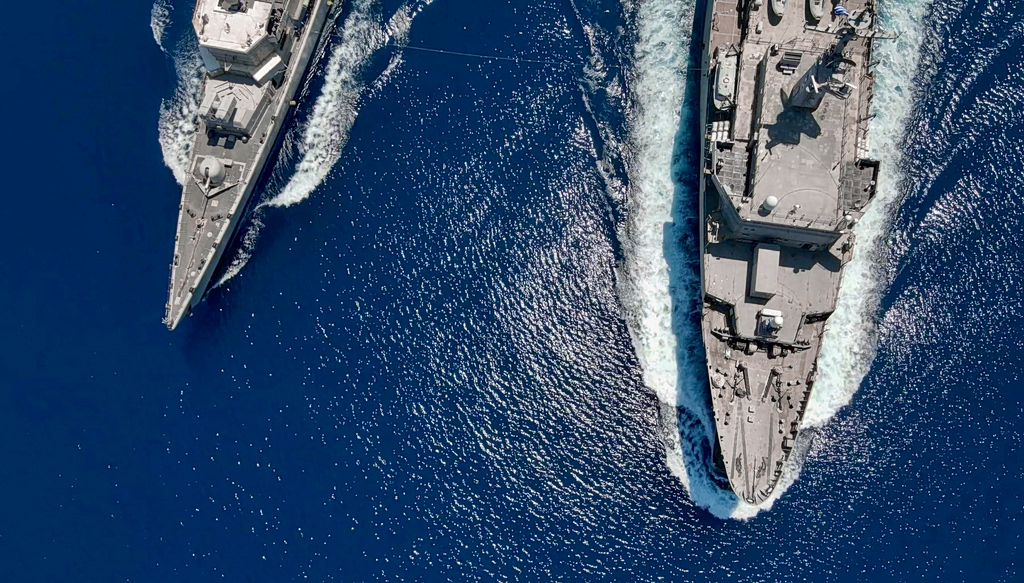
Defense ministry handout.
The changing nature of warfare, as demonstrated by the war in Ukraine and conflicts in the Middle East, has also made clear that countries seeking to build credible defenses must change the way they prepare for conflict, the analysis continues, while adding:
“The combination of conventional military assets with advanced technology has become a basic requirement, with artificial intelligence, unmanned systems, electronic warfare and networked battlefield capabilities increasingly shaping military planning.”
Greece’s Thorax program, for example, is designed to integrate information from military and state sensors, UVs, radar systems and other sources and use artificial intelligence to improve operational decision-making.
“At sea, an increasing part of the balance of power will be determined below the surface as well as above it. This requires Greece to invest in more sophisticated systems while reorganizing the way autonomous platforms are incorporated into naval operations. A planned naval autonomous systems operations command is intended to integrate robotics, unmanned platforms and artificial intelligence into a network-centric naval doctrine. The aim is to provide additional deterrence capabilities without relying exclusively on costly manned platforms.”
The approach is particularly relevant as Turkey continues to expand its naval and broader defense capabilities. Over the past few years, Ankara’s shipbuilding program and military exercises have demonstrated an ambition to increase its operational reach in the Aegean and eastern Mediterranean, while its broader defense industry is producing increasingly advanced unmanned and other military systems. Turkish naval exercises have also involved large numbers of warships across the Aegean and eastern Mediterranean.
On its part, Greece’s response has increasingly focused on technology as a “force multiplier”. Alongside new frigates, Greece’s armed forces are expanding drone capabilities, including new domestic production facilities, while the government is promoting more integrated air and missile defenses under the “Achilles’ Shield” program. The broader modernization effort also includes upgrades to fighter aircraft and the acquisition of long-range precision weapons.
The strategic challenge extends beyond the maritime domain. Greece is facing a more complex geopolitical environment in the eastern Mediterranean, where tensions involving Turkey intersect with wider regional instability and changes in the European and transatlantic security landscape. Athens has also sought to reinforce its position through closer defense cooperation with France and other partners while strengthening its own industrial and technological base.
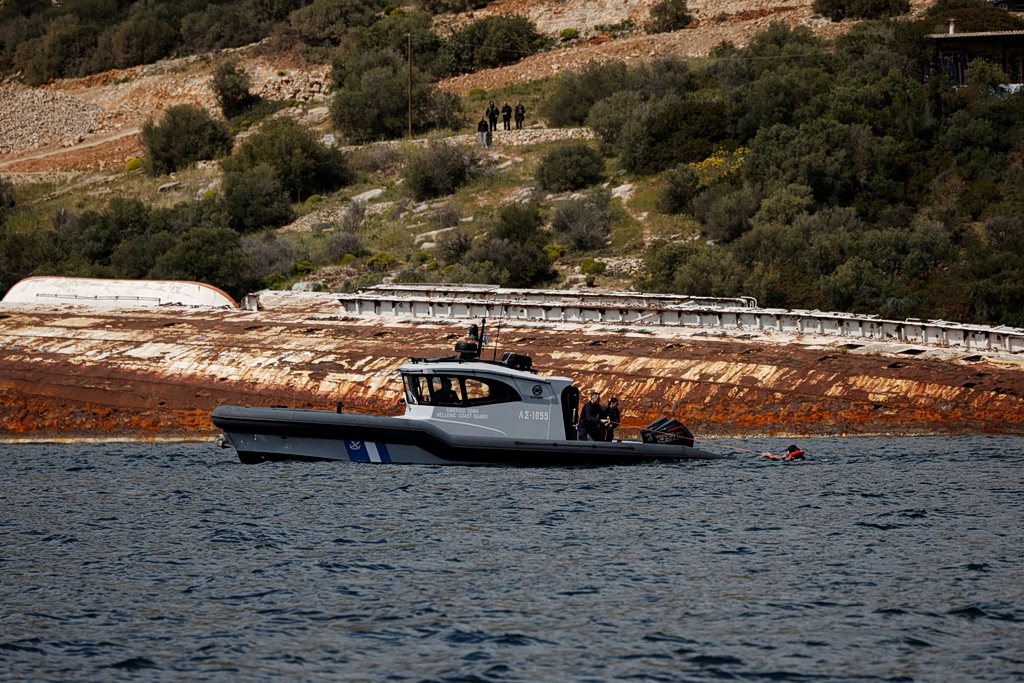
Hellenic Coast Guard personnel, aboard a patrol vessel, recover a person from the sea during a maritime emergency exercise simulating a drone strike on an oil tanker off the coast of Elefsina, Greece March 31, 2026. REUTERS/Louiza Vradi
This also explains the growing emphasis on domestic defense production. The Mitsotakis government has set a target for domestic companies to participate in at least 25% of future defense procurement programs, while major naval projects are increasingly linked to work at local shipyards. The objective is not only to acquire equipment but also to build the industrial and technological capacity needed to maintain and develop fielded systems and platforms.