
 Μake us preferred on Google
 About five years ago, during the pandemic and the restrictions on citizen movement, bicycles suddenly boomed. Many Greeks—especially residents of Attica—bought bikes. The enthusiasm was so intense that even months later, bicycles were sold out in shops, a situation made worse by global supply-chain problems.
At the time, many Athenians abandoned their cars for the cheaper and more ecological two-wheeled option—or simply for walking. Empty streets encouraged this shift, and people began to care more about the environment, their fitness, and their own time. Conditions made it possible, and many believed these healthy habits would last. For some, they did. But for the majority, especially in big cities, the old “bad” daily routine soon returned. Not even the energy crisis that followed the health crisis could stop it.
The result is visible today: traffic jams on all major arteries of Attica are an everyday occurrence during rush hours. In central Athens, there are no longer “rush hours” at all—congestion is constant, seven days a week. Tourism, tourist coaches parked near archaeological sites, and construction projects have all added to the pressure.
For many experts, hope lies with younger generations—Gen Z and Gen A—who are closer to European lifestyle models and more committed to health and sustainability.
“The Bicycle Can Change the City”
At the Athens conference, Spyros Papageorgiou, director of the organization Cities for Bicycles, emphasized the transformative role of cycling:
“The bicycle, more than 220 years after its invention, is still the only vehicle that can change the image of a city. Think of Amsterdam, Copenhagen, and more recently London and Paris. Beautiful, interesting cities where the defining feature isn’t monuments or heritage—but that more bicycles than cars fill the streets.”
He argued that pedestrian zones, painted façades, or planting more trees are important, but insufficient by themselves. Only widespread cycling can truly reshape Athens.

The Example of Paris
Papageorgiou pointed to Paris as a case study. The city has history, culture, and tourism—but also dangerous roads, infrastructure less advanced than Amsterdam or Copenhagen, and notoriously aggressive drivers. France also has a strong car industry and powerful car lobbies.
Despite this, since 2001 the city’s authorities have gradually changed both Paris’s infrastructure and its residents’ habits.
According to the Paris Regional Institute, 11.2% of all trips in the French capital are now by bicycle, while just 4.3% are by car. In 2010, bikes accounted for only 3% of trips.
In inner suburbs, the trend is similar: 14% of trips are now by bike, compared with 11.8% by car, thanks to new cycle lanes connecting the city to surrounding municipalities.
Still, walking and public transport remain dominant. One in two Parisians (53.5%) walks to work or daily errands, while 30% use the metro or buses.
Even Greeks who move to Paris quickly adapt. One student, Christos H., said:
“When there’s a transport strike, I struggle to find a bike to get to work. That’s how much demand there is.”
Athens: 3 Million Cars on the Road
By contrast, Athens has 2.5 to 3 million cars on its streets. 53% of Athenians commute by car, only 1–2% by bike, 8% on foot, and 35% by public transport.
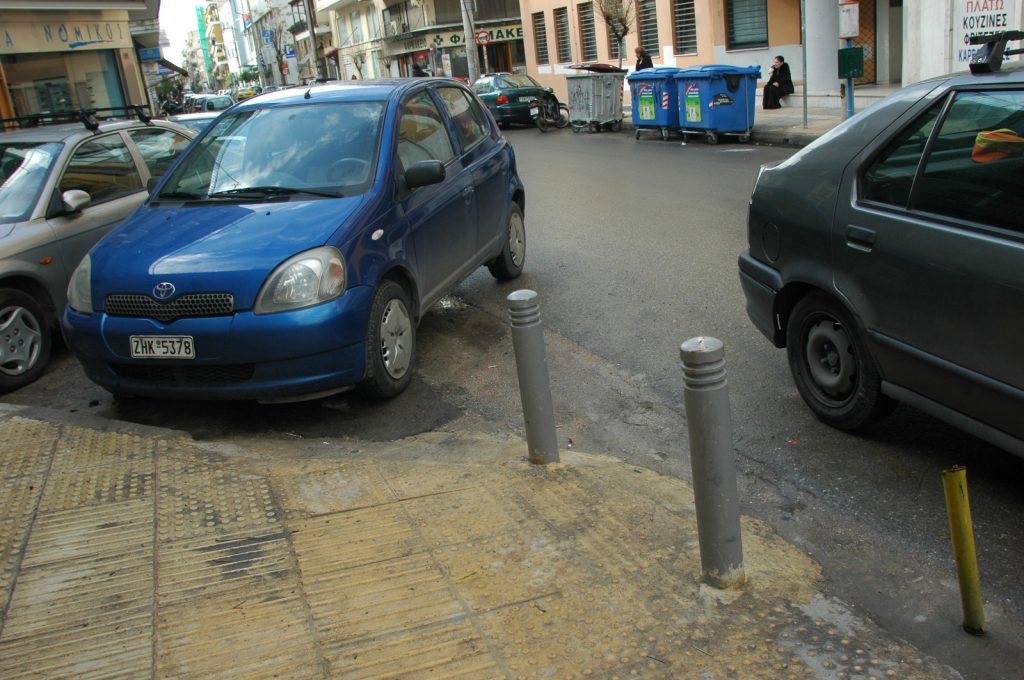
According to Dimitris Chrysafidis of the citizens’ initiative PEZI, more than 50 pedestrians die each year in Attica. Causes include distracted driving, excessive speed even on small side streets, and dangerously narrow sidewalks.
He highlighted Zacharoff Street, a side road linking Alexandras Avenue and Vasilissis Sofias Avenue, where sidewalks shrink to 20–40 cm and are obstructed by utility poles. Pedestrians are forced into the street, while cars speed down from Alexandras Avenue.
“The space for walking is constantly shrinking. Pedestrians are displaced by cars, by café tables, by obstacles on sidewalks, all pushing them into the road. Some European cities chose differently. In Paris, cars are now almost unnecessary—underground parking lots stand empty. Milan and Helsinki are moving the same way, combined with reliable transit. Athens must also choose: people or machines.”

Paris 2025: 500 Streets Pedestrianized
According to analyses from Paris city hall, increased cycling has significantly reduced car use. In some districts, bicycles have overtaken cars for local trips, cutting air pollution and traffic noise.
By 2025, 500 streets had been pedestrianized. The cycle lane network surpassed 1,300 km, offering safe daily travel alternatives.
The Benefits Observed in Paris
- Less congestion: Fewer cars on major arteries during peak hours.
- Faster trips: For journeys under 5 km, cycling is often quicker than driving.
- Lower costs: Bike rentals are cheaper than cars and even public transport.
- Health gains: Daily cycling reduces cardiovascular risks and increases fitness.
- Safer streets: As cycling numbers rise, accident rates fall proportionally.
- Boost to local economy: Cyclists shop more frequently at neighborhood businesses than drivers.
- Cleaner air and quieter streets.
- Social inclusion: Cycling is accessible to all income groups.
A Child-Friendly City
In 2025, Paris was named Europe’s “Child-Friendly Cycling City”, thanks to new safe routes around schools and educational programs encouraging children to cycle.
Athens at a Crossroads
Athens, by contrast, remains dominated by cars, clogged roads, and unsafe sidewalks. Experts stress that change is possible—Paris shows that even a city with powerful car lobbies and aggressive drivers can transform.