Can the owners of an apartment building actually stop an Airbnb from operating in their building? A recent ruling by the Athens Court of First Instance has brought this question, which concerns many property owners and sometimes ends up in court, back into focus.
The ruling, which said no to an Airbnb operating in an apartment building, does not establish a blanket ban on short term rentals, lawyers explain to Ta Nea, since the practice remains legal under Greek law. It does confirm, however, that operating one isn’t an absolute right, and that a building’s internal regulations (kanonismos in Greek), can, under certain conditions, serve as the main legal tool for restricting Airbnb activity.
So if a building’s regulations explicitly state that apartments are intended solely for residential use, or exclude their use for tourist rentals, that creates strong legal grounds for restricting short term leasing.
Case law on this isn’t uniform. Courts have also issued opposite rulings, in cases where the building regulations contain no prohibition clause and where it isn’t shown that the rental use substantially alters the residential character of the property. So each case is still judged on the specific wording of that building’s regulations and its particular circumstances.
This ruling comes as the Justice Ministry is preparing a sweeping overhaul of property law, unchanged since 1929, with the bill expected to be ready for a vote this fall. It remains to be seen what changes it will bring on this specific issue.
Based on what has been presented so far, ten changes are coming to the new legal landscape:
- Making it easier to amend outdated building regulations so they reflect today’s needs and keep the peace between owners and residents
- Strengthening mechanisms for faster, out of court dispute resolution between owners under the new code, easing the burden on courts
- Regulating issues arising from short term rentals, a newer form of leasing that has grown rapidly in recent years
- Updating rules for establishing horizontal and vertical property ownership to reflect today’s realities, so long hidden properties (for example, apartments bought under a preliminary sale agreement) can be registered with the Land Registry and unblocked for transfer
- Making use of unclaimed building rights, either by reallocating them among co-owners through an amended founding deed, or by returning them to landowners and their heirs, a change expected to unlock significant unused capacity in apartment buildings
- Allowing the splitting or merging of horizontal properties, regardless of what building regulations say, so large multi-room apartments can be repurposed to help address the housing shortage in major cities
- Reforming the role of the building manager, with clearer rules on duties, legitimacy, and obligations for those managing buildings, since the current lack of clear legislation on this role often leads to deadlock and litigation
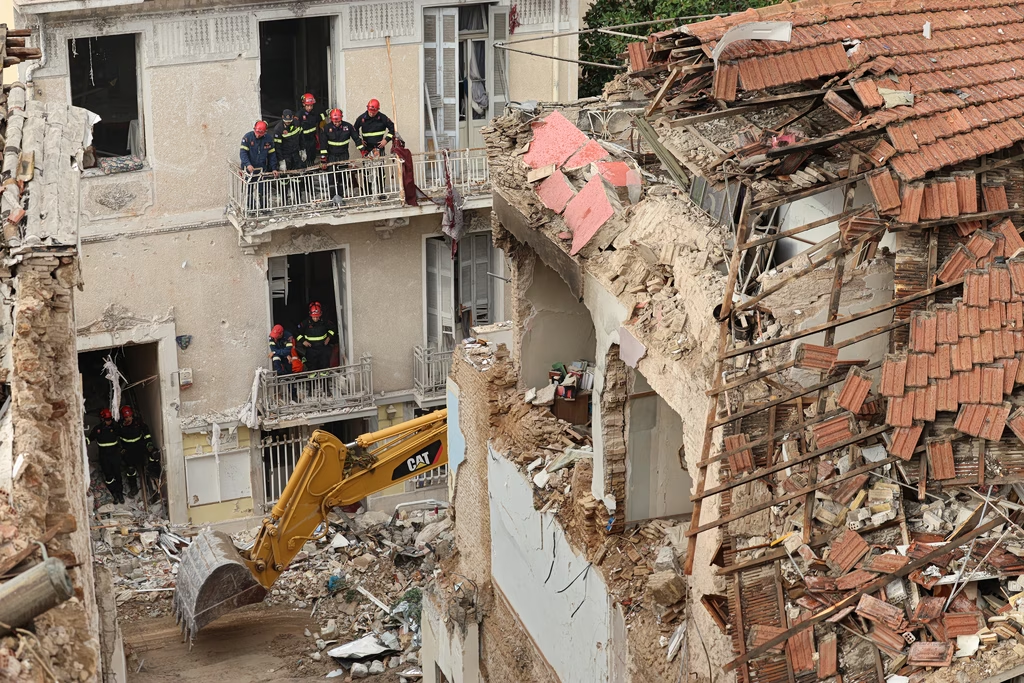
- Creating a specific procedure for collecting shared expenses, along with a reserve fund and building insurance, to address situations like the recent one in Petralona
- Lowering the voting thresholds required for necessary repairs and energy upgrades, since strict majority rules (up to 100% for amending regulations) have made it nearly impossible to carry out needed repairs or energy retrofits in older buildings
- Creating a new framework to make energy upgrades easier, covering rooftop solar panels, EV charging stations, or heat pumps, in cases where disputes arise over shared spaces
The 13 member drafting committee, made up of judges, university professors, institutional representatives, lawyers, notaries, and representatives from the environment ministry, the Land Registry, and the Technical Chamber, faces a complex task that touches nearly all of society.
Justice Ministry leadership has stressed the reform will respect property rights and the constitutional protections that safeguard them, aiming to resolve existing problems rather than create new points of conflict.